Body & Health · Sleep & body rhythms
Why we sleep
Nearly every animal sleeps, though it leaves them exposed. Weigh the leading explanations, from memory to brain upkeep, see which are contested, and learn how the 7-hour advice was set.
What you will learn
- Explain why sleep's near-universal spread across animals suggests a vital function
- Describe how some animals sleep with one half of the brain to stay alert
- Describe evidence that sleep after learning protects new memories
- Explain how replay during sleep is thought to move and reorganize memories
Lesson 1 of 4 · 4 min
Why nearly every animal sleeps despite the danger
You'll spend about a third of your life asleep. For an animal, that's a strange choice. A sleeping gazelle can't watch for lions, can't eat and can't look after its young. Yet sleep shows up in virtually all animals studied, from bats to fruit flies.
It even turns up in creatures without a brain. Cassiopea jellyfish have no brain or central nervous system, yet they still settle into a sleep-like state. When a costly habit is this widespread, biologists take it as a sign that sleep is ancient and does something animals can't skip.
Taking sleep away supports that. Rats kept fully awake for long periods lost weight and eventually died. What sleep actually does is still argued over. NINDS, the US brain research institute, calls its biological purpose a mystery.
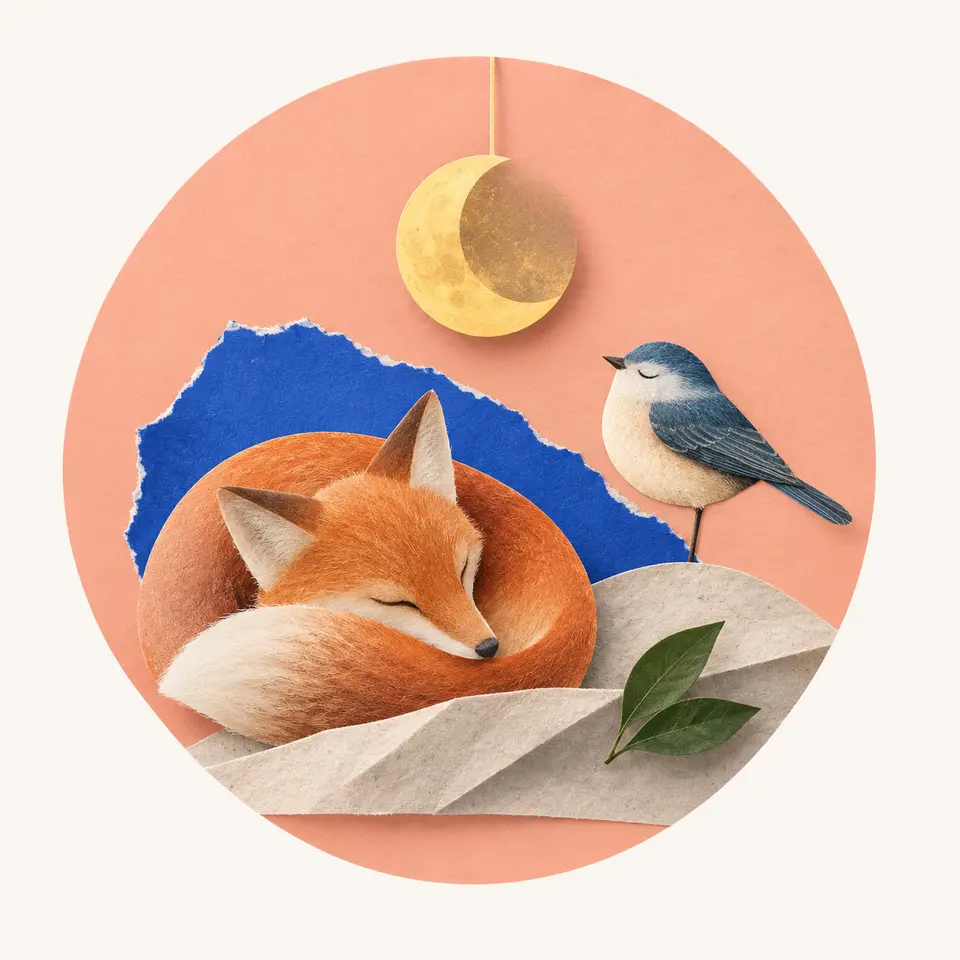
Some animals found a workaround. In unihemispheric sleep, one half of the brain sleeps while the other stays awake, and the eye linked to the awake half stays open. Dolphins and seals do it, perhaps so they can keep surfacing to breathe. Many birds do it too.
Ducks show it's about danger. Mallards at the edge of a flock, the most exposed spots, sleep with half the brain more than ducks in the middle. Their open eye faces outward.
Great frigatebirds fly over the ocean for days. Brain recordings showed they sleep in flight, with one half of the brain or both. They managed only about 41 minutes a day, under a tenth of what they sleep on land.
Try to recallHow does sleeping with half the brain help a duck at the edge of its flock?
One half of its brain sleeps while the other stays awake, keeping the opposite eye open. The duck at the edge faces the most danger, so it turns its open eye outward to watch for predators while still getting some sleep.
Sleep is costly, yet nearly every animal does it, so it must serve a deep purpose. Where danger is constant, some animals sleep one half of the brain at a time rather than give sleep up.
Lessons in this topic
Why nearly every animal sleeps despite the danger
See why sleep's spread across the animal kingdom points to a vital job, and how dolphins and birds sleep with half a brain.
How sleep strengthens and reshapes what you learn
See the experiments showing that sleep after learning protects memories, and how the sleeping brain replays and reorganizes them.
Does sleep clean and reset the brain
Look at two maintenance ideas, that sleep trims back connections built up during the day and that it washes out waste, and why the second is disputed.
How much sleep people need and who decided
Learn how experts reached the 7-hour advice for adults, what rare short sleepers show, and what sleep looks like without electric light.
Three quick stories from this topic
Sleeping on the wing
Frigatebirds flying over the ocean for days sleep only about 41 minutes a day
Brain recordings from great frigatebirds on flights of up to 10 days caught them sleeping in midair, sometimes with half the brain. They slept under a tenth as much as they do on land.
Half a brain at a time
Like dolphins, the birds can rest one half of the brain while the other half and its eye stay alert.
Why so little
The researchers concluded that the attention a long flight demands usually exceeds what half-brain sleep allows.
Sleep without electric light
People in societies without electric light slept no longer than many city dwellers
A 2015 study of three pre-industrial societies found people slept 5.7 to 7.1 hours a night. They went to sleep about 3.3 hours after sunset, not at dusk, and usually woke before sunrise.
Cold, not dark
Sleep tended to end near the coldest point of the night. The researchers suggest the daily temperature cycle may be a strong natural regulator of sleep.
No midnight break
Sleep wasn't split by long waking spells, and it ran about an hour longer in winter than in summer.
A smell that saves memories
A rose smell replayed during deep sleep helped people remember what they'd learned with it
In a 2007 study, people learned card positions while smelling roses. Those who got the smell again during deep sleep remembered more, while the smell did nothing in REM sleep or awake.
A cue for replay
The smell is thought to reactivate the new memory in the sleeping brain, which strengthens it.
Only if linked
People who hadn't smelled roses while learning got no benefit, so the cue only worked when tied to the memory.
Sources
- Brain Basics: Understanding Sleep, National Institute of Neurological Disorders and Stroke, NIH
- Sleep in animals, Wikipedia
- Sleep deprivation, Wikipedia
- Unihemispheric slow-wave sleep, Wikipedia
- Evidence that birds sleep in mid-flight (Rattenborg et al., 2016), Nature Communications, via PubMed
- Natural sleep and its seasonal variations in three pre-industrial societies (Yetish et al., 2015), Current Biology, via PubMed
- Odor cues during slow-wave sleep prompt declarative memory consolidation (Rasch et al., 2007), Science, via PubMed
- Rose-scented sleep improves memory, Nature News (2007)