Body & Health · Sleep & body rhythms
Your body clock and sleep pressure
Tell your need for sleep apart from your body's daily timing, then see how light sets that timing and why a changed schedule can clash with it.
What you will learn
- Tell the sleep need that builds while you're awake apart from circadian timing
- Use both influences to explain a mismatch between someone's schedule and their body
- Explain how light-dark cues help align circadian timing
- Explain why knowing a biological mechanism isn't enough to recommend a sleep treatment
Lesson 1 of 4 · 4 min
Why you can be exhausted and still not sleep
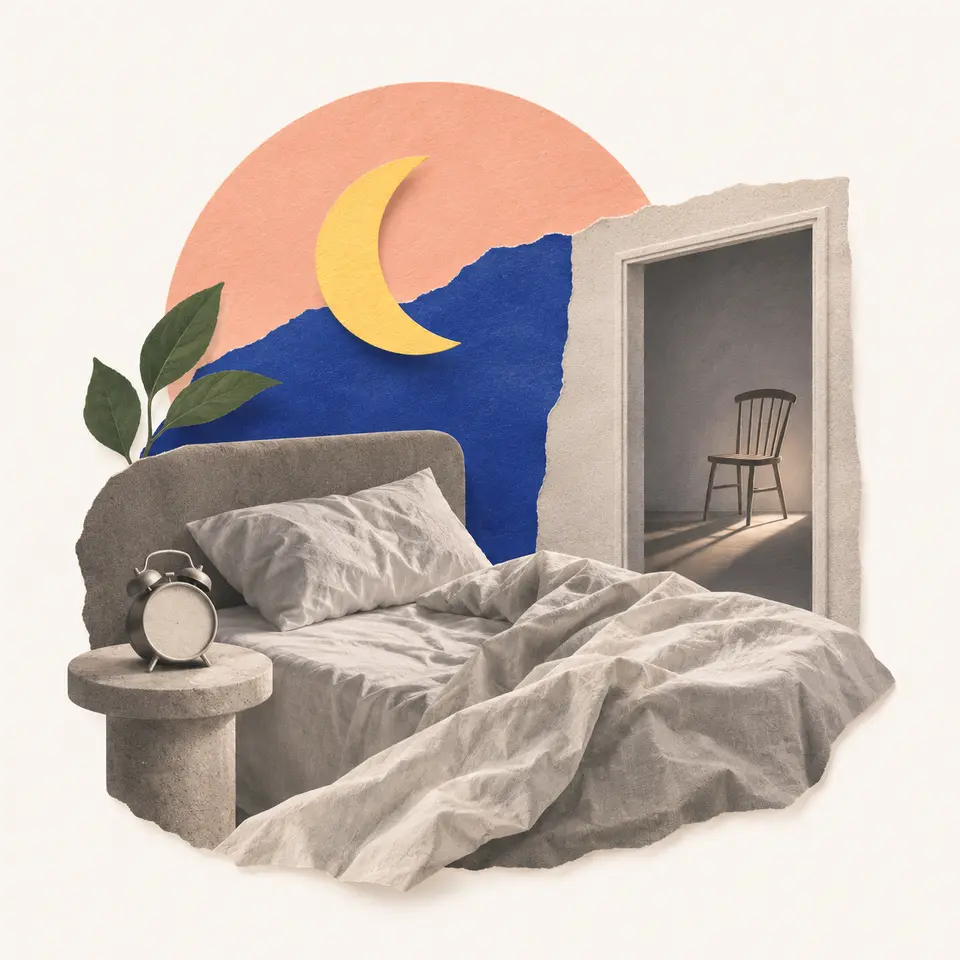
Say you've been awake for twenty hours on a long flight. You're exhausted. You get into the hotel bed and lie there, wide awake. How can a body that tired refuse to sleep?
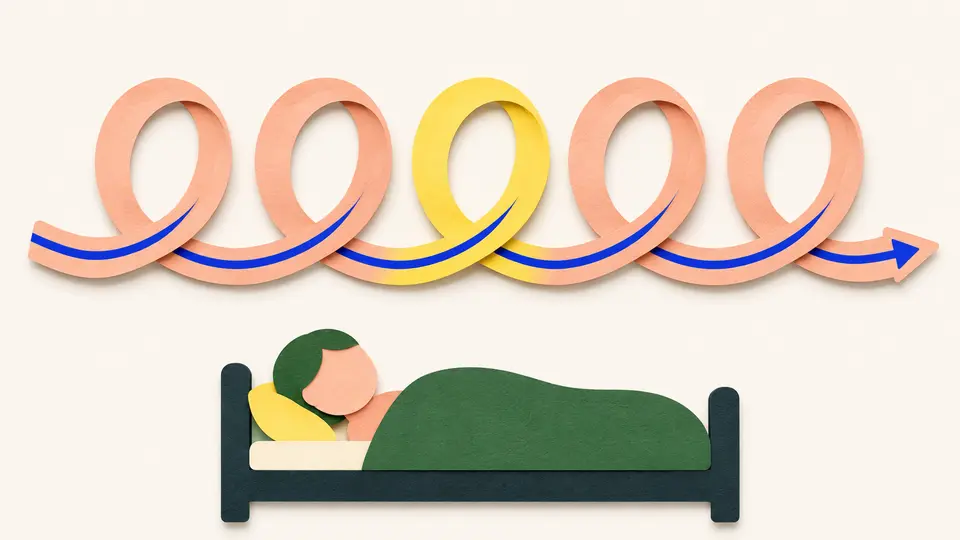
Because two separate systems decide when you sleep. One is sleep pressure, a need for sleep that grows the longer you're awake. The other is your body clock, which keeps its own daily schedule. Usually they agree. A change of schedule pulls them apart.
Sleep pressure tracks how long you've been awake. While you're up, a compound called adenosine keeps rising in your brain, and the rising level signals a shift toward sleep. Caffeine interrupts that signal by blocking adenosine.
The body clock tracks something else, the time of day. Its rhythm is called circadian, which means it repeats about every 24 hours. It helps decide when you feel awake and when you feel drowsy.
So one system counts hours awake, and the other keeps time.
Back to the hotel bed. The clock on the wall changed the moment you landed. Your body clock didn't, and it usually needs a few days to catch up. That lag is jet lag.
Meanwhile every hour awake has added sleep pressure. So pressure says sleep now, while your body clock still says daytime. You end up tired and unable to sleep.
This two-part picture explains a lot, and it has limits. Trouble sleeping can have other causes, including sleep disorders such as insomnia. So the model can suggest why a traveler lies awake. It can't diagnose anyone.
What it does is stop you treating tiredness as a single reading. There are two readings, hours awake and time of day, and they can disagree.
Try to recallA night worker feels tired but finds it hard to sleep during the day. How could sleep pressure and circadian timing together explain this, without diagnosing the worker?
Time awake may have built up their need for sleep, while their internal daily clock is still set for a different sleep time than the one they've planned. That's one possible explanation, and it isn't enough to diagnose anything or predict exactly what will happen.
Sleep pressure rises with every hour you're awake, and caffeine works by blocking the compound behind it. The body clock keeps time on a cycle of about 24 hours. When someone is exhausted and still can't sleep, one explanation is that the two are pulling in different directions.
Lessons in this topic
Why you can be exhausted and still not sleep
Meet the two systems that decide when you sleep, a pressure that builds while you're awake and a clock that keeps its own time, and see what happens when they disagree.
How light sets your body clock, and where melatonin fits
Follow light from your eyes to the brain's central clock and the hormone melatonin, then see why a real hormone doesn't make a melatonin supplement a proven treatment.
Why teenagers stay up late and grandparents wake early
See how the body clock's natural timing differs between people and shifts across a lifetime, and what happens when a late-running teenage clock meets an early school bell.
Why deep sleep comes early and REM comes late
Tell non-REM from REM sleep, see why deep sleep fills the early cycles and REM the late ones, and predict what a shortened or broken night takes away.
Three quick stories from this topic
Teen clocks and school bells
In puberty the body clock commonly shifts later, so teens get sleepy later at night
The shift is biological. In 2014 US pediatricians urged schools to start no earlier than 8:30 a.m. so that teenagers could sleep enough. In the 2011-12 school year, only 17.7% of US public middle and high schools did, and the average bell rang at 8:03.
Earliest and latest bells
Louisiana had the earliest average start time, 7:40 a.m. Alaska and North Dakota had the latest, at 8:33 and 8:31.
The other end of life
Older adults usually sleep less and wake earlier. Brain cells that promote sleep are lost as part of normal aging, which makes it harder to stay asleep.
Less REM sleep in the cold
In REM sleep your body doesn't regulate its temperature properly, so cold means less REM
REM is the phase when your eyes twitch, your brain activity resembles waking and dreaming usually happens. Your muscles also go limp. You usually get more REM late in the night, and you don't get as much of it in colder temperatures.
What REM is
REM, or rapid eye movement sleep, is the phase when your eyes twitch, your brain activity looks like waking, dreaming usually happens and your muscles go limp. You usually get more of it later in the night, and the whole cycle of REM and non-REM sleep repeats every 80 to 100 minutes.
A general pattern
This describes how sleep responds to temperature in general. It doesn't recommend a bedroom temperature or say what's right for any one person. Age changes the picture too, since newborns spend more time in REM.
Caffeine and adenosine
Caffeine keeps you awake by blocking adenosine, the compound that signals a need for sleep
While you're awake, adenosine keeps rising in your brain, and the rising level signals a shift toward sleep. Caffeine blocks it, which gives your body a false wakefulness cue. Your body clock is a separate system and keeps its own time.
A separate clock
Internal clocks on a cycle of about 24 hours also help decide when you feel awake and when you feel drowsy. Light and darkness keep them in step with the day.
When the two disagree
After a flight across time zones, hours awake have built up your need for sleep while your body clock is still adjusting. Jet lag usually resolves within a few days.
Sources
- How sleep works: Your sleep/wake cycle, NIH / NHLBI
- School Start Times for Middle School and High School Students, United States, 2011-12 School Year, CDC, Morbidity and Mortality Weekly Report
- How Sleep Works: Sleep Phases and Stages, NHLBI, NIH