Body & Health · Medicine & public health
Screening tests and what early detection doesn't prove
A test that finds disease before symptoms sounds obviously worth having. Learn what a screening result means, and why screening is judged by deaths prevented, since survival figures can improve when nobody lives a day longer.
What you will learn
- Say what a screening test is for and what it isn't for.
- Say what a screen-positive and a screen-negative result each mean.
- List the four things NCI says a working screening test achieves.
- Explain why finding a disease early isn't enough on its own.
Lesson 1 of 4 · 5 min
What a screening test can and can't tell you
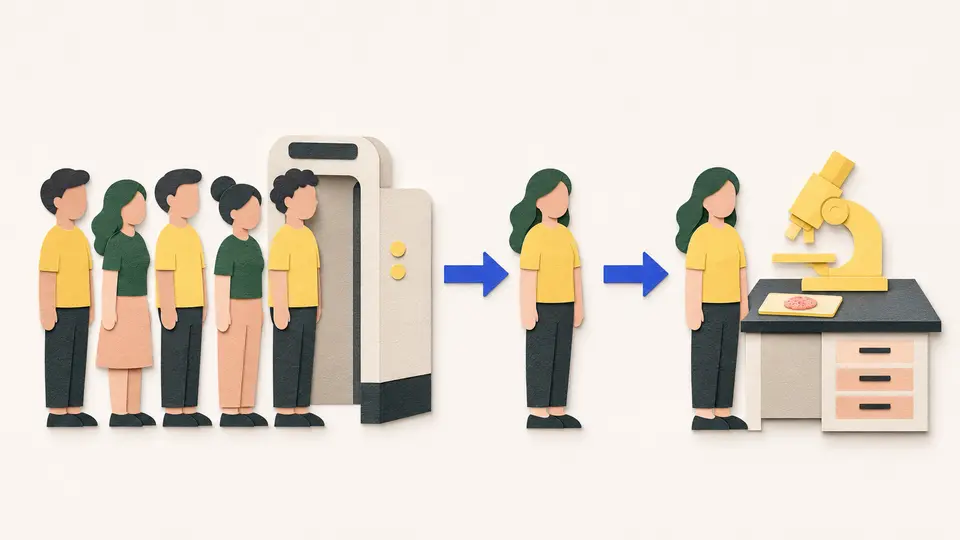
A letter arrives inviting you for a test. You feel fine, and nobody has noticed anything wrong with you. You've been picked by your age or risk group. This is a screening test, a test done on people who have no symptoms.
So an invitation doesn't mean a doctor suspects something. The US National Cancer Institute, or NCI, describes cancer screening as looking for cancer before a person has any symptoms. The NHS calls screening a way of finding apparently healthy people who may have a higher risk of a condition.
That definition comes with a limit people forget. Screening tests usually don't diagnose anything. Take a screening mammogram that finds a lump in the breast. A lump may be cancer or something else.
So diagnostic tests follow. One is a biopsy, in which cells or tissue are removed so a pathologist can check them under a microscope.
A screening result isn't a yes or a no. The NHS describes two outcomes. A normal result, called a screen negative, means you're at low risk of having the condition. It doesn't mean you'll never develop it, only that your risk is low right now.
A higher-risk result, called a screen positive, means you may have the condition. You'll be offered diagnostic tests to find out.
No screening test is 100% accurate, so either result can be wrong. A false positive says there's a problem when there isn't. It causes anxiety and usually leads to more tests and procedures, which carry risks of their own. A false negative misses a problem that's really there. It can lead someone to put off seeing a doctor even after symptoms appear.
Even a well-run program makes both kinds of error. A result moves your risk up or down. It never settles the matter alone.
Try to recallA friend gets a screen-negative result and concludes they don't have the condition and never will. What's wrong with each half of that conclusion?
The first half reads too much into the result. A screen negative means a low risk of having the condition, and screening tests aren't perfectly accurate, so a false negative is possible. The second half gets the timing wrong. A normal result means you're at low risk right now, and you could still develop the condition later.
The NHS runs screening this way from the first days of life, with a blood spot test for newborns, to a check for a dangerous swelling of the aorta offered to men when they turn 65. In every case the screening test sorts people by risk. Finding out what is actually there is the job of the tests that follow.
Lessons in this topic
What a screening test can and can't tell you
Screening tests people who feel well. Learn why the result is a statement about risk, and why it takes a second kind of test to diagnose anything.
Four things a screening test has to do
Finding a cancer early is only the first of four things a useful screening test does. See what the other three are, and which well-known tests manage all four.
Three ways screening can look better than it is
Lead-time bias, overdiagnosis and healthy screenee bias can each raise survival figures when nobody lives a day longer.
Why screening is judged by deaths, not survival
Screening studies count deaths from the cancer in screened and unscreened groups. See why that measure escapes all three biases, and what to ask about a test you're offered.
Three quick stories from this topic
Doctors misread survival too
In one survey, 76% of doctors wrongly read better survival as proof screening saves lives
The 2012 survey asked 412 primary care doctors about two imaginary screening tests. Better 5-year survival proves little, because finding a cancer earlier starts the survival clock sooner even when the patient dies on the same day.
The evidence that counts
A screening test is shown to work when fewer people die of the cancer in a screened group than in an unscreened one. In the same survey, 81% of the doctors correctly recognized that.
The question to ask
One of the researchers suggests asking what your chance of dying from the disease is if you're screened, and what it is if you're not.
The clock starts earlier
A cancer found at 60, not 67, makes a 5-year survivor of a man who still dies at 70
Survival is counted from the day of diagnosis. Diagnosed at 67 because of his symptoms, he lives three more years. Found at 60 by screening, he lives ten. In this example from the US National Cancer Institute, he gains no extra life at all.
What screening changes
A screening test moves the date of diagnosis earlier, so the measured survival time gets longer.
Lead-time bias
Survival may look longer because the diagnosis came earlier, but the person may die at the same time they would have anyway.
Korea's thyroid cancer surge
South Korea's thyroid cancer rate rose over sevenfold in a decade while deaths stayed flat
From 1999 to 2009, diagnoses went from 6.3 to 47.5 per 100,000 people as ultrasound screening of the thyroid spread. Nearly all the increase was small tumors. Researchers concluded it was most likely overdetection, with screening finding cancers that would never have caused symptoms.
What the scans found
Between 1999 and 2008, about 94% of the increase was tumors smaller than 2 centimeters, detected mainly by screening.
Pulling back
In 2014 a public campaign in South Korea argued against routine thyroid screening. Within a year, thyroid cancer operations fell by 35%.
Sources
- Cancer screening overview, patient version, NIH / National Cancer Institute
- NHS screening, National Health Service
- Crunching Numbers: What Cancer Screening Statistics Really Tell Us, National Cancer Institute
- Association between screening and the thyroid cancer "epidemic" in South Korea: evidence from a nationwide study, Park et al., BMJ 2016;355:i5745 (PMC full text)