Body & Health · Medicine & public health
How medicines work
Follow a tablet from mouth to target. See how drugs act on receptors and enzymes, why dose and timing matter, where side effects come from and what makes a generic the same drug.
What you will learn
- Trace a swallowed drug through absorption, distribution, metabolism and elimination
- Explain how a drug's half-life sets how often it is taken and how fast a dose change works
- Explain how most drugs work by binding to a receptor or blocking an enzyme
- Explain why side effects appear when a drug's target, or one like it, exists elsewhere in the body
Lesson 1 of 4 · 4 min
Where a swallowed pill goes, and why it matters
You swallow a headache tablet, and a while later your head feels better. The tablet never went near your head. So how did it get there? Every medicine you swallow makes the same four-step trip.
First comes absorption. The tablet breaks up and most of the drug passes through the wall of the small intestine into the blood. That blood doesn't go straight to the body. It flows through the portal vein to the liver first.
The liver is where most metabolism happens. Its enzymes, mostly a family called cytochrome P-450, change drug molecules, often into inactive ones. Some drugs lose much of their dose on this first pass, which is why a swallowed dose can be much bigger than an injected one.
What survives enters the general circulation, which carries blood round the whole body in about a minute. This is distribution. Last comes elimination. The kidneys filter most drugs and their leftovers into urine, and some leave in bile.
Once the body starts removing a drug, the level in the blood falls at a fairly steady proportional rate. The time it takes to fall by half is the drug's half-life. After one half-life, half is left. After two, a quarter.
Half-life decides how often you dose. A drug that's cleared in a few hours needs several doses a day, or a slow-release tablet or skin patch that feeds it in steadily. A drug with a long half-life can be taken once a day.
It also sets how fast a change works. A blood level takes about 4 to 5 half-lives to settle after you start, stop or change a dose. The heart drug digoxin has a half-life of 24 to 36 hours, so a new dose takes most of a week to show its full effect.
Try to recallWhy does changing the dose of a drug with a long half-life take days to show its full effect?
A drug's blood level takes about 4 to 5 half-lives to settle at a new steady level after a dose changes. If the half-life is a day or more, that adds up to several days. Digoxin, at 24 to 36 hours, takes most of a week.
A swallowed drug is absorbed by the gut, filtered by the liver, spread by the blood and removed mostly by the kidneys. How fast it's removed, its half-life, sets how often you take it and how long a change takes to work.
Lessons in this topic
Where a swallowed pill goes, and why it matters
Follow a tablet through the gut, liver, blood and kidneys, and see how that trip sets the dose and how often you take it.
Why a pill for one problem affects the rest of you
Learn how drugs work by fitting receptors and blocking enzymes, and why the same fit causes side effects elsewhere in the body.
Why the same dose can help one person and harm another
See how wide the gap is between a helpful and a harmful dose, and how age, genes and even grapefruit can move a person across it.
Why a new drug costs billions and its copy costs less
See why most drug candidates never reach a pharmacy, how patents pay for the winners, and what a generic must prove to count as the same drug.
Three quick stories from this topic
The small generic test
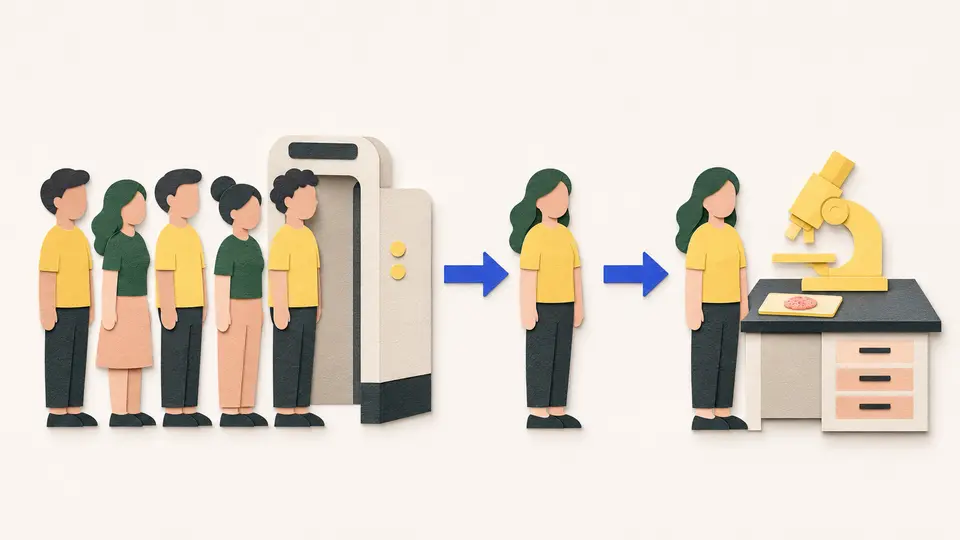
A generic drug can win approval on tests in as few as 24 healthy volunteers
The original drug's big trials already proved the ingredient works. The generic only has to show that it puts the same amount into the blood at the same speed.
Blood, not cures
These bioequivalence studies measure blood levels over time, which healthy people show as well as patients do.
Why generics cost less
Skipping years of large trials is a big reason a generic can sell for far less than the brand.
Grapefruit's lucky discovery
Grapefruit's effect on medicines was found by accident in a 1989 study about alcohol
Researchers used grapefruit juice to hide the taste of alcohol, and drug levels came out unexpectedly high. Chemicals in grapefruit block an enzyme that breaks down about half of all drugs.
One glass is enough
One whole grapefruit or a 200 mL glass of juice can push the drug felodipine to overdose levels.
Why it works
The enzyme, CYP3A4, sits in the gut wall and liver. Block it and more of each dose reaches the blood.
Allergy pills as sleep aids
Some over-the-counter sleep aids are allergy drugs sold for their side effect
Older allergy drugs such as diphenhydramine cross into the brain and block histamine there as well as in the nose. Sedation is their most common side effect, so it gets packaged as the main effect.
The brain gets a dose too
These older drugs are also less selective, so they reach more receptors than the ones in the nose. Drowsiness, dizziness and blurred vision are common results.
Why newer pills differ
Newer allergy drugs fit the body's histamine receptors more selectively and cause much less drowsiness.
Sources
- Introduction to Administration and Kinetics of Drugs, Merck Manual Consumer Version
- Drug Administration, Merck Manual Consumer Version
- Drug Distribution Within the Body, Merck Manual Consumer Version
- First pass effect, Wikipedia
- Drug Metabolism, Merck Manual Consumer Version
- Drug Elimination, Merck Manual Consumer Version
- Biological half-life, Wikipedia
- Drug Absorption, Merck Manual Consumer Version
- Bioequivalence and Interchangeability of Generic Medications, Merck Manual Consumer Version
- Generic Drugs: Questions & Answers, US Food and Drug Administration
- Grapefruit-drug interactions, Wikipedia
- H1 antagonist, Wikipedia