Body & Health · Body systems & senses
High blood pressure and how to read the numbers
Learn what the two numbers in a blood pressure reading measure, why high blood pressure is found by a routine check and not by symptoms, and why one high reading isn't a diagnosis.
What you will learn
- Say what the systolic and diastolic numbers each measure.
- Place a reading in the standard blood pressure categories.
- Explain why high blood pressure is usually found by a scheduled check rather than by symptoms.
- Name what controlling blood pressure can help prevent or delay.
Lesson 1 of 4 · 6 min
What the two blood pressure numbers measure
A blood pressure reading comes as two numbers with a slash, like 120/80 mm Hg. You say it as 120 over 80. The unit is millimeters of mercury, because early gauges showed the pressure as the height of a column of mercury. The Italian doctor Scipione Riva-Rocci introduced one in 1896.
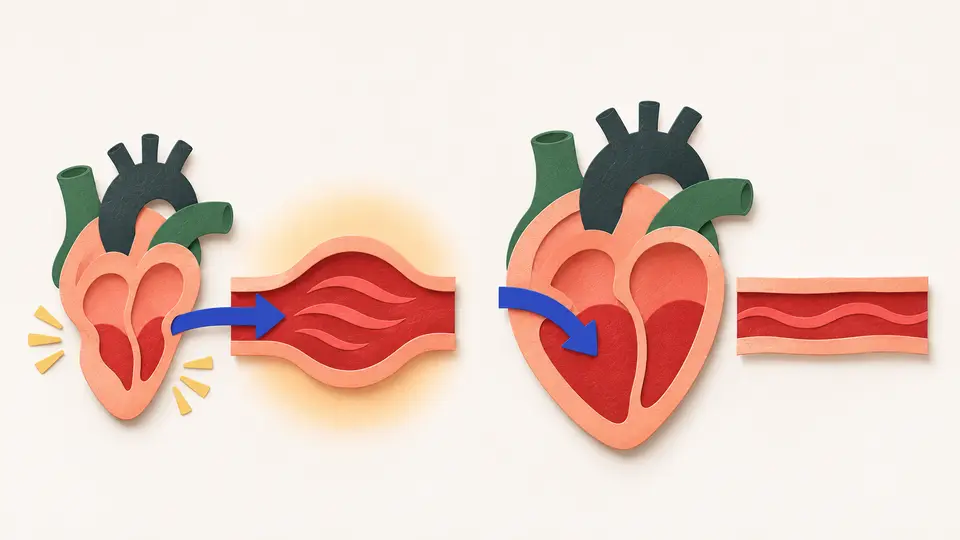
Blood pressure is the force of the blood on the walls of your arteries. That force isn't steady. It peaks each time the heart pumps and drops while the heart refills, so one number can't describe it.
The first number is the systolic pressure, the force when blood is pumped out of the heart. The second is the diastolic pressure, measured between heartbeats while the heart fills. One is the push. The other is what's left in the arteries during the pause.
A healthy reading is less than 120 systolic and less than 80 diastolic. High blood pressure, also called hypertension, means the force is often too high.
One caution before you read any result. Blood pressure changes through the day with what you're doing, so a single reading is only a sample.
Readings are sorted into five categories. Normal is less than 120 systolic and less than 80 diastolic. Elevated is 120 to 129 systolic with the diastolic still under 80.
Then come two stages of high blood pressure. Stage 1 is 130 to 139 systolic or 80 to 89 diastolic. Stage 2 is 140 or higher systolic or 90 or higher diastolic. Above 180 systolic or above 120 diastolic is a hypertensive crisis, and the advice is to contact a provider immediately.
The small words matter. Normal and elevated are joined by "and," so both numbers have to be in range. The stages are joined by "or," so one number is enough.
Take 118 over 84. The 118 looks ideal. But 84 is too high for normal or elevated, and it sits in the stage 1 band. So the reading is stage 1 on its second number alone. A reading of 134 over 76 is stage 1 on its first.
These labels describe a reading. High blood pressure as a condition is defined the same way, as consistent readings of 130 or higher systolic, or 80 or higher diastolic.
Try to recallA blood pressure reading comes back as 118 over 84. Which category does it fall in, and why isn't the first number enough to decide?
It's stage 1 high blood pressure. Stage 1 is 130 to 139 systolic or 80 to 89 diastolic, and because the two conditions are joined by "or," meeting either one is enough. The 118 alone would suggest normal, but the diastolic 84 falls in the stage 1 band and settles the label. Normal and elevated are joined by "and," so they need both numbers in range.
The first number is the push and the second is the pause. Under 120 and under 80 is normal. From 130 systolic or 80 diastolic upward, either number alone puts a reading in the high range, so read both.
Lessons in this topic
What the two blood pressure numbers measure
A blood pressure reading is two numbers, one for the heart's push and one for the pause between beats. Learn what each measures and how the pair places a reading in a category.
High blood pressure rarely gives a warning
High blood pressure usually causes no symptoms until it has done serious harm. See why that makes a yearly check the way to find it, and what controlling it can prevent.
Blood pressure risks you can change and ones you can't
Age, family history and sex affect the risk of high blood pressure and can't be changed. Salt, sleep, alcohol and some everyday medicines can. Learn to sort them, and what running in families does and doesn't show.
Why one high reading isn't a diagnosis
Blood pressure moves all day, so a single reading is only a sample. See why the definition of high blood pressure asks for consistent readings, and what the hedging words in health guidance tell you.
Three quick stories from this topic
One number is enough
A reading of 118 over 84 falls in the high blood pressure range on its second number alone
A normal reading needs both numbers in range, under 120 and under 80. The high categories need only one. So the 84 puts this reading in stage 1 despite the ideal 118, and a reading of 134 over 76 lands there on its first number.
Stage 1, joined by OR
Stage 1 means 130 to 139 systolic OR 80 to 89 diastolic, so either number on its own is enough to reach the label.
So 118 over 84 is stage 1
The systolic figure alone would read as normal, but the diastolic figure decides the category.
Everyday medicines and blood pressure
Ibuprofen, decongestants and birth control pills can all raise blood pressure
They appear with antidepressants on the US National Heart, Lung, and Blood Institute's list of medicines that make it harder for the body to control blood pressure. The better-known risks are salt, alcohol and too little exercise. These are things people take on purpose.
Two kinds of risk
Age, family history, race and ethnicity, and sex can't be changed. Habits such as eating a lot of salt, drinking too much alcohol and getting too little sleep can.
No warning either way
Symptoms from high blood pressure usually appear only after it has caused serious health problems, so a check with a cuff is how it gets found.
Why millimeters of mercury
Blood pressure is given in millimeters of mercury because early gauges used a column of it
In 1896 the Italian doctor Scipione Riva-Rocci wrapped a cuff made from a bicycle inner tube around the upper arm and read the pressure off mercury in a glass tube. Mercury gauges have since been retired over safety concerns. The unit stayed.
What the two numbers are
The first number is the systolic pressure, the force when the heart pumps blood out. The second is the diastolic pressure, measured between beats while the heart fills.
Healthy means both
A healthy systolic pressure is less than 120 mm Hg, and a healthy diastolic pressure is less than 80 mm Hg.
Sources
- High Blood Pressure: What Is High Blood Pressure?, National Heart, Lung, and Blood Institute
- From Concept to Cure: The Life and Legacy of Scipione Riva-Rocci, Cureus
- Beyond the numbers: the importance of contextual data when reusing blood pressure data from electronic health records, Frontiers in Digital Health
- High Blood Pressure: Causes and Risk Factors, National Heart, Lung, and Blood Institute