Body & Health · Body systems & senses
The lungs and breathing
Follow a breath from nose to air sacs and see how oxygen and carbon dioxide swap places across a wall far thinner than a hair. Then learn what sets your breathing rate without a thought.
What you will learn
- Trace the path of air from the nose to the air sacs and say what the airways do on the way
- Explain how the diaphragm and a drop in pressure, not the lungs themselves, draw air in
- Explain how oxygen and carbon dioxide cross the air sac wall by diffusion
- Describe how hemoglobin carries oxygen and how carbon dioxide travels back to the lungs
Lesson 1 of 4 · 4 min
Why your lungs can't pull in air by themselves
Take a breath through your nose. Before that air does anything useful, it gets cleaned and warmed. Ridges inside the nose make it tumble against a wet lining, and sticky mucus traps dust and germs.
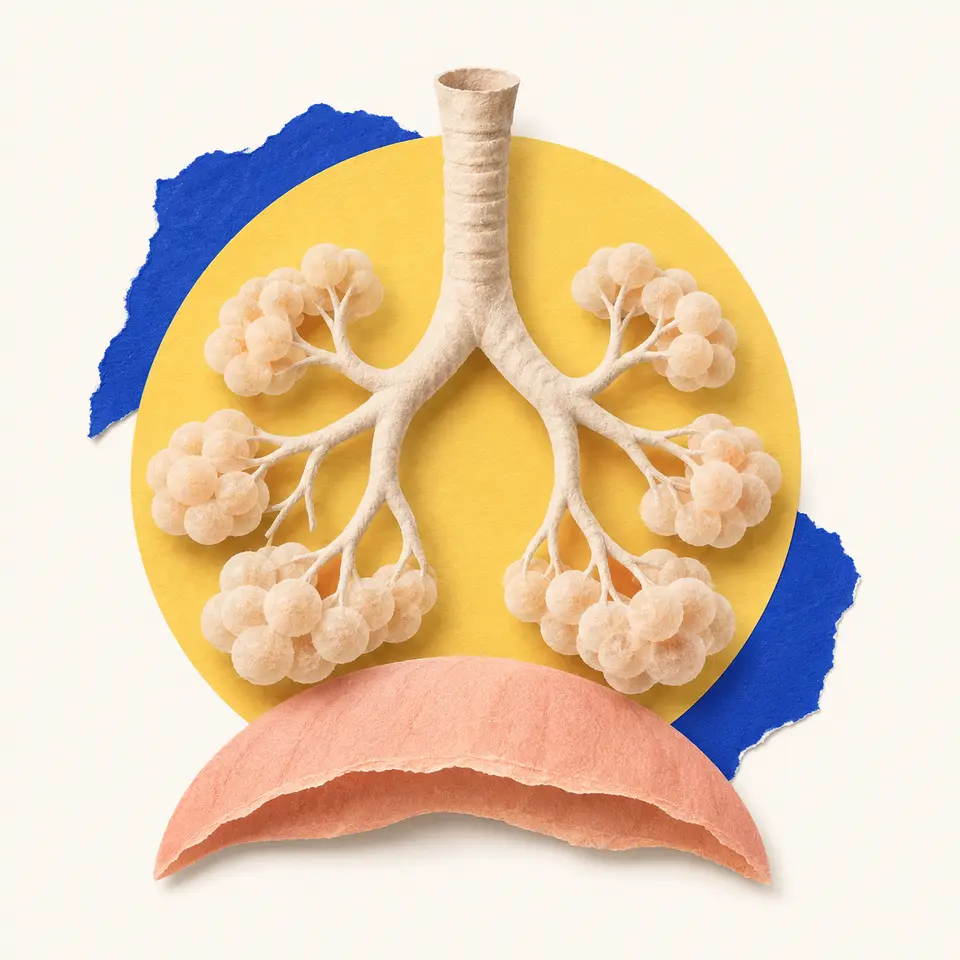
Then the air heads down the windpipe, which splits into two tubes, one per lung. Each tube keeps splitting, like the branches of a tree turned upside down. The thinnest branches, the bronchioles, are about 1 millimeter across, and each lung has more than a thousand of their final tips.
Up to this point no oxygen has reached your blood. These tubes only carry air. The swap happens at the very end, in tiny bubble-shaped air sacs called alveoli. A careful count of six adult lungs found an average of 480 million of them.
Your lungs have no muscle that can pull air in. They're like sponges that can't self-expand. Something outside them has to do it.
That something is the diaphragm, a dome of muscle under the lungs. When it contracts, it flattens and moves down, so the chest gets bigger. The lungs stretch with it. A bigger space means lower pressure inside the lungs, because the same air is spread out. Air then flows in from the room, where the pressure is now higher.
Breathing out at rest takes no effort. The diaphragm relaxes and the stretched lungs spring back like a balloon let go, pushing air out. A quiet breath moves about 500 milliliters. Muscles between the ribs and in the belly join in only when you breathe hard.
Try to recallWhy does air flow into the lungs when the diaphragm contracts?
The contracting diaphragm moves down and makes the chest bigger, and the lungs stretch with it. The larger space lowers the air pressure inside the lungs. Air then flows in from outside, where the pressure is higher.
You can now follow a breath down the airway tree to the air sacs, and explain how a falling diaphragm lowers the pressure so air flows in.
Lessons in this topic
Why your lungs can't pull in air by themselves
Follow air down a branching tree of tubes to hundreds of millions of air sacs, and see which muscle actually does the pulling.
How oxygen gets from your lungs into your blood
See how oxygen and carbon dioxide cross the air sac wall with no pump at all, and how red blood cells carry them on.
Why holding your breath gets hard so fast
Learn which gas your brainstem watches to set each breath, and why that alarm can fail a diver who breathes hard before going under.
Where breathing breaks down, and how it's measured
See how asthma, emphysema and pneumonia each block a different step of breathing, and what a lung function test and a finger oxygen clip actually measure.
Three quick stories from this topic
480 million air sacs
An adult's lungs hold about 480 million air sacs, by one careful count
Researchers who counted the air sacs in six adult lungs found anywhere from 274 to 790 million. Bigger lungs had more sacs, not bigger ones, since each sac stayed about the same size.
Why so many
Gas crosses only where air meets blood. Splitting the lung into millions of tiny sacs gives 70 to 80 square meters of wall for that swap.
The end of a long tree
Every sac sits at the tip of an airway that has branched again and again from the windpipe.
The carbon dioxide alarm
Your urge to breathe is set off by rising carbon dioxide, not falling oxygen
When you hold your breath, the strain builds because waste carbon dioxide is collecting. Sensors on the brainstem react to the acid it forms near the brain long before oxygen runs short.
Why it usually works
Most of the time carbon dioxide rises as oxygen falls, so watching one gas tracks the other.
When it fails
Breathing hard before a breath-hold dive lowers carbon dioxide, so the urge comes late and oxygen can run out first.
Hemoglobin's seventy-fold boost
Hemoglobin lets your blood carry about 70 times more oxygen than it could dissolve
Oxygen dissolves poorly in watery plasma, so only about 1.5% of the oxygen in your blood travels that way. The rest rides on hemoglobin inside red blood cells, each molecule holding up to four.
Iron does the holding
Each hemoglobin molecule has four iron-containing groups, and each one binds a single oxygen molecule.
Why blood turns bright red
Hemoglobin loaded with oxygen is bright red, which is why oxygen-rich blood looks brighter.
Sources
- 22.1 Organs and structures of the respiratory system, OpenStax, Anatomy and Physiology 2e
- The number of alveoli in the human lung (Ochs et al., 2004), American Journal of Respiratory and Critical Care Medicine, via Europe PMC
- How your body controls breathing, National Heart, Lung, and Blood Institute (NIH)
- 22.3 The process of breathing, OpenStax, Anatomy and Physiology 2e
- Freediving blackout, Wikipedia
- 22.5 Transport of gases, OpenStax, Anatomy and Physiology 2e
- Hemoglobin, Wikipedia