Body & Health · Body systems & senses
The heart and circulation
Follow blood through two connected circuits, and see how valves, vessels and electrical signals keep it moving.

What you will learn
- Trace blood through the lung and body circuits
- Tell an artery from a vein by the direction of flow
- Explain how heart valves prevent backflow
- Explain why the heart muscle needs its own coronary vessels
Lesson 1 of 4 · 4 min
Why blood visits the heart twice
Follow one drop of blood out of your heart, down to your big toe and back again. It arrives low on oxygen, having handed it over along the way. It can't set off around the body again like that.
So it makes a second trip first. The heart, which is about the size of your fist, sends it to the lungs to pick up oxygen. Then the blood comes back to the heart and is pumped out to the body.
The heart serves two circuits. One runs to the lungs and the other to the rest of the body. Blood passes through the heart twice on every lap.
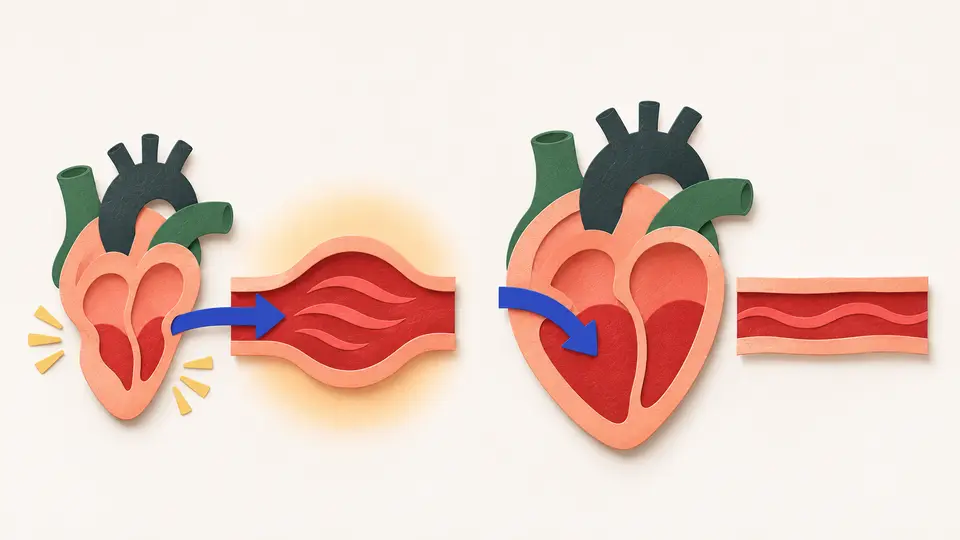
Start with blood coming back from the body. It enters the right side of the heart, and the right ventricle pumps it to the lungs, where it picks up oxygen.
From the lungs it returns to the left side. The left ventricle then pumps it into the body circuit, and it generates the high pressure needed to reach your whole body.
Two words to keep. A ventricle is a lower chamber that pumps blood out. An atrium is an upper chamber that receives blood. Each side of the heart has one of each, which makes four chambers.
Most people learn that arteries carry oxygen-rich blood and veins carry oxygen-poor blood. In the body circuit that's mostly true. It's a pattern, though, and the names mean something else.
Artery and vein describe direction. An artery carries blood away from the heart. A vein brings blood back to it. The names say nothing about oxygen, and the lung circuit shows why.
The pulmonary artery carries oxygen-poor blood from the heart to the lungs. It's an artery because the blood is leaving the heart. The pulmonary veins bring oxygen-rich blood back, and they're veins because the blood is returning.
So in the lung circuit the familiar pattern is reversed. When a diagram colors a vessel red or blue, the color usually shows how much oxygen the blood carries. To name the vessel, ask which way the blood is going.
Try to recallA vessel brings oxygen-rich blood from a lung to the heart. Is it an artery or a vein, and why?
It's a pulmonary vein, because it carries blood toward the heart. How much oxygen the blood carries doesn't decide whether a vessel is an artery or a vein.
The route is body, right heart, lungs, left heart, and back to the body. That's why blood visits the heart twice on each lap. And a vessel's name tells you its direction, away from the heart for an artery and toward it for a vein.
Lessons in this topic
Why blood visits the heart twice
Trace blood through the lung circuit and the body circuit, and learn the rule that tells an artery from a vein.
How heart valves keep blood moving one way
See how four valves stop blood from flowing backward, what makes the lub-dub of a heartbeat, and why the heart muscle needs a blood supply of its own.
The signal behind a heartbeat and what a pulse measures
Follow the electrical signal that makes the chambers contract in order, and tell heart rate apart from blood pressure.
Capillaries, veins and the trip back to the heart
See why exchange happens only in capillaries, and how blood at low pressure climbs back to the heart.
Three quick stories from this topic
What makes the lub-dub
The lub-dub of a heartbeat is the sound of four valves closing, two at a time
The lub is the two valves between the upper and lower chambers closing, once the upper chambers have filled the lower ones. The dub is the two exit valves closing after the blood has been pumped out. Each closure stops blood from flowing backward.
Four valves, one job
Two valves sit between the atria and the ventricles, and two sit where blood leaves the ventricles. Their flaps open to let blood through and close to stop it flowing backward.
When a valve fails
Heart valve diseases can cause backflow or slow the flow of blood through the heart.
Capillaries could hold all your blood
If every capillary bed in your body opened at once, it would hold every drop of your blood
There would be none left in the arteries, the veins or the heart. So rings of muscle at the capillary entrances stay closed most of the time and open only where tissue needs oxygen. Your blood is rationed.
How the sphincters ration flow
A precapillary sphincter is a ring of smooth muscle at the entrance to a capillary. When the surrounding tissue needs oxygen and has waste to get rid of, the sphincters open and blood flows through the bed for exchange. Then they close again, so blood goes where it's needed.
Why the count is so large
A single metarteriole can feed a bed of 10 to 100 capillaries, each only 5 to 10 micrometers wide. Exchange needs that enormous surface close to every cell. That's also why circulation depends on routing blood as well as pumping it.
Why recruits flex their legs
Military recruits are trained to flex their legs at attention so they don't faint
Blood in the leg veins is at low pressure and has to climb against gravity. What moves it is leg muscle squeezing the veins, while one-way valves stop it sliding back. Stand rigid for long enough and blood pools in the legs.
The muscle pump
When leg muscles contract, they press on the veins beside them. Valves above the muscle open and valves below it close, so the blood moves up toward the heart.
Where the blood is
About 64% of the body's blood sits in the veins of the body circuit at any moment. If it pools in the legs, the brain doesn't get enough oxygen-rich blood.
Sources
- How the Heart Works: The Heart, NHLBI, NIH
- How Blood Flows through the Heart, NHLBI, NIH
- How the Heart Beats, NHLBI, NIH
- Structure and Function of Blood Vessels, OpenStax, Anatomy and Physiology 2e
- Blood Flow, Blood Pressure, and Resistance, OpenStax, Anatomy and Physiology 2e