Body & Health · Movement & fitness
How the body adapts to exercise
Compare what endurance and strength training change in the body, and see why one workout or one person's response can't tell the whole story.
What you will learn
- Tell an immediate response to exercise apart from a training adaptation
- Explain why different training demands can produce different adaptations
- Explain how endurance adaptations support sustained muscle work
- Explain why muscle size alone doesn't account for strength gains
Lesson 1 of 4 · 4 min
Why a hard workout isn't the same as getting fitter
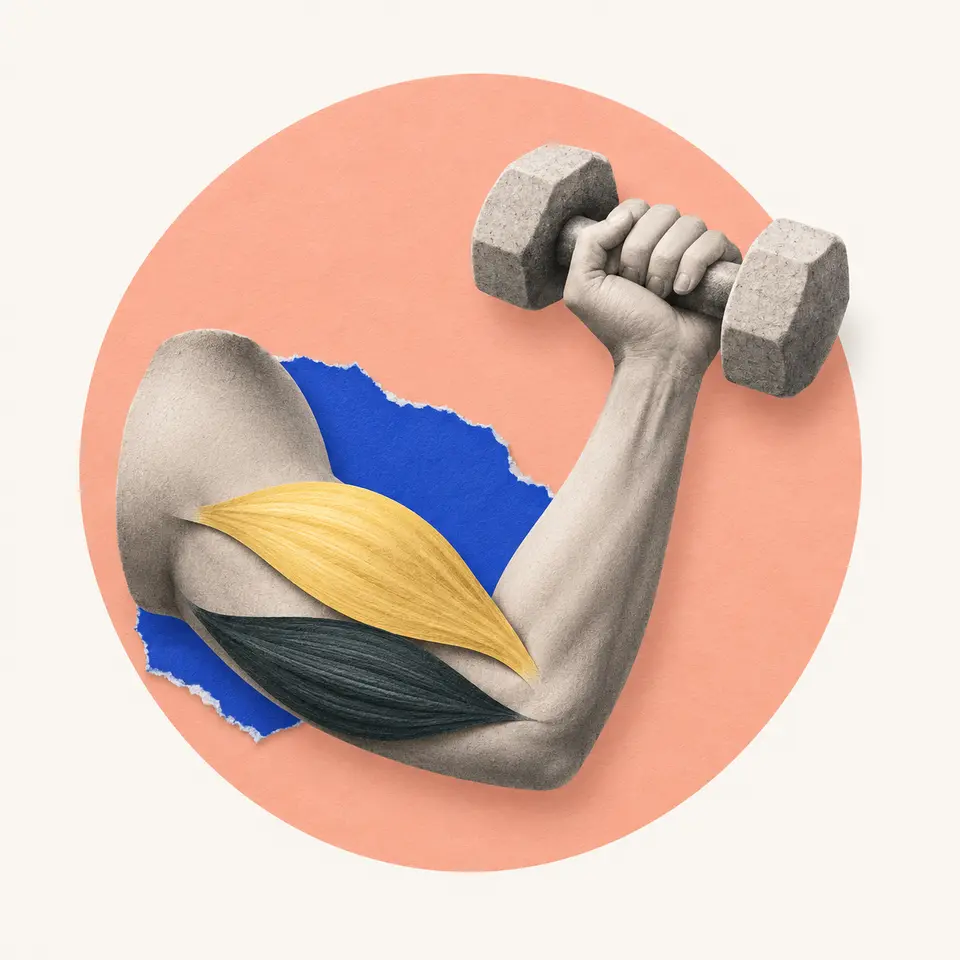
Run up a steep hill and your heart pounds. It beats faster to get more oxygen to your working muscles. Stop to rest and it slows again. That pounding is an immediate response, and it lasts about as long as the effort does.
A training adaptation is something else. It's a lasting change that builds when you repeat a demand, such as extra energy machinery inside a muscle or better nerve control of it. In strength training studies, these changes generally show up after 8 to 12 weeks.
So how wrecked you feel after one session doesn't measure how much you've adapted.
Your body adapts to the particular demand you keep repeating. It never gets a general instruction to "be fitter."
The broad pattern is old knowledge. People who train by exercising for a long time develop better oxygen delivery and endurance. People who work against a heavy load get bigger and stronger muscles.
How much changes depends on how often, how hard and how long you train, and on who you are.
Training is usually sorted into two kinds. Endurance training is a fairly light load kept up for a long time, and it improves how your body delivers and uses oxygen. Strength training is a heavy load for a short time, and it raises the force you can produce.
The two kinds overlap. Pure endurance or pure strength exercise is rare, and most activities combine them. So the useful question about any training is which demand it repeats.
Picture two people training for 10 weeks. One does long sessions of steady cycling. The other lifts heavy weights. Both finish every session worn out.
A 1980 study by Hickson ran this kind of comparison. The endurance group raised its maximal oxygen uptake, a standard measure of aerobic fitness, by 20% to 25%. It gained no appreciable leg strength. The strength group got steadily stronger, and its oxygen uptake didn't rise at all.
That's the principle called specificity. You adapt to the demand you repeat. The pattern describes groups of people, so it isn't a training plan or a promise for any one person.
Try to recallWhy is "Both workouts felt equally hard, so they must produce the same adaptation" weak reasoning?
How hard a workout feels doesn't tell you which demand it repeats. Long, sustained effort and heavy loads train different things. In Hickson's 1980 study, the endurance group gained aerobic fitness and no strength, and the strength group gained strength and no aerobic fitness. How much anyone adapts also depends on the person and their training history.
Feeling worn out tells you about today's session. To learn what training changed, ask what was measured, after how many weeks and which demand was repeated. In Hickson's study, ten weeks of hard training left one group fitter and the other stronger, and neither group got both.
Lessons in this topic
Why a hard workout isn't the same as getting fitter
Tell what your body does during one workout apart from what weeks of training change, and see why the kind of training decides which change you get.
What endurance and strength training change inside you
See how endurance training builds the energy supply inside a muscle, and why strength depends on your nervous system as well as on muscle size.
Why the same training gives people different results
See how far people's responses to one identical program can differ, what shapes the difference, and why neither an average nor a success story predicts your own result.
Why hard endurance training can hold back strength
Look at the concurrent-training effect, the conditions that soften it, and why a tidy molecular explanation for it didn't hold up in humans.
Three quick stories from this topic
Fitness gains run in families
How much fitter exercise makes you runs in families
In one study, 481 inactive adults from 98 families did the same 20-week endurance program. Some gained little or nothing in aerobic fitness, and others gained more than twice the average. Responses differed 2.5 times more between families than within them.
What was measured
Fitness was measured as maximal oxygen uptake, the most oxygen the body can use per minute. The average gain was about 400 milliliters a minute, and some people gained more than a liter.
Up to 47% inherited
The researchers estimated that up to 47% of the variation in response was heritable. An average result can't tell you where in that range you would land.
Light weights build muscle too
In studies, light weights lifted to failure built as much muscle as heavy weights
What mattered was reaching the point where another repetition is impossible. In one study, people who only flexed as hard as they could, with no weight at all, gained similar muscle thickness to a group lifting heavy. Heavy weights still built more strength.
The proposed reason
The hypothesis is about recruitment. When you reach failure, all of a muscle's motor units are recruited, whatever the load. In one study, people who repeatedly contracted a muscle as hard as they could with no load at all gained muscle thickness similar to a high-load group.
Size isn't the whole story
These findings are about muscle size. The same review says high loads are still needed to maximize strength gains, and it presents the size result as an emerging shift in thinking that isn't yet a settled rule. None of this is a training prescription, and strength also depends on how the nervous system activates muscle.
Train one leg, strengthen both
Strength-train one leg and the untrained leg gets stronger too
Across studies, the limb that did no work gained about half as much strength as the trained one, with no muscle growth. The likely reason is that strength is partly learned by the nervous system, and that learning spills over to the other side.
The numbers
A pooled analysis found that strength rose 7.6% in the untrained limb. That was 56% of the gain in the trained limb, after 15 to 48 training sessions.
Why early gains come fast
When people start strength training, strength climbs quickly as the nervous system learns the exercise. Muscle grows more slowly and drives the later gains.
Sources
- Adaptations to Endurance and Strength Training, Cold Spring Harbor Perspectives in Medicine; PMC full text
- How the Heart Beats, NHLBI, NIH
- Interference of strength development by simultaneously training for strength and endurance, European Journal of Applied Physiology and Occupational Physiology (PubMed record)
- Familial aggregation of VO2max response to exercise training: results from the HERITAGE Family Study, Journal of Applied Physiology (PubMed record)