Body & Health · Medicine & public health
Clinical trials
A new treatment is tested in stages before approval. Learn why trials use control groups, random allocation and blinding, what the placebo effect really is, and how scandals shaped the rules.
What you will learn
- Explain why a treatment needs a comparison group to show that it works
- Explain why random allocation, kept secret in advance, makes a comparison fair
- Describe what Phases 1, 2 and 3 each test and who takes part
- Explain why a drug is still watched after approval
Lesson 1 of 4 · 4 min
How a fair test tells a cure from luck
Most people with a cold get better whether they take anything or not. So if you take a remedy and recover, did it work? You can't tell from one person. The answer needs a comparison.
In 1747 the Scottish naval surgeon James Lind faced scurvy on HMS Salisbury. He took 12 sick sailors, kept them in one place on one diet, and gave pairs six different extras. These were cider, dilute sulfuric acid, vinegar, seawater, oranges and lemons, or a spicy paste.
The fruit pair stopped after six days when the oranges ran out, and by then one sailor was fit for duty. Only the cider pair showed any other effect. Because the sailors were alike apart from the treatment, the difference pointed at the fruit.
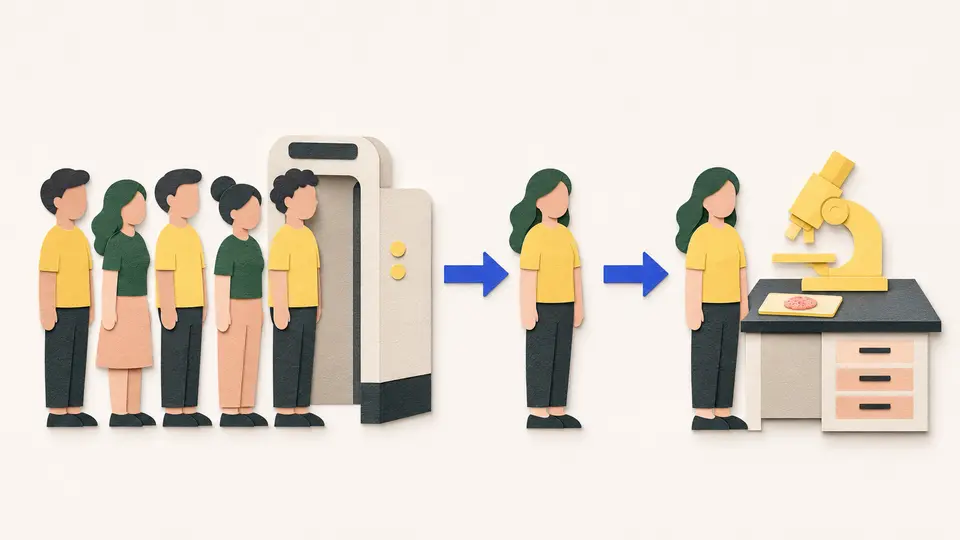
A comparison is only fair if the groups start out alike. Say a doctor picks who gets a new drug. They may give it to the patients who look strongest, without even meaning to. Then the drug looks good because of who got it.
The fix is random allocation, letting chance decide. In 1948 Britain's Medical Research Council tested streptomycin, a new antibiotic, on tuberculosis. Each patient's group was written on a card inside a numbered sealed envelope, ordered by random numbers. Nobody enrolling a patient knew what the next envelope said.
After six months, 4 of 55 patients given streptomycin had died, against 15 of 52 on bed rest alone. Because chance had sorted them, the gap belonged to the drug. This is usually called the first randomized controlled trial in medicine.
Try to recallWhy did the 1948 streptomycin trial keep each patient's group in a sealed envelope until enrollment?
So nobody could know, or steer, who got the drug. If doctors know the next assignment, they may send stronger or weaker patients to one group. Hidden random allocation keeps the groups alike, so a difference in results comes from the treatment.
A treatment shows it works only against a comparison group that's alike in every other way. Random allocation, hidden until each patient joins, is how a trial makes the groups alike.
Lessons in this topic
How a fair test tells a cure from luck
See why a treatment has to be compared with something, and why chance, not the doctor, should decide who gets what.
From the first dose to millions of patients
Follow a new drug through Phases 1 to 3, and see why the testing goes on after approval.
What a sugar pill can and can't do
Find out what the placebo effect really is, why much of it is people getting better anyway, and why trials hide who's getting what.
The scandals that wrote the rules for trials
See how abuses taught medicine to demand informed consent, and how missing evidence, from thalidomide to unpublished trials, led to rules on proof and openness.
Three quick stories from this topic
The missing antidepressant trials
Published antidepressant trials looked 94% positive while the FDA's own files showed 51%
A 2008 study matched 74 trials the FDA had reviewed against journal articles. Almost all positive trials were published. Most negative ones were never published or were written up to sound positive.
A third went missing
Of the 74 trials, 31% never appeared in a journal at all.
Why it matters
Doctors judge drugs from the published record. When failures stay hidden, treatments look better than they are.
Lind's six days of oranges
The 1747 scurvy trial's fruit group got only six days of oranges before the fruit ran out
James Lind gave two sailors two oranges and a lemon a day on HMS Salisbury. By the sixth day one was fit for duty. The other pairs, on cider, vinegar, seawater and acid, mostly stayed sick.
Twelve sailors, six pairs
Lind kept all 12 patients together on one diet, so the extras were the only difference between the pairs.
Ignored for decades
His 1753 treatise was mostly ignored. The Royal Navy's official lemon juice ration came decades later.
The powerful placebo
The 1955 paper that made the placebo effect famous didn't allow for natural recovery
The Powerful Placebo persuaded doctors that dummy pills had big clinical effects. A 1997 reanalysis found no placebo effect in its data, because patients who start at their worst tend to improve anyway.
Regression to the mean
People seek help when symptoms peak, so their next measurement is likely to be better whatever they take.
What a fair test shows
A 2010 Cochrane review of 234 trials comparing placebo with no treatment found no important clinical effects in general.
Sources
- James Lind, Wikipedia
- Lind J (1753), A treatise of the scurvy, James Lind Library
- Why the 1948 MRC trial of streptomycin used treatment allocation based on random numbers, Iain Chalmers, James Lind Library (2011)
- The MRC randomized trial of streptomycin and its legacy, John Crofton, James Lind Library (2004)
- Randomized controlled trial, Wikipedia
- Selective publication of antidepressant trials and its influence on apparent efficacy, Turner and colleagues, New England Journal of Medicine (2008)
- Placebo, Wikipedia