Engineering & Inventions · Design & invention
Thomas Edison
Edison didn't invent the light bulb alone, and his bigger invention was a lab that turned out inventions to order. See what his team built, how the bulb became a system, and where his fame overshoots.
What you will learn
- Explain what made Menlo Park different from a lone inventor's workshop
- Describe how the phonograph grew out of Edison's telegraph and telephone work
- Explain what Edison's team needed from a filament and why high resistance mattered
- Describe the parts of the system Edison built to sell electric light
Lesson 1 of 4 · 4 min
The lab Edison built to invent on demand
In 1876 Thomas Edison moved his family and his assistants to Menlo Park, a village about 25 miles southwest of New York City. He built a lab with the equipment to work on any invention. He wanted it to hold "a stock of almost every conceivable material."
Edison had started as a telegraph operator, working night shifts across the Midwest in the 1860s. By the 1870s he was inventing for telegraph companies. His quadruplex telegraph, which sent two messages each way on one wire at once, paid for the new building.
Menlo Park joined a machine shop to chemical and electrical labs, with staff to run them. Head machinist John Kruesi turned Edison's rough sketches into working models, so ideas got built and tested fast.
That made it the first industrial research laboratory, a place built to produce inventions as a business. The National Park Service calls it the model for later labs such as Bell Laboratories, and says it's sometimes considered Edison's greatest invention.
Western Union wanted a telephone to compete with Alexander Graham Bell's. Edison's answer was a carbon transmitter, a button of packed carbon whose electrical resistance changed as a voice shook it. Telephones used that idea for the next century.
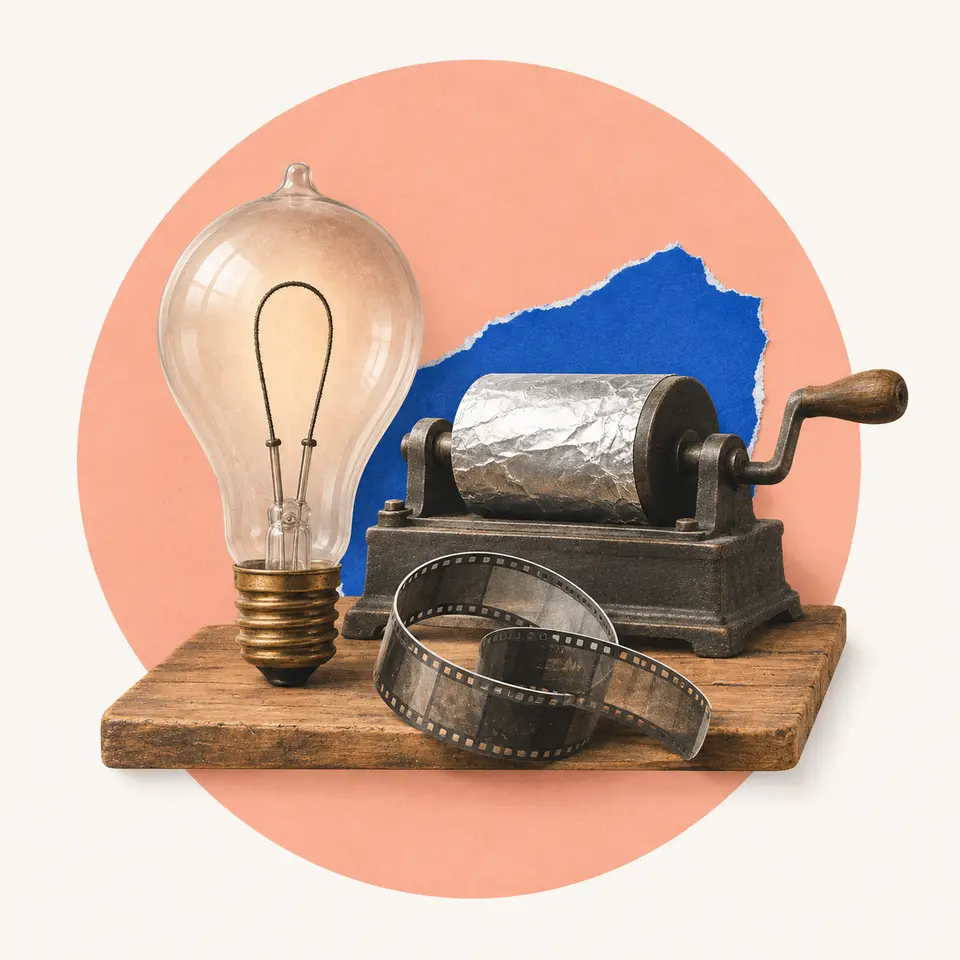
Edison had been trying to play back recorded telegraph messages. In summer 1877, while working on the telephone, he found a way to record sound itself. In his phonograph, a voice shook a thin disk joined to a needle, and the needle pressed a groove into tinfoil wrapped around a turning cylinder.
He unveiled it late in 1877, and people found it almost magical. The press called him the Wizard of Menlo Park. Its inventor was deaf in one ear and barely hearing in the other.
Edison then did little with the phonograph for about a decade. He came back to it only after Bell's associates brought out a rival that recorded on wax-coated cylinders.
Try to recallHow did Edison's work on the telegraph and the telephone lead to the phonograph?
He had been working on ways to play back recorded telegraph messages. In 1877, while improving the telephone for Western Union, he found a way to record sound itself. The phonograph pressed a voice's vibrations into tinfoil on a cylinder and could play them back.
Menlo Park put machinists, materials and equipment in one place so inventions could be made to order. Its first sensation, the phonograph, grew straight out of telegraph and telephone work.
Lessons in this topic
The lab Edison built to invent on demand
See how a former telegraph operator set up a laboratory in 1876 to turn out inventions as a business, and how the phonograph came out of it a year later.
How a light bulb became an electric system
See why Edison's team needed a long-lasting, high-resistance filament, and why they also built generators, wiring, meters and a power station to sell light.
Edison's hits, misses and 1,093 patents
See how Edison's lab moved into movies, why he fought alternating current and lost, and how his biggest bet, on iron ore, failed.
Who really invented Edison's inventions
See what Joseph Swan, Lewis Latimer and Edison's own staff contributed, and what the story of a lone genius leaves out.
Three quick stories from this topic
The nearly deaf inventor
The man who invented the phonograph was deaf in one ear and nearly deaf in the other
Thomas Edison lost most of his hearing as a boy. Historian Paul Israel blames scarlet fever and untreated middle-ear infections. Yet his machine for recording sound, unveiled in 1877, made him world famous.
Picking the music
Edison couldn't read sheet music. Through 1915 he still approved every artist on his company's records himself.
Loud enough for Edison
He tested telephone transmitter designs until he found one loud enough for his own ears.
Latimer's telephone drawings
Lewis Latimer drew the patent drawings for Bell's telephone before he worked for Edison
The son of parents who escaped slavery, Latimer learned drafting as an office boy at a patent law firm. Bell hired him for the telephone drawings in 1876, and he later improved carbon filaments for Edison's rival Hiram Maxim.
Joining Edison
Edison's company hired him in 1884 as a draftsman and an expert witness in its patent cases.
A first book
In 1890 he wrote the first book on electric lighting, Incandescent Electric Lighting.
The zinc electricity meter
Edison's first electricity meters were jars of zinc plates, weighed once a month
Part of each customer's current passed through a zinc solution and moved zinc onto a plate. The plate's gain in weight showed how much electricity had flowed, and the bill was worked out from that.
Part of a system
Edison built generators, underground wires and meters so electric light could be sold as a service.
Pearl Street
His first US power station switched on in lower Manhattan on 4 September 1882.
Sources
- Thomas Edison, Wikipedia
- Biography of Thomas Alva Edison, Thomas A. Edison Papers, Rutgers University
- Edison biography, US National Park Service, Thomas Edison National Historical Park
- John Kruesi, Wikipedia
- Phonograph, Wikipedia
- Lewis Howard Latimer, Wikipedia