Economics & Money · Money & banking
How banks create money when they lend
Follow a new loan onto a bank's books and a borrower's, then see what happens when the money is spent or repaid and what stops banks from creating it without limit.

What you will learn
- Explain how a bank loan can create a matching deposit.
- Tell newly created money apart from newly created net wealth.
- Tell customer deposits apart from central-bank reserves.
- Explain why a bank can't safely lend without limit.
Lesson 1 of 4 · 4 min
Where the money for a bank loan comes from
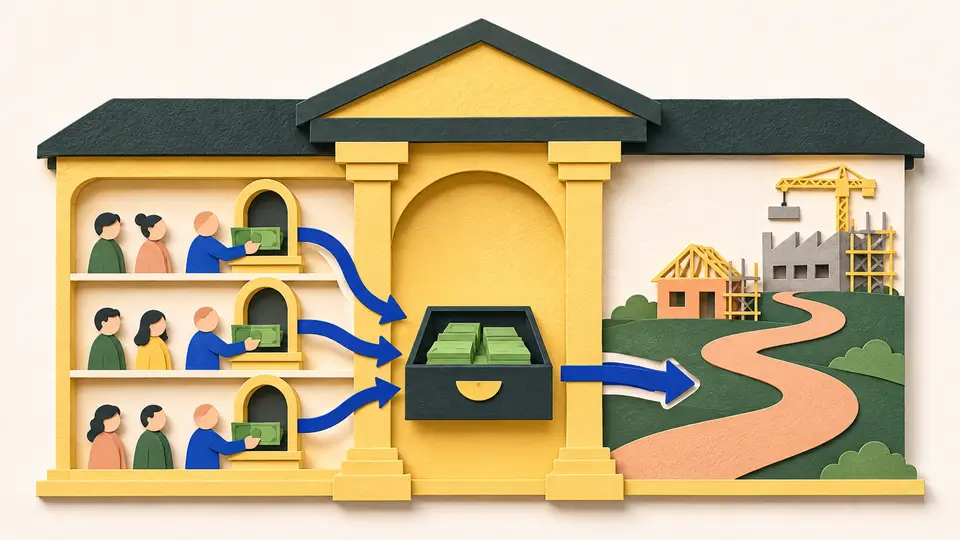
Say a UK bank approves your loan of £1,000. A moment later your balance is £1,000 higher. Nobody delivered banknotes, and no other customer's account went down. So where did the money come from?
The bank wrote it in. When a bank makes a loan, it credits the borrower's account with a new deposit, and the Bank of England says that money didn't exist until that moment. Some economists call it fountain pen money, created at the stroke of a banker's pen.
Look at the bank's books first. The loan is an asset for the bank, because it's a claim on your future repayments. The deposit is a liability, because a deposit is a record of how much the bank owes its customer.
So the bank's books grow on both sides at once, by £1,000 each. "The bank created money" is a fair description of the new deposit. It leaves out the matching loan, and the loan is half of what happened.
On your books, the sides swap. The deposit is your asset and the loan is your debt. At the moment the loan is made, you have £1,000 more in the account and you owe £1,000.
So your net wealth hasn't changed. What's changed is timing. You can spend £1,000 now, and you have to repay it later, with interest on top.
A number in an account counts as money because you can pay with it, by debit card or bank transfer. Money doesn't have to be a physical object.
Most of it isn't. At the end of 2013, bank deposits made up 97% of the money held by UK households and companies. Notes and coins were the other 3%.
These lessons follow the Bank of England's description of the UK system. It doesn't claim that every country or era has worked the same way.
Try to recallA borrower receives a new £1,000 deposit and owes a matching £1,000 loan. Leaving fees and interest aside, why hasn't the borrower's net wealth gone up at that moment?
The borrower has gained a £1,000 asset and an equal debt. Taking the new debt away from the new asset leaves nothing, so there's no immediate increase in net wealth.
Lessons in this topic
Where the money for a bank loan comes from
Follow a £1,000 loan onto the bank's books and onto yours, and see why new money isn't new wealth.
Why a bank can't create money without limit
Follow a newly created deposit to another bank, and see what the lending bank has to hand over and what absorbs its losses.
What happens to money when a loan is repaid
See why repaying a bank loan removes money from the economy, while paying a neighbor only moves it.
Two popular stories about banks that get it backwards
Compare how banks really lend with the savings-first and money-multiplier stories, then see what the central bank's interest rate limits.
Three quick stories from this topic
Loans create new money
When a bank lends you money, it creates that money on the spot
The bank doesn't pass along another customer's savings. It credits your account with a deposit that didn't exist a moment earlier. Economists call this fountain pen money, made at the stroke of a banker's pen.
Two entries at once
The bank records a loan it's owed and a deposit it owes. You gain money to spend and an equal debt, which is why the Bank of England says banks create money, not wealth.
Why it isn't unlimited
Once you spend the deposit at another bank, your bank has to settle in reserves it holds at the central bank. It also needs capital to absorb loans that go bad.
Cash is 3% of UK money
Only about 3% of the UK's money exists as banknotes and coins
A Bank of England explainer last updated in 2019 puts bank deposits at 79% of the money in the UK economy and banks' reserves at the central bank at 18%. Banks created those deposits electronically when they made loans, so most money was never printed.
Three kinds of money
Deposits are the balances households and firms hold at commercial banks, and they're created mostly when banks lend. Reserves are electronic central-bank money that commercial banks hold in accounts at the Bank of England and use to pay one another. Notes and coins are the only physical form of money.
Why the split matters
Because deposits dominate, changes in bank lending move the quantity of money far more than the printing press does. The percentages are a UK snapshot from one explainer at one point in time and can change, and other countries have different shares.
Repayment deletes money
Paying off a credit card bill destroys the money the purchases created
Each card purchase is a small bank loan that puts a new deposit in the shop's account. When you pay the bill, your deposit and the loan shrink together. The Bank of England's word for what happens to that money is deleted.
A transfer is different
Buying from another customer can shift money into that person's account. It doesn't necessarily reduce a bank loan, so it needn't have the same effect on the amount of money.
Watch the wider flows
Banks make new loans while older ones are being repaid. One repayment doesn't determine the whole economy's money stock or predict its inflation rate.