Economics & Money · Money & banking
What stops a bank run
A rush of withdrawals can bring down a bank whether or not the rumor behind it is true, and deposit insurance removes the reason to run, though that protection has costs of its own.
What you will learn
- Explain the maturity mismatch between a bank's loans and its deposits
- Explain why a run can bring down a bank whether or not the rumor behind it is true
- Explain why deposit insurance can stop a bank run before it starts
- Work out how much of a depositor's balances the FDIC limit covers
Lesson 1 of 4 · 5 min
Why a rumor can sink a healthy bank
During the Great Depression, the number of banks halved in three years. Many failed in a bank run, a rush of depositors all trying to withdraw at once. To see how a rush can kill a bank, start with what a bank promises.
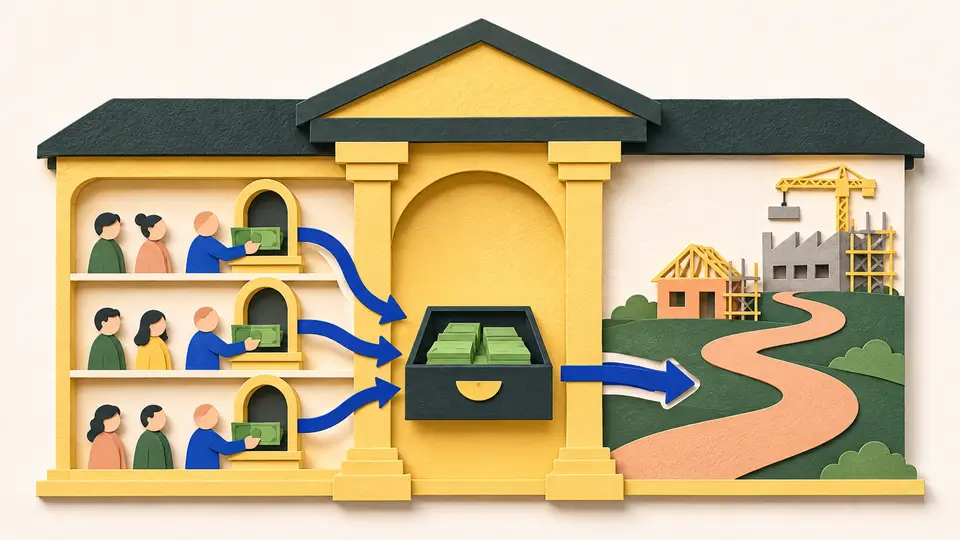
A borrower buying a home needs to know the lender won't suddenly demand the money back. A saver wants money available at any moment for unexpected bills. They want opposite things, and a bank serves both. It owes you your deposit whenever you ask, while its loans come back over years.
Douglas Diamond and Philip Dybvig showed in 1983 why this works. Households don't all need their money at the same time. So a bank can promise every one of them instant access while most of the money sits in long-term loans.
Turning long-term loans into deposits you can spend today is called maturity transformation. The gap in timing is the maturity mismatch, and it's also the weak point. If a large share of depositors ask at once, the bank has to call loans in early or sell assets fast. Assets sold in a hurry fetch less than they're worth.
Diamond and Dybvig also showed how it fails. Say a rumor starts that more savers are about to withdraw than the bank can handle. True or false, it gives you a reason to get your money out first, because the bank may not be able to pay whoever comes last.
The rush forces the bank to recover loans early and dump assets in fire sales, hurried sales at less than the assets are worth. Those losses can make it collapse.
That's what makes a run self-fulfilling. In the model, the bank's loans are sound if they're left to run their course. What fails is confidence. Once it's gone, waiting is the worst choice for each depositor. So a bank that could have paid everyone over time dies because everyone asks at once.
The damage outlasts the run. In the 1930s, fear of more runs led surviving banks to hold assets they could sell quickly and to hold back on new loans. Diamond and Dybvig shared the 2022 Nobel Prize in economics with Ben Bernanke for research on banks and financial crises.
Try to recallA rumor spreads that a bank can't pay all its depositors, though the bank's long-term loans are sound. Explain how the rumor alone can bring the bank down.
Each depositor worries that if others withdraw first, the bank won't have enough left, so each has a reason to withdraw now whether the rumor is true or not. When many do it at once, the bank must call in loans early and sell assets quickly, and fire sales bring in less than the assets are worth. Those losses can make the bank fail, so the rumor makes itself true.
A bank's usefulness and its fragility come from the same promise, instant access to money that's tied up in long loans. So a fix has to work on depositors' fear of being last. Guarantee that they'll be paid whatever others do, and the reason to run is gone.
Lessons in this topic
Why a rumor can sink a healthy bank
A bank promises instant access to money that's tied up in long loans, and that promise is why a rush of withdrawals can destroy it whether or not the rumor behind the rush is true.
How deposit insurance stops a bank run
See how a deposit guarantee removes the reason to run, and work out how much of several US accounts the FDIC covers.
The day Silicon Valley Bank lost $40 billion
Follow the 2023 run on Silicon Valley Bank to see why uninsured depositors moved first and how rising interest rates set it up.
Why letting banks fail is costly, and so is saving them
Weigh the lasting damage done by the bank failures of the 1930s against the risk-taking that a deposit guarantee can invite.
Three quick stories from this topic
More than $250,000 insured
One person can have far more than $250,000 insured at a single US bank
The FDIC's $250,000 limit applies to each ownership category. Your own accounts, your share of a joint account and an IRA are each covered separately at the same bank. Two accounts in your name alone share one limit.
Grouping comes first
All deposits in the same ownership category at the same insured bank are added together before the $250,000 limit applies. The same category at a different insured bank gets its own limit.
What it doesn't cover
The insurance covers deposits only, and only at FDIC-insured banks. Investment products aren't covered, even when an insured bank sells them.
A $40 billion one-day run
Silicon Valley Bank lost more deposits in one day than Washington Mutual lost in 16
On March 9, 2023, depositors pulled over $40 billion from Silicon Valley Bank. Washington Mutual's 2008 run took about $19 billion over 16 days. About 94% of Silicon Valley Bank's deposits were uninsured, so its customers had every reason to get out first.
Why it went so fast
The deposits were largely uninsured and came from a concentrated network of venture capital investors and tech firms, who withdrew in a coordinated way, fueled by social media.
Faster than 2008
Estimates for 2008 put Wachovia's outflows at about $10 billion over 8 days and Washington Mutual's at $19 billion over 16 days.
Insurance that never pays
In theory, deposit insurance that everyone trusts never has to pay out
A bank run starts when depositors fear being last in line. Guarantee their money and nobody needs to rush, so the bank never has to dump its assets at a loss. That reasoning earned Douglas Diamond and Philip Dybvig a share of the 2022 Nobel Prize in economics.
Where the idea comes from
Douglas Diamond and Philip Dybvig showed in 1983 how a rumor can start a self-fulfilling run, and how a government guarantee removes the reason to run. They shared the 2022 Nobel Prize in economics with Ben Bernanke.
The catch
A guarantee can also encourage banks to take risky bets that taxpayers pay for when they fail, which is why it comes with rules on bank capital and borrowing.
Sources
- The Prize in Economic Sciences 2022 - Popular science background - NobelPrize.org, Nobel Prize Outreach
- Understanding Deposit Insurance, Federal Deposit Insurance Corporation
- Review of the Federal Reserve's Supervision and Regulation of Silicon Valley Bank, Board of Governors of the Federal Reserve System