Economics & Money · Money & banking
Central banks and interest rates
A central bank sets the price of borrowing for a whole economy. See how the Fed, the ECB and the Bank of England move rates, why politicians are kept off the lever, and what QE did.
What you will learn
- Explain what a central bank is and who its customers are
- Compare the goals the law gives the Federal Reserve, the European Central Bank and the Bank of England
- Explain what a policy rate is and how a central bank sets it
- Trace how a change in the policy rate reaches loans, spending and prices, and why it takes time
Lesson 1 of 4 · 4 min
The bank where your bank keeps its money
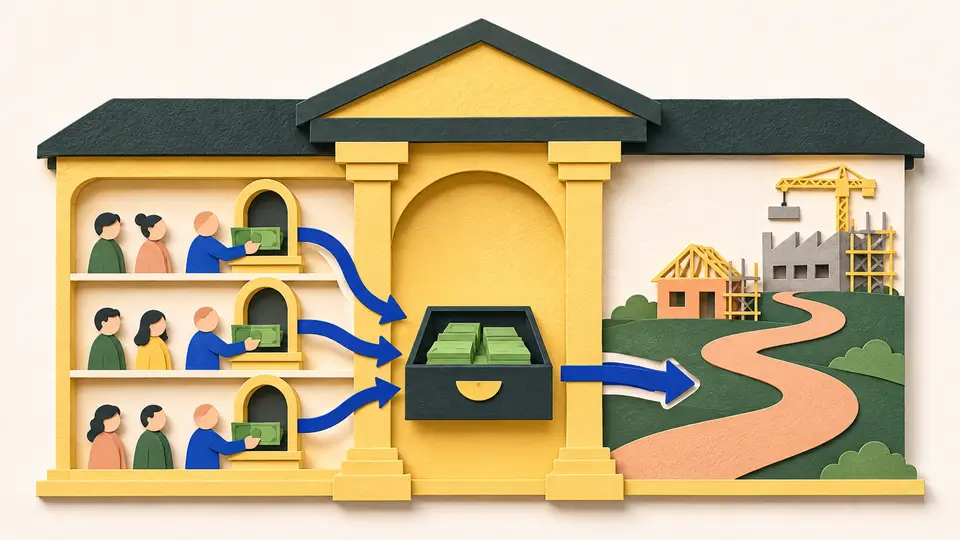
When you pay a friend who uses a different bank, your bank has to pay theirs. Banks settle those payments every day, on a huge scale, through accounts at one special bank. That bank is the central bank.
In the US it's the Federal Reserve, in the euro area the European Central Bank and in Britain the Bank of England. Their customers are mostly commercial banks and the government, not people like you.
The money banks keep there is called reserves. A reserves account does for a bank what a current account does for you. When one bank pays another, the central bank moves reserves from one account to the other.
The central bank is also the government's bank. The Federal Reserve Banks keep the US Treasury's account and lend to banks that run short of cash. Central banks issue banknotes too.
Lawmakers or governments write each central bank's goals. They differ more than you might expect.
Congress gave the Fed two goals, which it calls the dual mandate. One is stable prices. The other is maximum employment, the most jobs the economy can sustain without inflation picking up.
The ECB has a single main goal, price stability, which it defines as 2% inflation over the medium term. It counts inflation below 2% as just as bad as inflation above it.
The Bank of England also aims for 2% inflation, but the government sets that target. The Bank supports the government's growth aims only once inflation is taken care of. So when the two clash, the Fed must weigh jobs against prices, while the other two put prices first.
Try to recallHow do the goals the law gives the Federal Reserve differ from those of the European Central Bank?
The Fed has a dual mandate from Congress, maximum employment and stable prices, so it has to weigh jobs against inflation. The ECB has one main goal, price stability, defined as 2% inflation over the medium term. It treats inflation below that as just as bad as inflation above it.
A central bank is the bank for banks and for the government, and it alone creates reserves. The Fed answers for jobs and prices, while the ECB and the Bank of England put stable prices first.
Lessons in this topic
The bank where your bank keeps its money
Find out who a central bank's customers are, what power sets it apart, and how the goals lawmakers give it differ between the US, the euro area and Britain.
How one interest rate reaches your mortgage
See what the policy rate is, who sets it, and how a change works its way through bank loans and spending to prices over a year or two.
Why politicians don't get to set interest rates
See why rate-setting was handed to appointed officials, using the inflation of the 1970s and Paul Volcker's harsh cure as the case.
What central banks did when rates hit zero
Learn how quantitative easing pushes down long-term interest rates when the policy rate can't go lower, and what economists still argue about it.
Three quick stories from this topic
£895 billion of new money
The Bank of England bought £895 billion of bonds with money it created itself
From March 2009, the Bank paid for bonds with newly created central bank reserves, not taxes or borrowing. Its rate couldn't go lower, so buying bonds was a second way to cut borrowing costs.
How it lowers rates
Heavy buying pushes bond prices up. Each bond's fixed payment is then a smaller return, and mortgage rates follow those yields down.
Now in reverse
Since February 2022 the Bank has been shrinking its bond holdings, a process called quantitative tightening.
Tractors at the Fed
Indebted farmers once drove tractors into Washington to blockade the Federal Reserve
In the early 1980s Paul Volcker's Fed pushed its key rate to 20% to break inflation. Farmers drowning in costly debt blockaded its building, and homebuilders mailed it pieces of lumber.
The cure
US inflation had peaked at 14.8% in March 1980. By 1983 it was below 3%.
The cost
The high rates helped cause the 1980 to 1982 recession, and unemployment rose above 10%.
The two-year wait
A change in UK interest rates takes around two years to have its full effect
The Bank of England puts the delay at 18 to 24 months. A rate change has to pass through bank loans and household spending before it reaches prices in the shops.
Why the delay
Higher rates raise loan and mortgage payments, people spend less, and only then do businesses find it harder to raise prices.
Steering by forecast
Because of the lag, the Bank's rate-setters have to judge what inflation will be in the next few years, not what it is today.
Sources
- The Fed Explained: Who We Are, Board of Governors of the Federal Reserve System
- Money in the modern economy: an introduction, Bank of England Quarterly Bulletin, 2014 Q1
- Central bank, Wikipedia
- Transmission mechanism of monetary policy, European Central Bank
- The Fed Explained: Monetary Policy, Board of Governors of the Federal Reserve System
- Monetary policy, Bank of England
- Monetary policy, European Central Bank
- Quantitative easing, Bank of England
- Paul Volcker, Wikipedia
- Interest rates and Bank Rate: our latest decision, Bank of England