Economics & Money · Taxes, public spending & inequality
Who bears the cost of a tax?
See why the person who sends a tax to the government often isn't the one who bears it, and how buyers' and sellers' room to adjust decides who does.
What you will learn
- Tell statutory payment responsibility apart from economic tax incidence.
- Calculate the buyer and seller shares of a simple tax wedge.
- Explain elasticity as how strongly quantity responds to price.
- Predict which side tends to bear more of the burden when one side is less responsive.
Lesson 1 of 4 · 4 min
Why the one who pays a tax may not bear its cost
Look at a US pay stub and you'll find 6.2% of wages taken for Social Security. The employer pays a matching 6.2% that never shows on the stub. On paper, the tax is split evenly.
Economists usually assume the worker ends up paying both halves, because employers pass their half on as lower wages. How much gets passed on is still debated, but the law's even split doesn't settle it.
A shop is in the same position when it sends the government a tax on each sale. If the tax pushes the price up, part of that money came from the customer. Tax incidence asks who bears a tax once prices have adjusted.
Here's the mechanism in a made-up example. Say an item sells for 10. Then a tax of 2 per unit comes in, and the shop has to send it to the government.
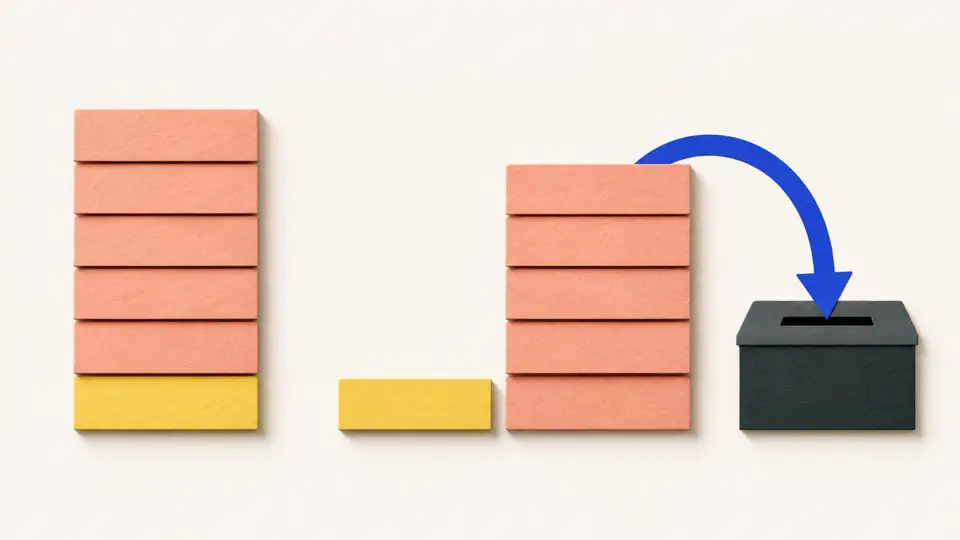
If the shop added the full 2 to the price, some customers would stop buying. So the price settles in between. Say buyers now pay 11.50. The shop passes on 2 and keeps 9.50.
Compare both with the old price of 10. Buyers pay 1.50 more and the shop keeps 0.50 less, which together make the 2 of tax. Another market could split the same tax very differently.
So there are two questions. The first is who has the legal duty to hand the tax over. Here that's the shop, and the law answers it.
The second is who ends up worse off. Here it's mostly the buyers and partly the shop. The law is silent on that, and prices decide it.
Economists call the gap between the two prices a wedge. Buyers pay 11.50, sellers keep 9.50, and the wedge is the 2 of tax.
To find each side's share, compare its price with the price before the tax. The buyers' share is how far their price rose. The sellers' share is how far theirs fell.
There's one trap. The shop's payment of 2 and the customer's extra 1.50 aren't separate costs. The 1.50 is part of the 2.
Try to recallAn item cost 20 before a 3-unit tax. After prices adjust, buyers pay 22 and sellers keep 19 after tax. How much of the per-unit burden falls on each side?
Buyers pay 22 - 20 = 2 more. Sellers keep 20 - 19 = 1 less. The buyers' 2-unit burden and the sellers' 1-unit burden add up to the 3-unit tax.
Lessons in this topic
Why the one who pays a tax may not bear its cost
See how a tax can change prices, and work out how much of it falls on buyers and how much on sellers.
Why a tax lands on the side that can't walk away
See how elasticity, the strength of buyers' and sellers' response to price, decides which side bears more of a tax.
Why a tax raises less than the simple math says
Work out a tax's revenue from what's still sold after people respond, and see why a shrinking tax take can mean the tax is working.
A tax can raise money or change behavior, rarely both
Use elasticity to predict whether a tax will mostly raise revenue or mostly cut the taxed activity, and to estimate how big the response will be.
Three quick stories from this topic
Who pays the employer's half
Economists usually assume US workers pay their employer's half of Social Security tax too
The law splits the 12.4% tax evenly, 6.2% from the worker and 6.2% from the employer. Employers can pass their half on by paying lower wages than they otherwise would. How much they do is still debated.
Who sends it and who bears it
The law decides who sends a tax to the government. Prices and wages decide who ends up worse off, and the two can differ.
The side that can't adjust
In the standard model, the side of a market that responds less to a price change bears more of a tax.
Hotels that can't move
A tax on beachfront hotel rooms lands mostly on the owners, because a hotel can't move
Vacationers can pick another town, so a tax can't push room prices up much. The hotel stays on its beach and accepts a lower price. Cigarette taxes work the other way, because smokers are the ones who find it hard to walk away.
The side that can't adjust pays
A tax drives a wedge between what buyers pay and what sellers keep. Whoever responds less to the price change carries more of that wedge. Hotels that can't move keep operating at lower net prices. If supply were elastic, owners could take their businesses elsewhere, and the tax would show up as a lower quantity sold instead.
The mirror image of cigarettes
The same rule explains why cigarette taxes fall mainly on smokers, whose demand is inelastic. The relative elasticity of supply and demand decides whether a tax hits an industry or its customers, whoever writes the check.
The tax built to shrink
Britain's sugar tax was designed to raise less money the better it worked
The 2016 Budget expected £520 million in the first year. Drink makers then cut sugar in the drinks it covers by 46% on average, and in the year to March 2025 the levy brought in £327 million. By 2024, 89% of UK soft drinks paid nothing.
Revenue follows what's still sold
A tax's revenue is the rate times the quantity sold after the tax. When producers change the product to escape it, the taxed quantity shrinks.
Less money, more success
The levy's main aim was lower sugar, so falling revenue showed it working. Cigarette taxes keep raising money because smokers' demand barely responds to price.
Sources
- 5.3 Elasticity and Pricing - Principles of Economics 3e | OpenStax, OpenStax, Rice University
- Topic no. 751, Social Security and Medicare withholding rates, Internal Revenue Service
- Who Pays the Employer Share of the Payroll Tax?, Center for Retirement Research at Boston College
- Tax incidence, Wikimedia Foundation
- Budget 2016, HM Treasury
- Soft Drinks Industry Levy statistics commentary 2026, HM Revenue & Customs
- HMT-HMRC Soft Drinks Industry Levy Review, HM Treasury and HM Revenue & Customs
- Sugar tax, Institute for Government