Economics & Money · Taxes, public spending & inequality
How a progressive tax works
Tax brackets charge each layer of income its own rate, and credits, payroll taxes and sales taxes shift who pays what.
What you will learn
- Calculate federal income tax by applying each bracket's rate to its own layer of taxable income
- Explain how the standard deduction reduces the income that the tax brackets apply to
- Calculate the extra tax on a raise that crosses into a higher tax bracket
- Distinguish a marginal tax rate from an average tax rate and say what each one measures
Lesson 1 of 4 · 5 min
Tax brackets charge income in layers
Say you're single and your taxable income for 2026 is $60,000. Your top dollars fall in the 22% bracket, but you don't owe 22% of all $60,000. The US federal income tax charges your income in layers, each at its own rate.
That's what makes it a progressive tax, one whose rate rises as the amount being taxed rises. The idea is as old as the modern income tax. Britain's first, introduced in 1798 to pay for a war with France, began below 1% on small incomes and reached 10% on incomes over £200.
In the IRS's words, you pay tax as a percentage of your income "in layers called tax brackets." For a single filer in 2026, the first $12,400 of taxable income is taxed at 10%. The layer above that, up to $50,400, is taxed at 12%, and the next one, up to $105,700, at 22%.
Four more layers follow, ending with 37% on taxable income over $640,600. Married couples filing jointly get the same rates with wider layers.
Now work out your $60,000. The first $12,400 is taxed at 10%, which comes to $1,240. The next $38,000, from $12,400 up to $50,400, is taxed at 12%, adding $4,560. Only the last $9,600 lands in the 22% layer, adding $2,112. Your federal income tax is $1,240 plus $4,560 plus $2,112, or $7,912.
One step comes before the brackets. They don't apply to everything you earn, only to your taxable income, which is what's left after deductions. A deduction is an amount you subtract from your income so you don't pay tax on it.
Most people take the standard deduction, a set amount that depends on filing status. For 2026 it's $16,100 for single filers, $32,200 for married couples filing jointly and $24,150 for heads of household. If your deductible expenses and losses add up to more than the standard deduction, you can subtract them one by one instead. That's called itemizing. Either way, the deduction comes off your income before any bracket rate is applied.
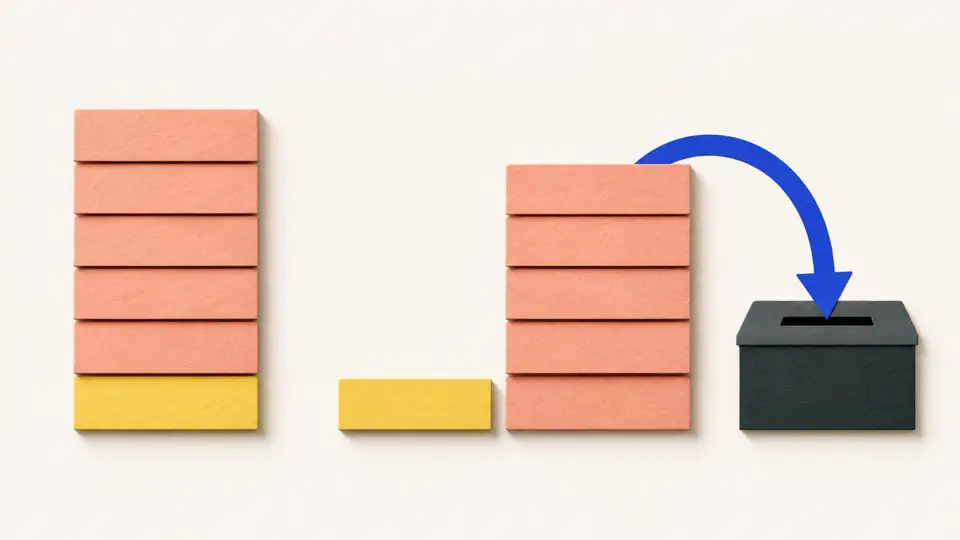
Picture a single filer with $76,100 of income in 2026 who takes the standard deduction. Subtracting $16,100 leaves $60,000 of taxable income, and that's the figure the brackets turn into a tax bill of $7,912. The $16,100 covered by the deduction owes no federal income tax. In effect it works like one more layer at the bottom, taxed at 0%.
Try to recallA single filer with $50,000 of income in 2026 takes the $16,100 standard deduction. Explain what the deduction does and how much income the tax brackets then apply to.
A deduction is subtracted from income before the tax is worked out, so no tax is paid on that amount. Subtracting $16,100 from $50,000 leaves $33,900 of taxable income, and the brackets apply only to that. The first $12,400 of it is taxed at 10% and the rest at 12%, while the $16,100 covered by the deduction owes no income tax.
So a federal income tax bill takes two steps. Subtract the deduction to get taxable income, then tax each layer of it at its own rate. A bracket's rate never reaches the dollars below it.
The dollar figures move every year. The IRS adjusts more than 60 tax provisions for inflation, including the brackets and the standard deduction. The 2026 figures generally apply to returns filed in 2027.
Lessons in this topic
Tax brackets charge income in layers
Work out a federal income tax bill layer by layer, and see how the standard deduction shrinks the income that's taxed.
Why a raise into a higher bracket still pays
Only the part of a raise that crosses into a higher bracket pays the higher rate, and your average tax rate stays below your top rate.
Why a $1,000 credit beats a $1,000 deduction
Compare what equal deductions and credits save, and see how a refundable credit can give back more than you paid in tax.
Taxes that take a bigger share from smaller incomes
A cap on Social Security tax and a flat-rate sales tax both take a smaller share of income as income rises.
Three quick stories from this topic
A 24% bracket, a 17% bill
In 2026 a single US filer just inside the 24% tax bracket owes about 17% of taxable income
The 24% applies only to dollars above $105,700. Everything below that line is taxed in layers at 10%, 12% and 22%, and those cheaper layers pull the overall share down. A higher bracket's rate never reaches back to the income beneath it.
What the raise costs in tax
The first $5,700 of the $10,000 raise stays in the 22% bracket and adds $1,254 of tax. The last $4,300 is taxed at 24% and adds $1,032. The raise costs $2,286 in federal income tax, and the filer keeps $7,714 of it.
Why the average rate stays lower
Each layer of income keeps its own rate, so this filer's share of income paid in tax stays well below the top rate. On $110,000 of taxable income, the filer owes $18,998, about 17.3%, though the top layer is taxed at 24%.
The first modern income tax
The first modern income tax was brought in to pay for a war, and its top rate was 10%
William Pitt the Younger introduced it in Britain's budget of December 1798, to buy weapons for the war with revolutionary France. It began below 1% on incomes over £60 and reached 10% on incomes over £200. It was abolished in 1802.
A graduated tax from the start
Pitt's tax was graduated, or progressive. It began at 2 old pence in the pound, one 120th of income or about 0.83%, on annual incomes over £60, and rose to a maximum of 2 shillings, or 10%, on incomes over £200.
It raised less than hoped
Pitt hoped the tax would raise £10 million, but receipts for 1799 totaled just over £6 million. It was levied from 1799 to 1802, when Henry Addington abolished it during the Peace of Amiens.
The Social Security wage cap
A US worker paid $1 million in 2026 owes the same Social Security tax as one paid $184,500
The 6.2% tax stops at a wage cap, set at $184,500 for 2026, so both pay $11,439. That's 6.2% of the smaller salary and about 1.1% of the larger one. Medicare tax has no cap and applies to every dollar of wages.
How the two taxes split
Social Security tax is 6.2% for the employee and 6.2% for the employer, 12.4% in total. Medicare tax is 1.45% each, 2.9% in total. The extra 0.9% Additional Medicare tax has no employer match.
A smaller share at the top
Because of the cap, an employee's Social Security tax on 2026 wages tops out at $11,439, which is 6.2% of $184,500. For someone earning $369,000, that's 3.1% of wages.
Sources
- Federal income tax rates and brackets, Internal Revenue Service
- IRS releases tax inflation adjustments for tax year 2026, including amendments from the One, Big, Beautiful Bill, Internal Revenue Service
- Progressive tax, Wikimedia Foundation
- Credits and deductions for individuals, Internal Revenue Service
- Topic no. 751, Social Security and Medicare withholding rates, Internal Revenue Service