Economics & Money · Markets, prices & incentives
Scarcity and opportunity cost
Every choice uses up time, money or materials that could have gone elsewhere. Learn to name what a choice really costs, and why economists count the option you gave up.
What you will learn
- Explain why scarcity means every choice gives up something else
- Work out a choice's opportunity cost as the value of the best alternative given up
- Explain how a decision at the margin weighs the extra benefit of one more unit against its extra cost
- Use marginal utility to explain why water costs less than diamonds
Lesson 1 of 4 · 4 min
What a choice really costs you
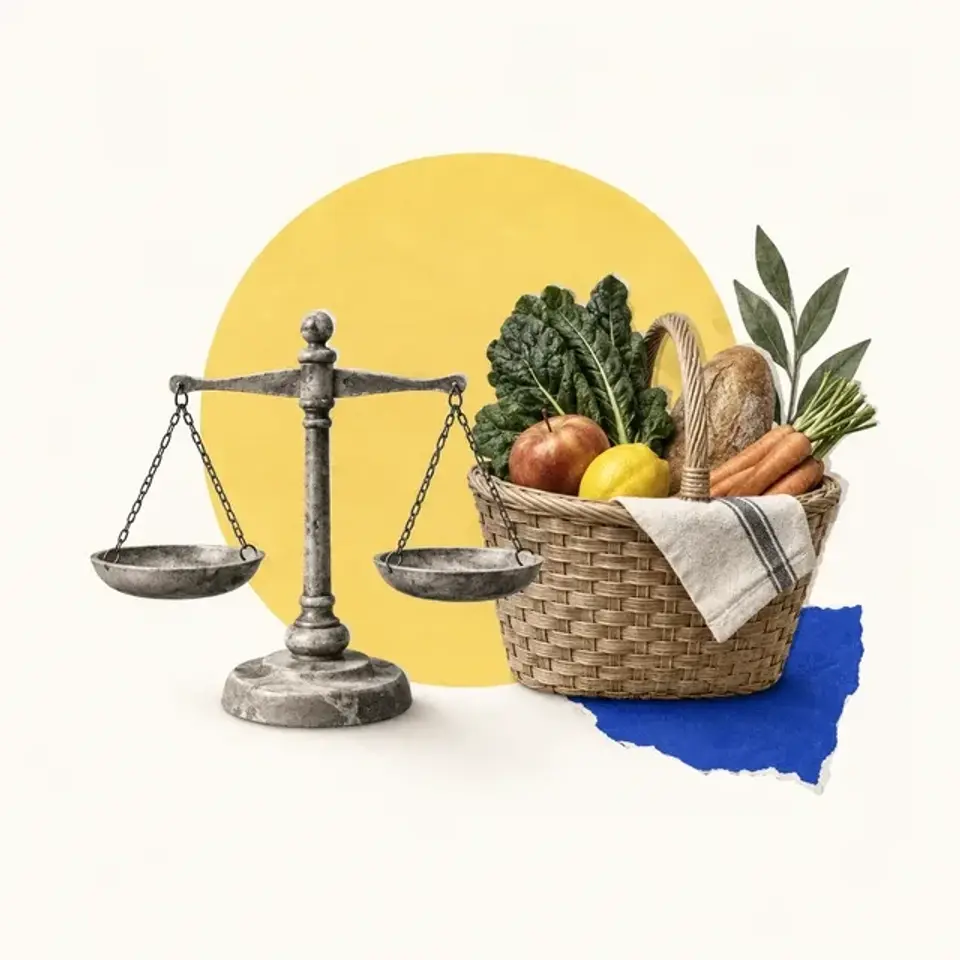
Say you have one free evening and two things you'd like to do with it. You can't do both, so picking one means losing the other. Economists call this scarcity. It isn't the same as rare. Your evening is scarce because you want more from it than it can give.
Lionel Robbins built a famous definition of economics on this. It studies how people match their ends with scarce means that have alternative uses. A resource with only one possible use would never force a choice.
Take Alphonso, a student in a textbook example. He has $10 a week for burgers at $2 and bus tickets at 50 cents. Each burger he buys means four bus tickets he can't. So the burger's real cost is four bus tickets, and the $2 is a way of counting them.
The opportunity cost of a choice is the value of the best alternative you give up. Austrian economist Friedrich von Wieser coined the term in 1914. Take a night at the movies. You pay for the ticket, and you also lose the evening you'd have spent reading. The cost is the money plus the book.
Only the next best option counts. You might have read, gone running or slept. You'd still lose just one of them, the one you'd have picked, because the evening could only go one way.
A free ticket shows the method. Say you win a free ticket to an Eric Clapton concert that you can't resell. Bob Dylan plays the same night. His tickets cost $40, and you'd pay up to $50 to see him. Going to Clapton loses $50 of enjoyment but keeps your $40. So the opportunity cost is $10.
Try to recallA friend gives you a free ticket to a game, and you can't resell it. Your next best plan that night is a $30 comedy show you'd happily pay $45 for. What does the free game really cost you, and why?
It costs $15. Going to the game loses the $45 of enjoyment the comedy show would have given. You also keep the $30 you'd have paid for it, so you give up $45 minus $30.
Scarcity means every use of your time or money pushes out another use. You can now price a choice by the best option it pushes out, net of anything you'd have paid for that option.
Lessons in this topic
What a choice really costs you
Scarcity means every choice pushes something else out. Learn to price a choice by the best option you passed over, which is often more than the money you paid.
Why water is cheap and diamonds are dear
Most choices are about a little more or a little less. See how thinking about the next unit decides what you buy, and how it solves an old puzzle about prices.
The curve that maps an economy's trade-offs
The production possibility frontier shows every best mix an economy can make with what it has. Read it for trade-offs and waste, and see what moves it.
The costs no invoice shows
A founder's lost salary and a student's lost wages never appear on a bill. Learn to count them, and see why people so often forget to.
Three quick stories from this topic
The security line cost
Waiting at airport security may cost more than putting a marshal on every flight
A textbook estimate values 30 extra minutes per trip for 800 million US air passengers at $20 an hour, as much as $8 billion a year. A sky marshal on every flight would cost roughly $3 billion.
Time is a cost
Waiting never shows up on a bill, but those hours could have gone to work or rest. That's an opportunity cost.
A rough number
The 30 minutes and $20 an hour are the textbook's own conservative assumptions, not a measured total. The point is how large a cost can be without any spending.
Economists' opportunity cost quiz
Only 21.6% of economists surveyed got a textbook opportunity cost question right
At a 2005 economics meeting, 199 PhD economists and students were asked what a free Eric Clapton ticket costs when Bob Dylan plays the same night. The right answer, $10, was the least popular of four.
The answer
You'd pay up to $50 to see Dylan, and his tickets cost $40. Skipping Dylan loses $50 of enjoyment but saves $40, so you give up $10.
A disputed verdict
Paul Ferraro and Laura Taylor called the result dismal. In 2012 Joel Potter and Shane Sanders replied that, under other ways of counting, every answer could be defended.
Water and diamonds
Adam Smith saw that water is more useful than diamonds yet buys almost nothing
In The Wealth of Nations he wrote that nothing is more useful than water, while a diamond has scarcely any use yet trades for a great quantity of other goods. Later economists solved it by pricing the next unit.
The marginal answer
Water is so plentiful that one more glass serves a minor use. Diamonds are scarce, so one more still meets a want people pay for.
When it flips
A traveler dying of thirst in a desert would pay more for water than for diamonds, because for him the next drink is priceless.
Sources
- Scarcity, Wikipedia
- How Individuals Make Choices Based on Their Budget Constraint, OpenStax, Rice University
- 3.4 The feasible set, CORE Econ, The Economy 2.0: Microeconomics
- Opportunity cost, Wikipedia
- Opportunity Cost, Econlib, The Concise Encyclopedia of Economics
- Friedrich von Wieser, Wikipedia
- Do Economists Recognize an Opportunity Cost When They See One? A Dismal Performance from the Dismal Science, The B.E. Journal of Economic Analysis & Policy, via RePEc
- Do Economists Recognize an Opportunity Cost When They See One? A Dismal Performance or an Arbitrary Concept?, Southern Economic Journal, via RePEc
- Paradox of value, Wikipedia