Economics & Money · Markets, prices & incentives
Externalities, the costs and benefits prices miss
A market makes too much of what harms bystanders and too little of what helps them, and a corrective tax or a private bargain can put the missing cost back into the decision.
What you will learn
- Distinguish the private cost of producing something from its social cost
- Explain why a market with an external cost produces more than the efficient amount
- Explain why an activity whose benefits spill over to others tends to be underproduced
- Describe how patents and subsidies try to return spillover benefits to the producer
Lesson 1 of 4 · 5 min
Why a factory's smoke never shows up in its prices
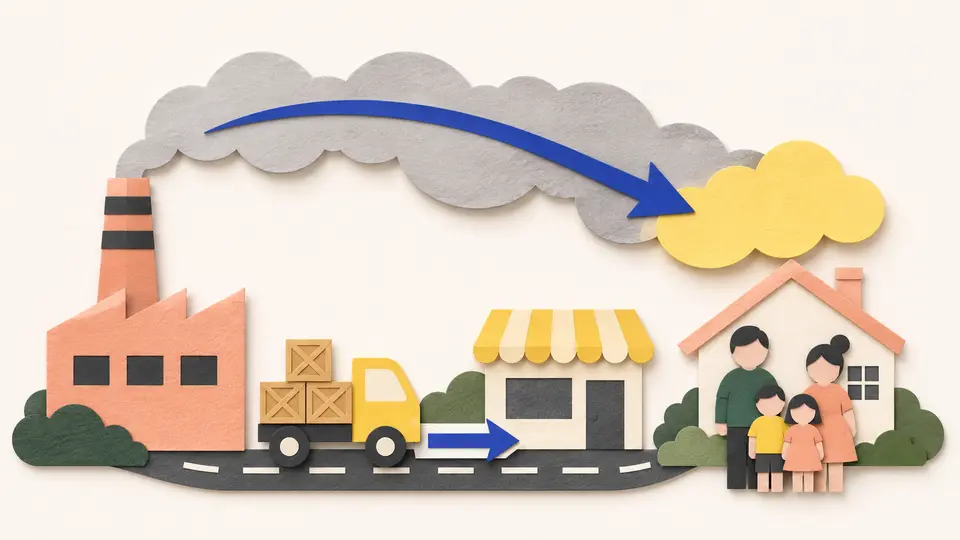
Picture a factory with a smokestack. Its owners pay for materials, wages, energy and machines, and they decide how much to make by comparing those bills with what buyers will pay. The smoke isn't on any bill.
Someone still pays for it. A family living near the stack puts up with dirtier air. People downwind run up higher health care costs. A local tourist trade can lose business.
Economists call a side effect like this an externality, an effect on people outside the deal that the product's price doesn't take into account. What the factory pays is the private cost. Add the harm to everyone else and you get the social cost, the full cost to society of making the good.
With pollution, the social cost is bigger than the private cost. The factory never pays for the harm, so it never passes that cost on to its customers, and the product sells for less than it really costs to make. Most side effects of buying and selling are too small to matter. The large ones are among the main reasons governments step into the economy.
Why does that gap lead to too much output? The factory keeps producing as long as buyers will pay more than it costs the factory to make one more ton. Buyers compare the price with what the product is worth to them. Nobody in that exchange weighs the harm downwind.
Put numbers on it. The factory's own cost is $40 a ton, each ton does $15 of harm, and a buyer values one more ton at $45. The factory happily sells it, because $45 covers its $40. But society as a whole pays $55 for a ton that's worth $45 to the person who bought it. Making that ton leaves everyone together $10 worse off.
That's the general result. Goods with negative externalities are overproduced when decisions count only private costs. Economists call it a market failure, because every buyer and seller can act sensibly and the result is still wasteful for society as a whole.
Try to recallA factory's own cost is $40 a ton and each ton causes $15 of harm to people nearby. A buyer offers $45 for one more ton. Explain whether the sale happens and whether society gains from it.
The sale happens, because $45 covers the factory's own $40 cost and the harm to its neighbors isn't part of the factory's decision. Society loses from it. The full social cost of the ton is $55, the $40 private cost plus $15 of harm, and the buyer values it at only $45, so producing it leaves everyone together $10 worse off. That's how an external cost leads a market to produce more than the efficient amount.
So a price tells you what a thing cost its maker, which can be less than what it cost everyone. When part of the cost lands on people outside the sale, expect too much of the thing to be made.
Benefits can spill over too, onto people who don't pay for them. Then the market makes too little.
Lessons in this topic
Why a factory's smoke never shows up in its prices
Separate a product's cost to its maker from its cost to everyone, and see why the gap means too much gets made.
Why markets pay for too little research
Research that helps outsiders gets too little investment, since the firm doing it can't collect from them, and patents and subsidies try to close that gap.
How a tax can put pollution on the polluter's bill
Calculate the tax that makes a polluter face the full cost of its output, and see why setting it is hard.
Why bargaining fixes a noisy neighbor but not smog
Use the Coase theorem to predict what happens when neighbors can bargain over a harm, and see why the answer breaks down for air pollution.
Three quick stories from this topic
The doctor and the candy maker
An 1879 lawsuit over a candy maker's noise fed into a Nobel-winning economic theory
The candy maker had pounded ingredients in two large mortars for over 20 years when the doctor next door built a consulting room against the wall and sued. By Ronald Coase's logic, if the two could bargain cheaply, the court's ruling would only decide who paid whom.
Why the ruling matters less
If quiet is worth more to the doctor than pounding is to the candy maker, the noise stops under either ruling. One of them pays the other, and the law decides which.
Where it breaks down
A smokestack has thousands of victims and nobody owns the air. Coase himself argued that real bargaining costs are rarely low enough for the neat result.
The tax nobody can price
The inventor of the pollution tax conceded we seldom know enough to use it well
Arthur Pigou proposed in 1920 that a polluter pay a tax equal to the harm it causes other people, so the firm faces the same cost society does. He also conceded that we seldom know enough to decide where, and how far, the state should step in.
Where the idea came from
Arthur Pigou set it out in The Economics of Welfare in 1920. He suggested taxing polluters the cost of the harm to others, and subsidizing activities that benefit others by the amount they benefit.
The hard part is the number
Pigou conceded that we seldom know enough to say how far the state should interfere, and William Baumol argued that measuring social cost is almost impossible.
The cotton gin's poor inventor
Eli Whitney's cotton gin company went out of business four years after he invented the gin
He built it in 1793 and patented it in 1794, but planters made their own versions with small changes and lawsuits ate the profits. The company closed in 1797. An invention's benefits spill onto people who never pay the inventor, so markets tend to fund too little research.
A private return below the social return
A firm weighs only what it can collect. A project worth doing for society can fail the firm's own test, so less research gets done than would be best.
Two fixes
A patent lets an inventor charge others for using an idea. A subsidy leaves the idea free and pays the producer for part of the benefit that goes to others.
Sources
- Externalities: Prices Do Not Capture All Costs, International Monetary Fund
- Sturges v Bridgman, Wikimedia Foundation
- Coase theorem, Wikimedia Foundation
- Pigouvian tax, Wikimedia Foundation
- Eli Whitney, Wikimedia Foundation
- 13.1 Investments in Innovation - Principles of Economics 3e, OpenStax, Rice University