Economics & Money · Personal finance
How insurance pools risk
Insurance turns a large, uncertain loss into a small, certain premium, though an insured patient still pays part of the bill and hidden risk can unravel a pool.
What you will learn
- Explain how an insurance pool pays the large losses of a few members from the premiums of many
- Calculate the expected claims per member that a pool's premiums have to cover
- Calculate what a patient pays for covered care under a deductible and coinsurance
- Explain how an out-of-pocket maximum caps what a patient pays for covered care in a year
Lesson 1 of 4 · 5 min
How insurance turns a huge risk into a small bill
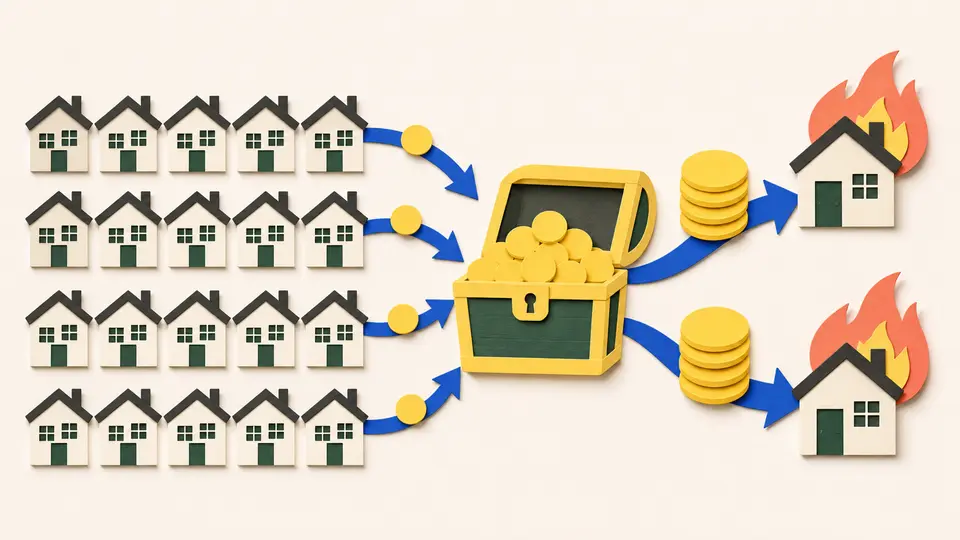
Nobody can tell you whether your house will burn down this year. An insurer can't either. But across a large group of similar homes, the number of fires in a year is much easier to predict. Insurance is built on that difference.
You pay the insurer a fee called a premium, a small loss you know about in advance. In return the insurer promises to pay if a covered loss happens. So you swap a large, uncertain loss for a small, certain one. The fire may never come, and the premium is owed either way.
The insurer can keep its promise because it collects premiums from many people and pays the losses of the few. The arrangement is called a risk pool. It rests on the law of large numbers, under which predicted losses come close to actual ones in a large group.
Insurance doesn't make a fire any less likely. It moves the cost of one from the household to the pool.
Setting a premium starts with arithmetic. Say 1,000 homeowners each face a 1% chance each year of a $20,000 loss. On average 10 of them will have that loss, so the pool expects to pay out $200,000 a year. Spread across 1,000 members, that's $200 each.
You get the same figure by multiplying the chance of a loss by its size, since 1% of $20,000 is $200. That $200 is each member's expected claims.
A premium of exactly $200 wouldn't be enough. It also has to cover the cost of issuing policies and handling claims, the capital that makes sure claims can be paid, and some profit. What the insurer earns by investing premiums before it pays claims offsets part of that.
And the pool won't see exactly 10 losses every year. Some years bring more, and the capital is there to pay claims when they do.
Members don't all pay the same, either. Setting prices for each kind of risk is called ratemaking, and it uses statistics and probability to estimate future claims. At its simplest, a type of policy with twice the losses is charged twice as much.
Try to recallSay 5,000 drivers each have a 2% yearly chance of a $6,000 claim. Find the expected claims per driver and for the pool, and say why premiums would exceed them.
Each driver's expected claims are 2% of $6,000, which is $120 a year. Across 5,000 drivers that's $600,000, the same as 100 claims of $6,000 each. Premiums would be higher than $120, because they also pay for issuing and running the policies, handling claims, capital to pay claims in a bad year and profit. Anything the insurer earns by investing the premiums offsets part of that.
So a premium is your share of the pool's expected claims, plus the cost of running the pool and keeping it able to pay. Many policies also leave the first part of a loss with you, an amount called a deductible. In US health insurance, the deductible is only the start of what an insured patient still pays.
Lessons in this topic
How insurance turns a huge risk into a small bill
See how premiums from many members pay the losses of a few, and why each premium has to cover more than the member's expected claims.
What you still pay with health insurance
Work out a patient's share of a medical bill under a deductible and coinsurance, and see where the yearly cap stops it.
Where a premium dollar goes
Calculate a health insurer's medical loss ratio, and see why some risks are much harder to insure than others.
When customers know more than the insurer
Hidden risk can drive low-risk customers out of an insurance pool, and a menu of deductibles helps an insurer sort them.
Three quick stories from this topic
Deductibles sort customers
A menu of deductibles gets insurance customers to reveal how risky they are
Someone who expects few claims picks the cheap premium with the high deductible. Someone who expects many pays more for a low one. Their choices sort them into risk groups the insurer couldn't see, a method economists call screening.
The hidden-information problem
Customers know more about their own risk than the insurer does. At one price for everyone, a policy is a better deal for high-risk buyers, and low-risk buyers drift away.
Who worked it out
Michael Rothschild and Joseph Stiglitz showed how a menu of contracts sorts customers. Stiglitz shared the 2001 Nobel Prize in economics for work on markets with unequal information.
The Great Fire and fire insurance
London's Great Fire of 1666 burned over 13,000 houses and gave rise to fire insurance
The fire turned insurance from a convenience into an urgent need. In 1681 the economist Nicholas Barbon and eleven associates opened the first fire insurance company, the Insurance Office for Houses. It started by insuring 5,000 homes.
From convenience to urgency
The fire turned insurance from a matter of convenience into one of urgency. Christopher Wren's new plan for London in 1667 included a site for an insurance office, and several fire insurance schemes were tried and came to nothing before Barbon's.
Five thousand homes to start
Barbon's office, at the back of the Royal Exchange, insured brick and frame homes, starting with 5,000 of them. Around the same time, the first insurance schemes for underwriting business ventures became available.
The 80/20 rebate rule
US health insurers generally owe customers a rebate if under 80% of premiums goes to care
It's called the 80/20 rule. Insurers have to spend at least 80% of premium money on medical care and quality improvement, or 85% for large employer plans. The rest can go to administration, marketing and profit.
The medical loss ratio
The share of premiums spent on claims and quality improvement is called the medical loss ratio. An insurer that spends 80 cents of each premium dollar that way has a ratio of 80%.
How the rebate arrives
An insurer that misses its target for the year has to notify customers by August 1. The rebate can come as a check, a deposit or a reduction in future premiums.
Sources
- Insurance, Wikimedia Foundation
- Deductible - Glossary, HealthCare.gov, U.S. Centers for Medicare & Medicaid Services
- The 2001 Prize in Economic Sciences - Popular information - NobelPrize.org, Nobel Prize Outreach
- Medical loss ratio (MLR) - Glossary, HealthCare.gov, U.S. Centers for Medicare & Medicaid Services
- Rate Review & the 80/20 Rule, HealthCare.gov, U.S. Centers for Medicare & Medicaid Services