Economics & Money · Personal finance
Household budgeting
A budget is a plan for money before you spend it. Learn to sort what comes in and goes out, plan for the bills that come once a year, and set up saving that doesn't depend on willpower.

What you will learn
- Explain why a household budget starts from take-home pay and covers one period, usually a month
- Tell fixed costs apart from flexible spending, and both apart from needs and wants
- Explain why tracking real spending for a month comes before setting limits
- Compare envelope, zero-based and percentage budgets and what each asks of you
Lesson 1 of 4 · 4 min
Where your month's money goes before you choose
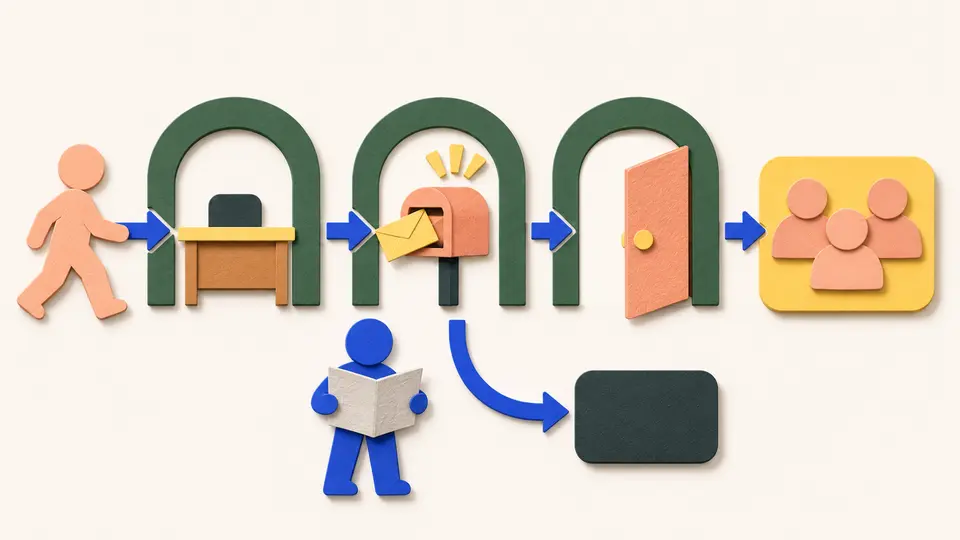
Say your job pays $48,000 a year. That's $4,000 a month on paper. Tax and other deductions come out first, so maybe $3,200 lands in your account. A budget is a plan for that money before you spend it.
So a budget starts from take-home pay, the money that actually reaches you after deductions. A plan built on the bigger salary figure would spend money you never receive.
Next you pick a period, usually a month, because rent, phone bills and most loan payments come monthly. Inside the month, timing still matters. Rent due on the 1st can't wait for pay that arrives on the 15th, so the CFPB's tools have you check cash week by week.
Then the plan lists every way money leaves, with an amount for each. Penn State Extension's budget workbook sets one goal for every family above all others. Spending won't be more than income.
Now sort the spending. Fixed costs are the ones you can't cut without a big change, like rent or a car payment. The CFPB points out that lowering them means something drastic, such as moving house or selling the car.
Flexible spending is everything you can turn up or down this month. Penn State's list includes food, clothing, transport, entertainment and gifts. Subtract fixed costs from take-home pay, and what's left is the money your choices steer.
Try to recallA gym contract signed for a year is a want. Why does a household budget still treat it as a fixed cost for now?
Fixed or flexible is about whether you can change the amount this month, and the contract stops you cutting it until it ends. Need or want is a separate question about whether you could live without it. So the gym is a want with a fixed amount.
You build a budget from take-home pay for one month. Fixed costs come off first, and what's left is the flexible money your choices decide.
Lessons in this topic
Where your month's money goes before you choose
Build a month's plan from the pay that actually reaches you, then split spending into bills that barely move and spending you can steer.
Track first, then pick a budget you'll keep
See why a month of tracking beats guessing, and how envelope, zero-based and percentage budgets each turn that record into a plan.
Why the yearly bills keep catching you out
See why costs that come once a year or once in a while break monthly budgets, and how to turn them into a steady monthly amount.
Why budgets slip, and how automatic saving helps
See how mental accounting and the way you pay change what you spend, why spending creeps up with pay, and how automatic transfers do what willpower can't.
Three quick stories from this topic
Card bids ran higher
Students bid twice as much for Celtics tickets when told they'd pay by credit card
In an auction for a pair of Boston Celtics tickets, MIT business students told to pay by card bid an average of $61. Those told to pay cash bid $29. A card bill arrives later as one total, so the cost stings less.
Same tickets, different payment
The tickets and the auction were the same for everyone. Only the promised way of paying changed.
The pain of paying
Cash makes the cost felt at the moment you pay. That may be one reason some people budget with cash envelopes.
Japan's 1904 budget ledger
Japan's kakeibo household ledger first appeared in a women's magazine in 1904
Journalist Hani Motoko built it around four questions. How much is coming in, how much will you save, how much did you spend, and how can you improve? The publishing house of her magazine still lists a kakeibo among its books.
A ledger, not an app
You write down income and planned saving at the start of the month, record daily spending, and total it each week and month.
Why the last question matters
Asking how to improve turns a record of last month's spending into a plan for the next one.
Saving from future raises
Workers who pledged future raises to savings went from saving 3.5% to 13.6% of pay
In the first company to try Save More Tomorrow, 78% of workers offered the plan joined. Each raise sent part of the new money into retirement savings, and the average saving rate climbed over 40 months and four annual raises.
Decide once
Workers made the choice a single time, in advance. After that the money moved without another decision.
Who designed it
Economists Richard Thaler and Shlomo Benartzi, who reported the results in 2004.
Sources
- Personal budget, Wikipedia
- Your Money, Your Goals: A financial empowerment toolkit, US Consumer Financial Protection Bureau
- Building a budget, Penn State Extension
- Your Money, Your Goals toolkit (2016 edition), US Consumer Financial Protection Bureau
- Listening to the customer, lecture slides on payment and pricing, MIT OpenCourseWare
- Mental accounting, Wikipedia
- Kakeibo, Wikipedia
- Fujin no Tomo, Wikipedia
- Jiyu Gakuen school profile, Jiyu Gakuen
- Save More Tomorrow: using behavioral economics to increase employee saving, Journal of Political Economy (Thaler and Benartzi, 2004), via RePEc