Economics & Money · Investing & financial markets
Why bond prices fall when rates rise
When interest rates rise, a fixed-rate bond loses market value, but an owner who holds it to maturity still collects what it promised if the issuer pays.
What you will learn
- Explain why a fixed-rate bond's price falls when market interest rates rise
- Explain how a bond's yield to maturity moves when its price rises or falls
- Explain why price changes matter less to a bondholder who keeps a bond until it matures
- Explain what a US government guarantee on a bond covers and what it leaves out
Lesson 1 of 4 · 5 min
Why rising rates make an older bond worth less
Say you lend $1,000 for 10 years at 6% interest. A year later, comparable new loans pay 7%. Yours hasn't changed, but it's now worth less than you paid for it.
That loan is a bond. When you buy one, you're lending money to its issuer, which may be a government, a city or a company. The issuer promises a set rate of interest, called the coupon rate. It also promises to repay the principal, or face value, when the bond matures.
Many bonds pay a fixed coupon for their whole term. So your bond keeps paying 6% while a new one pays 7%. No buyer will pay full price for yours when the same money earns more elsewhere.
To sell before it matures, you'd probably have to offer it below face value, at a discount. If rates had fallen instead, your 6% would look generous, and buyers would pay more than face value.
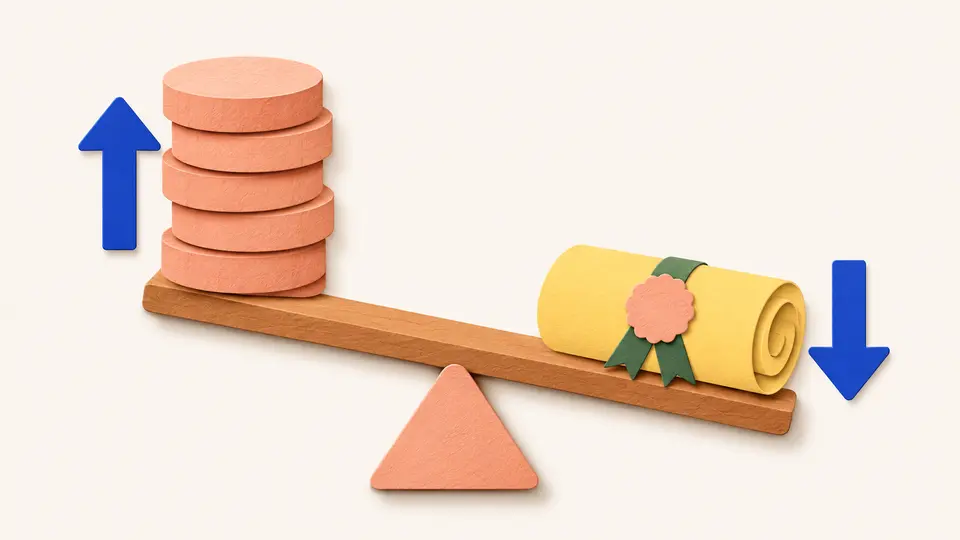
The US Securities and Exchange Commission, or SEC, pictures a seesaw. Market interest rates sit on one end and the prices of fixed-rate bonds on the other. When one goes up, the other comes down. This is interest rate risk, and it applies to every fixed-rate bond, US Treasury bonds included.
A second number moves whenever the price does. A bond's yield to maturity is the yearly return you'd earn if you bought it at today's price and held it until it matures. The payments are fixed, so paying less for them means earning more.
The SEC gives an example. A bond has a $1,000 face value, a 3% coupon and 10 years to maturity. It's bought for $1,000 when market rates are 3%.
A year later, market rates have risen to 4%. The bond's price falls to $925. At that price, its fixed payments give a new buyer a yield of 4%. Had rates fallen to 2% instead, the price would have risen to $1,082 and the yield dropped to 2%.
That's where the price settles. It moves until the old bond's yield matches the market rate. So a bond bought below face value yields more than its coupon rate, and one bought above face value yields less.
Real sales work the same way. At one Treasury auction, a 20-year bond with a 1.75% coupon sold at a yield of 1.85%. Buyers paid about $98.34 for each $100 of face value.
Try to recallA Treasury note pays a 2% coupon. After market rates rise, its yield to maturity is 3%. Would its price be more than, equal to or less than its face value, and why?
Less than face value. The note still pays only 2% of its face value a year, so a buyer looking for a 3% return will pay less for it. A bond whose yield to maturity is higher than its coupon rate sells below face value. The buyer gets the 2% coupon plus the gain from paying less than face value and receiving the full face value at maturity, and together those make up the 3% yield.
So the seesaw has a rule behind it. When market rates rise, an older fixed-rate bond's price falls until its yield matches what a new bond pays. When rates fall, its price rises.
Whether a lower price costs you anything depends on whether you sell before the bond matures.
Lessons in this topic
Why rising rates make an older bond worth less
See why a bond's price drops when new bonds pay more, and why its yield moves the other way.
When a lower bond price costs you money
Work out what a bondholder gets by holding to maturity, and what a US government guarantee does and doesn't cover.
Which bonds swing most when rates change
Compare how maturity and coupon shape a bond's sensitivity to rates, and use duration to estimate a price move.
What holding a bond to maturity doesn't fix
A bond's promise is only as good as its issuer, and even a holder who never sells faces inflation and the chance of an early call.
Three quick stories from this topic
Duration and a 1-point rise
A 1-point rise in interest rates would knock about 10% off a bond with a duration of 10
Duration is a single number that estimates how sensitive a bond's price is to interest rates. For each 1-point change in rates, the price moves by roughly that many percent the other way. Bond funds list it on their fact sheets.
Duration isn't maturity
A bond's maturity is simply the date its principal has to be repaid in full. Duration also reflects the interest the bond pays over its life, its call features and its yield. In general, a higher coupon lowers it and a longer maturity raises it.
Low duration isn't low risk
Duration measures sensitivity to interest rates only. A bond or bond fund with a low duration still faces credit risk, inflation risk and call risk, which its offering document or prospectus describes.
A guarantee doesn't cover the price
A bond backed by the US government can still lose market value when interest rates rise
The guarantee covers the interest payments and the repayment at maturity. It doesn't cover the price. In an SEC example, a $1,000 Treasury bond paying 3% is worth $925 a year later, after market rates rise to 4%.
What the guarantee promises
When the US government guarantees a bond, it promises to make the interest payments on time and to pay the principal in full when the bond matures. A holder who keeps the bond until then gets both.
Why the price can still fall
A bond's market price changes with several factors, including market interest rates. When rates rise, new bonds pay more and older ones sell for less. The SEC calls it a misconception that an insured or government-backed bond can't lose value.
What high-yield means
A high-yield bond pays more because its issuer is more likely to miss payments
The name advertises the reward and leaves out the reason. High-yield bonds have lower credit ratings than investment-grade bonds, which signals more risk of default, so they offer higher interest rates in return.
What credit risk is
Credit risk is the chance that an issuer fails to make its interest or principal payments on time and defaults. Credit ratings signal how big that chance is.
Holding to maturity doesn't help
A holder who never sells avoids price swings from changing interest rates. The bond's promise is still only as good as the issuer's ability to pay.
Sources
- Bonds - FAQs, U.S. Securities and Exchange Commission, Investor.gov
- Investor Bulletin: Fixed Income Investments, When Interest Rates Go Up, Prices of Fixed-Rate Bonds Fall, U.S. Securities and Exchange Commission, Investor.gov
- Brush Up on Bonds: Interest Rate Changes and Duration, Financial Industry Regulatory Authority
- Understanding Pricing and Interest Rates, U.S. Department of the Treasury, TreasuryDirect