Business & Organizations · Sales & pricing
The sales funnel
Few strangers become customers in one step. See how a sales team moves people from first contact to a signed deal, how to read the numbers at each stage, and how selling to a business differs.
What you will learn
- Name the stages a sales funnel moves people through, from lead to closed deal
- Use the share of people passing each stage to find where a funnel leaks
- Explain why selling to a business takes longer and involves several decision makers
- Explain why asking about the buyer's problem works better than pitching features
Lesson 1 of 4 · 4 min
Why a sales team needs a thousand names for a few deals
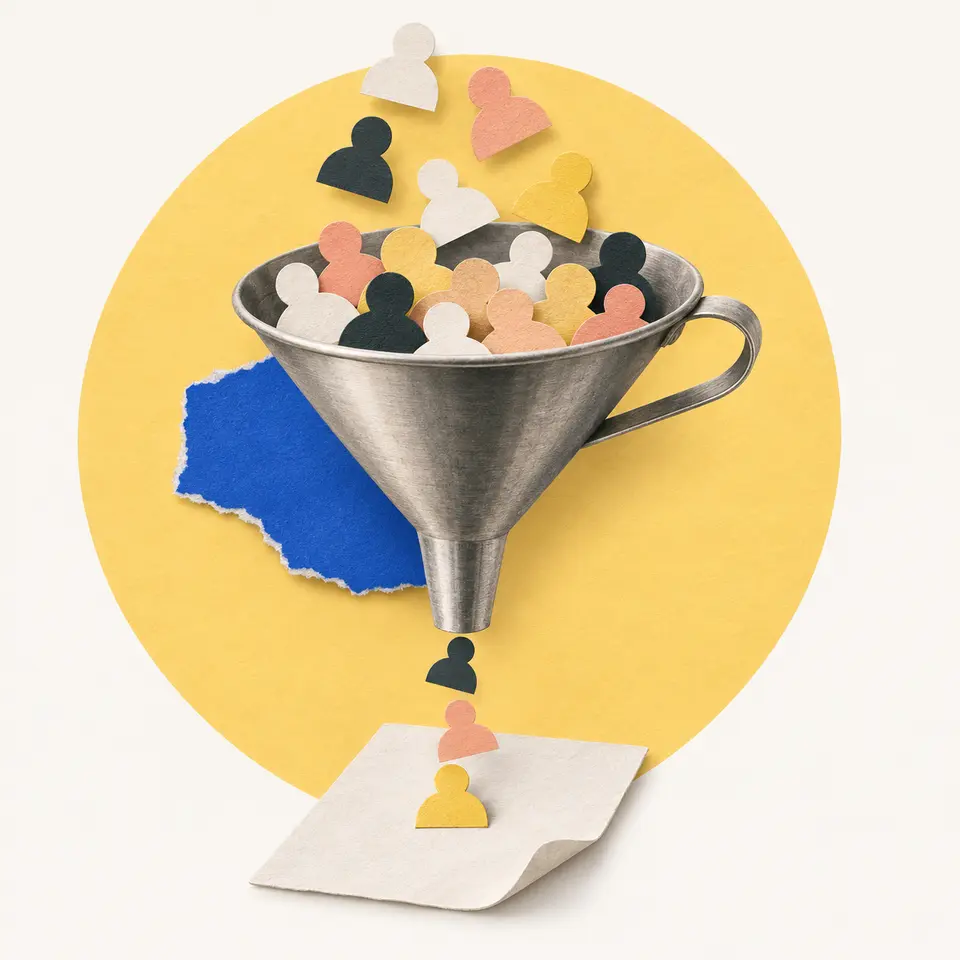
Picture a kitchen funnel. Lots goes in at the top, and only a trickle comes out the bottom. Salespeople have drawn their work this way since at least a 1924 book on selling bonds.
The top is full of leads, names of people or firms who might buy. They come from ads, trade shows, referrals or bought lists. Most won't buy, so the first job is qualifying, which means checking each lead is a real fit.
A qualified lead is a prospect. It wants the product, can pay, has the authority to decide and is eligible to buy. Prospects get a presentation or proposal. Some raise objections, a few agree, and the deal closes.
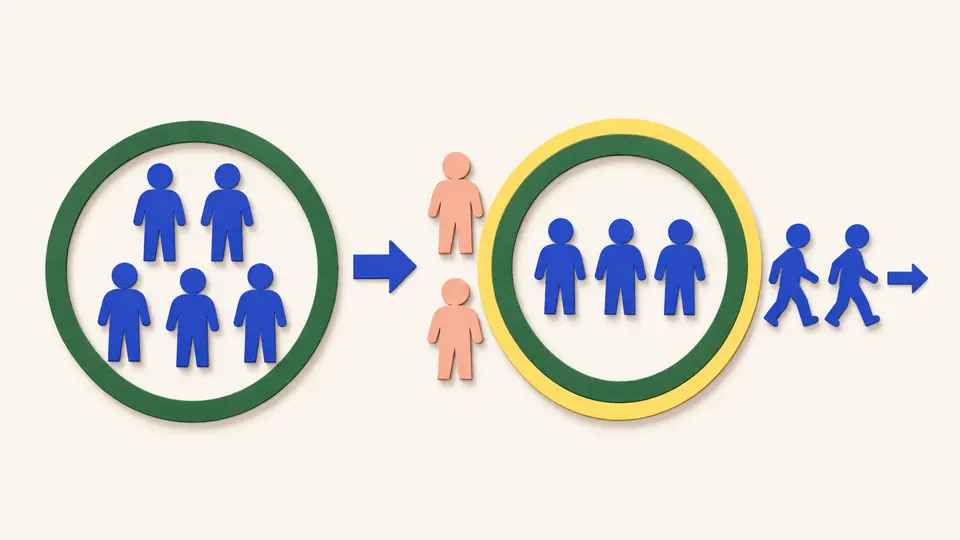
Teams track the conversion rate at each stage, the share that moves on to the next. Take the numbers from the start. 1,000 leads at 20% gives 200 prospects. Half get a proposal, so 100. A quarter of those close, so 25.
Because the rates multiply, a weak stage hurts everything below it. If qualifying slipped from 20% to 10%, deals would halve to 12 or 13, with every later stage unchanged.
So managers compare each rate with past months to find the leak. Proposals that rarely close point to training on closing. A low qualifying rate points to poor leads.
A funnel turns lots of leads into a few deals, stage by stage. Watch the share passing each stage, and you can see where it leaks and how many names you need.
Lessons in this topic
Why a sales team needs a thousand names for a few deals
Follow the stages from a name on a list to a signed deal, and use the share that passes each stage to find where a funnel leaks.
Selling to a business means selling to a committee
See why business deals take months and need several people's approval, and why the best salespeople ask about the buyer's problem before pitching anything.
How salespeople are paid and the end-of-year rush
Compare the main ways companies pay salespeople, and see how a bonus for hitting a yearly target pulls sales into the last weeks of the year.
When buyers don't need a salesperson
See how free versions and self-service sign-ups let the product do the early selling, and when a phone team is enough or a rep still needs to visit.
Three quick stories from this topic
A funnel since 1924
Salespeople have pictured the path to a purchase as a funnel since at least 1924
A 1924 book called Bond Salesmanship linked the funnel to the steps of attention, interest, desire and action. The shape stuck because each step really does hold fewer people than the last.
Wide top, narrow spout
Many people hear of a product, fewer get interested, and only a few buy.
Still in use
Sales teams today track the share of people passing each stage to find where the funnel leaks.
35,000 sales calls
One research team watched 35,000 sales calls over 12 years to learn what works
Neil Rackham's team of 30 researchers studied calls in more than 20 countries, backed by firms including Xerox and IBM. The work became the 1988 book SPIN Selling, built on asking buyers about their problems before pitching anything.
Four kinds of question
SPIN stands for Situation, Problem, Implication and Need-payoff questions, moving from facts to what a fix is worth.
Why questions sell
A buyer who names a need believes it more than one who is told about it.
The year-end sales bulge
US manufacturers sell more at the end of their fiscal year than in the middle
Sales also dip at the start of the year, beyond any normal seasonal pattern. Economist Paul Oyer traced it to pay plans that give salespeople a bonus for hitting a yearly target.
Pay that jumps
When a bonus switches on at a target, the last few sales before the deadline are worth far more than the rest.
Orders pulled forward
Reps chasing the target move deals earlier, sometimes with discounts, and next year starts thin.
Sources
- 15.3 Steps in the personal selling process, OpenStax, Principles of Marketing
- Chapter 15 key terms, OpenStax, Principles of Marketing
- Purchase funnel, Wikipedia
- Funnel analysis, Wikipedia
- 15.4 Management of the sales force, OpenStax, Principles of Marketing
- Neil Rackham, Wikipedia
- SPIN Selling, Huthwaite International
- Fiscal year ends and nonlinear incentive contracts: the effect on business seasonality, Quarterly Journal of Economics (Oyer, 1998), abstract on EconPapers