Business & Organizations · Accounting & business finance
Debt, equity and who stays in control
A business can raise money by borrowing or by selling shares. Work out what each choice does to the owners' returns and to who controls the company.
What you will learn
- Compare what a loan and a sale of shares cost a founder
- Explain why selling shares can cost a founder control
- Calculate an investor's stake from the pre-money valuation
- Explain when selling new shares costs existing owners value
Lesson 1 of 4 · 5 min
Borrow the money or sell part of the company
Say a founder needs money to grow her company. She can borrow it, or she can sell investors part of the company. Each choice has a price, and the two prices are paid in different things.
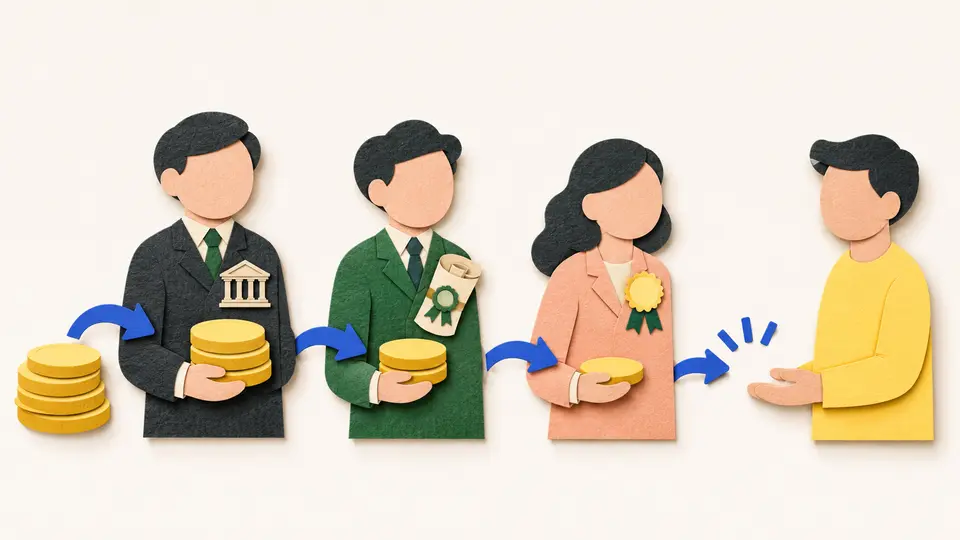
A loan is paid for in interest and risk. The founder keeps complete control, which is why the U.S. Small Business Administration points owners who want that toward a loan. But the payments come due in good years and bad. A company that borrows too much can default, or fail to pay what it owes, in a downturn that a company with less debt would survive.
Selling shares is paid for in ownership. A venture capital firm isn't lending. It invests in return for equity, normally an ownership share plus an active role in the company.
What do the buyers get? A share of common stock gives its holder a claim on the company's profits. It also gives a vote on company policy and on who sits on the board of directors.
It also puts them last in line. If the company fails and its assets are sold off, a process called liquidation, creditors, bondholders and preferred stockholders are paid first. When that happens through bankruptcy, common stockholders typically get nothing. That's the bargain of owning shares. They carry the most risk, and they have the most room to gain if the company grows.
Selling shares has a second cost. A company usually raises money by issuing new shares. The founder's own shares don't go anywhere, but they become a smaller slice of a bigger total. That's called stock dilution.
Say the founder owns all 900 shares and the company sells 100 new ones to an investor. There are now 1,000 shares. Her 900 make up 90% of them, since 900 divided by 1,000 is 0.9. The investor holds the other 10%.
New common shares come with votes, on directors and on big decisions such as selling the company or closing it down. Venture capitalists want more than votes. Almost all of them ask for at least a seat on the board, and once they've invested they take an active part in the company.
So the Small Business Administration's advice to founders is blunt. Be prepared to give up some control as well as some ownership.
Try to recallSay a founder holds 600 of her company's 1,000 shares, each with one vote. She sells 300 new shares to a venture capital firm. Does she still hold a majority of the votes, and what else is the firm likely to ask for?
No. There are now 1,300 shares. Since 600 divided by 1,300 is about 0.46, she holds about 46% of the votes and has lost her majority. The firm is also likely to want at least a seat on the board of directors.
The slices keep shrinking, because a growing company usually sells shares more than once. Founders start with 100%. By the later stages, before the company is sold or listed on a stock market, they frequently hold less than 35%.
So here's the trade. A loan costs interest and can sink the company in a bad year, but the founder keeps every share and every vote. Money from selling a stake never has to be repaid, but it costs her part of the company and often some say in how it's run.
Lessons in this topic
Borrow the money or sell part of the company
A loan costs a founder interest and adds risk. Selling shares costs her part of the company, and usually some say in how it's run.
What a funding round says a company is worth
Work out what share of a startup an investor's money buys, and learn when new shares cost the existing owners money and when they don't.
How borrowing magnifies gains and losses
Calculate how debt lifts the owners' return in a good year and deepens their loss in a bad one, and see how thin Lehman Brothers' cushion was in 2008.
How founders keep control with a minority of the shares
Two classes of shares let founders own a small part of a company and still hold most of the votes. See the math and the case supporters make for it.
Three quick stories from this topic
Shares with no vote
Google's parent company has a class of shares that carries no votes at all
Alphabet has three classes of shares. Class A carries one vote per share. Class B carries 10 and is held only by founders and insiders. Class C carries none. A setup like this lets insiders raise money from the public and keep control of the company.
Ten votes a share
The Class B shares are called super-voting shares. With them, insiders can keep a majority of the votes without owning more than half of the shares.
The case made for it
Supporters argue that insider control keeps a company stable and spares its managers short-term pressure. It's also an effective defense against hostile takeovers.
The one-penny up round
A startup's share price may be nudged up by one penny so a funding round counts as up
Raising money at a lower share price than last time is called a down round. It can dilute the founders, damage the company's reputation and make future money costlier. So companies and investors may engineer a deal to land just above the old price.
Up, down or flat
The Wall Street Journal calls a round up when the share price is above the previous round's, down when it's below and flat when it's the same.
Not always the company's fault
Down rounds were common when the dot-com bubble burst in 2000 and 2001 and during the 2008 financial crisis. A down round can reflect poor market conditions more than the company.
Lehman's thin cushion
A fall of about 3% in Lehman Brothers' assets would have wiped out its shareholders
Its last annual statements showed $691 billion in assets against $22 billion of stockholders' equity. Everything else was owed to someone. Borrowing on that scale multiplies profit in good years and leaves almost no cushion in bad ones.
Higher than reported
Bankruptcy examiner Anton R. Valukas found that Lehman's true accounting leverage was higher. Dubious accounting treatments, including one called repo 105, had understated it.
The company's own measure
Almost half of Lehman's balance sheet was closely offsetting positions and very-low-risk assets. The company emphasized "net leverage," which excluded them. Measured that way, its ratio was 16.1.
Sources
- Plan your business, U.S. Small Business Administration
- Leverage (finance), Wikipedia
- Return on equity, Wikipedia
- Common stock, Wikipedia
- Stock dilution, Wikipedia
- Share class, Wikipedia
- Super-voting stock, Wikipedia
- Pre-money valuation, Wikipedia