Mind & Psychology · Habits & behavior
How signals and rewards train behavior
Classical conditioning teaches the body what a signal predicts. Operant conditioning changes what you do through what follows it. Learn both, and why something learned this way can come back after it seems gone.
What you will learn
- Name the four terms in a conditioning procedure and place them in Pavlov's study
- Explain why pairing two things together isn't enough to condition a response
- Build the four consequences from two questions and place an example in each
- Name the factors that change how well a consequence works
Lesson 1 of 4 · 6 min
What Pavlov's dogs were really learning
Ivan Pavlov was studying digestion. He had rerouted his dogs' digestive fluids outside the body so he could measure them. Then he noticed something odd. The dogs began to salivate at the sight of the technician who usually fed them, before any food appeared.
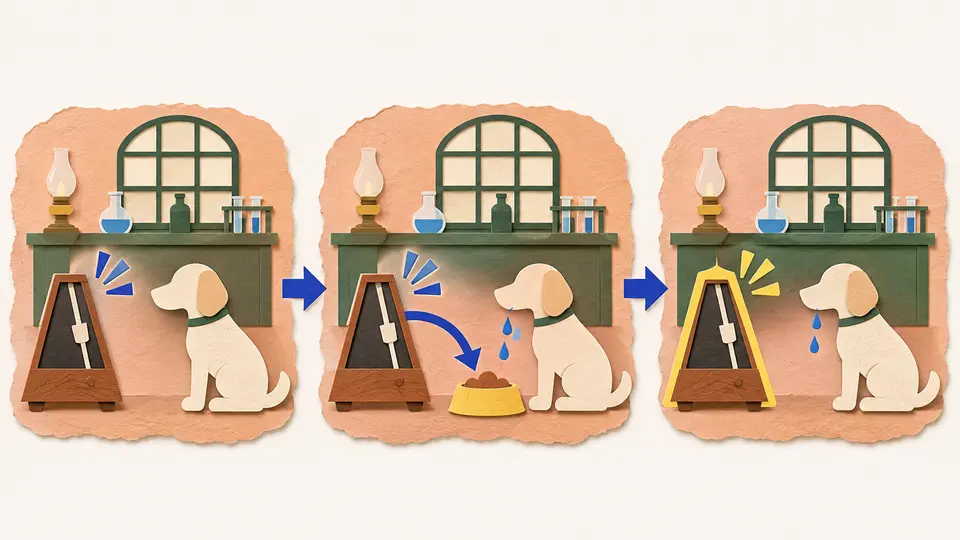
To test it, he sounded a metronome and then gave a dog food. After a few repetitions the dog salivated at the ticking alone. He published his results in 1897, and the procedure is now called classical conditioning.
Four terms describe it. The food is the unconditioned stimulus, because it makes a dog salivate with no training at all. That salivation is the unconditioned response, an inborn reflex.
The ticking starts out neutral. After training it's the conditioned stimulus, and salivating to it is the conditioned response. Conditioned here means learned.
The learned response is less permanent than the reflex, and it isn't an exact copy. Pavlov noted that the saliva a signal produces differs in composition from the saliva food produces.
It's tempting to picture conditioning as glue. Two things happen together often enough and they stick. Two experiments rule that out.
In the first, the ticking is paired with food as before. But food also arrives at other times, so it's just as likely without the ticking as with it. Now the ticking tells the dog nothing, and conditioning fails. The pairings were all there. The information wasn't.
The second is called blocking. Say the signals are a tone and a light. First the tone is paired with food. Then the tone and the light come on together, followed by the same food. Tested alone afterward, the light produces no response. It was paired with food every time, but the tone already predicted the food, so the light added nothing.
So what an animal learns is a prediction. Robert Rescorla summed up the change in a 1988 article titled "Pavlovian conditioning: It's not what you think it is."
It also explains why one pairing can be enough. A single bad experience with a food can put you off it, and a single fright can condition a fear.
Try to recallIn a conditioning experiment, a tone sounds before food, but food also arrives at plenty of other times. Predict the outcome, and say what it demonstrates.
Conditioning fails. The tone is paired with food, but food is just as likely without the tone, so the tone predicts nothing and the animal doesn't come to respond to it. That shows conditioning depends on prediction, and pairing alone isn't enough. Blocking makes the same point. A second signal added alongside one that already predicts the food gains no response of its own, although it's paired with the food every time.
Pavlov's dogs weren't gluing a sound to a meal. They were learning that the sound meant food was coming. A signal gets that power only while it predicts something the animal doesn't already know. It works on people too. A clock showing dinner time can make you feel hungrier than you were a moment before.
Lessons in this topic
What Pavlov's dogs were really learning
Pavlov's dogs didn't just link a sound to food. Learn the four terms of classical conditioning, and the experiments showing that the sound has to predict the food.
Why negative reinforcement isn't punishment
In operant conditioning, positive and negative don't mean good and bad. Learn the two questions that sort any consequence, and what makes a consequence work.
Why slot machines are so hard to walk away from
Change only when a reward arrives and behavior changes with it. Learn the four schedules of reinforcement, and why a behavior learned in one room may not show up in another.
Why a response that faded can suddenly come back
A conditioned response fades when its signal stops paying off, but the learning stays. See the ways it returns, and why a familiar room can change how a drug acts.
Three quick stories from this topic
The dinner-time clock
Seeing that it's dinner time can make you hungrier than you were a moment earlier
Signals that reliably come before food become triggers for the body's preparations to eat, such as releasing digestive juices into the stomach. Those preparations bring on hunger. It's the learning Pavlov found in dogs that salivated at the sound of a metronome.
What Pavlov saw
His dogs began to salivate at the sight of the technician who usually fed them, before any food appeared. A metronome sounded before meals soon had the same effect.
A signal has to predict
If food is just as likely without the signal as with it, the animal learns nothing from the signal. What counts is whether it predicts the food.
Negative reinforcement
Negative reinforcement makes a behavior more likely, since negative only means taken away
A child frightened by fireworks puts on headphones and the noise stops, so the headphones go on again next time. Removing the noise reinforced the behavior. Punishment is the opposite kind of consequence, one that makes a behavior less frequent.
Two questions
Was something added or removed? That's positive or negative. Did the behavior become more or less frequent? That's reinforcement or punishment.
Negative punishment
If your lunch is stolen from the office refrigerator, you stop leaving it there. Something was removed, and the behavior decreased.
The room and the dose
A drug dose someone is used to can become an overdose in an unfamiliar room
When a drug is always taken in the same place, the surroundings can come to trigger a bodily reaction that offsets the drug's effect. That reaction may contribute to tolerance. Somewhere new, those signals are missing, so the usual amount may act with nothing to offset it.
The same learning as Pavlov's dogs
A cue that reliably comes before a drug can trigger a conditioned response. For regular coffee drinkers, the smell of coffee alone may bring a feeling of alertness.
Learning is covered, not erased
A conditioned response that has faded can reemerge when an animal is returned to the place where it was first learned.
Sources
- Classical conditioning, Wikimedia Foundation
- Operant conditioning, Wikimedia Foundation