Language & Communication · Writing systems & reading
Why English spelling lags behind speech
English letters stopped matching English sounds centuries ago. See how the vowels moved, how silent letters got in, what the mismatch costs new readers and why reform keeps failing.
What you will learn
- Explain how the Great Vowel Shift left English vowel letters with outdated values
- Describe how printing helped fix spellings that no longer matched speech
- Explain why scholars added silent letters such as the b in debt
- Identify silent letters that rest on a mistaken word history, such as the s in island
Lesson 1 of 4 · 5 min
The vowels moved and the letters stayed
Sew and new don't rhyme, but kernel and colonel do. The letters ough sound different in each of thought, drought, tough, cough, through and though.
The fullest description of English spelling is a 2015 dictionary by Greg Brooks. It needs more than 450 pages to list all the ways a sound can be written and a letter can be read.
A large part of the mismatch comes from one change in pronunciation, the Great Vowel Shift. It ran mainly between 1400 and 1700, beginning in southern England, and it altered every long vowel in the language.
Before it, English long vowels sounded much like those of Italian and German. Name and make had an 'ah' vowel, as German Name and machen still do. During the shift that vowel moved to the 'eh' of bed and then to the 'ay' of today. Moon and book once sounded something like moan and boke.
English spelling began to settle in the same period, the 15th and 16th centuries. So the vowels kept moving and the letters stayed where they were. Nobody noticed, because the changes were gradual.
German went through similar vowel changes slightly earlier, and German changed its spelling to match. Middle High German bīzen, 'to bite', is now written beißen.
For generations after the Norman conquest of 1066, official writing in England was done in French and Latin. When written English came back, around 1300, it had no standard spelling. The word people might be spelled peple, pepill, poeple or poepul.
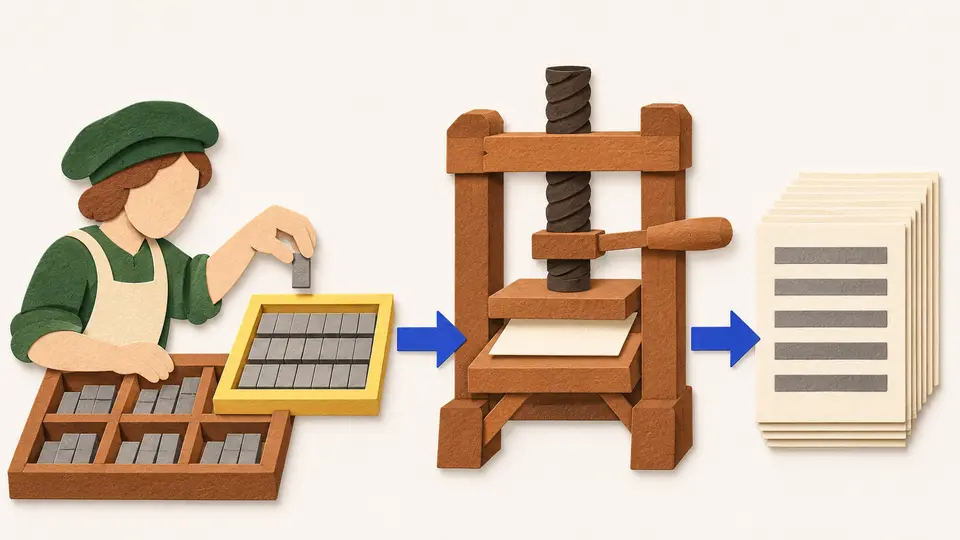
Then printing arrived. The merchant William Caxton set up the first English press in 1476, after 30 years on the Continent. He brought typesetters back with him, and some of them didn't speak English all that well.
The priority was getting pages set quickly. So printing houses developed habits for spelling frequent words, often based on what made typesetting faster. Hadde might become had, and thankefull thankful.
The typesetters' own habits got in too. Ghost had often been spelled gost. Its h came from Flemish influence, and the word was printed so often, especially in holy ghost, that the new spelling came to look right.
So the press froze spellings just as the vowels were moving. By the 19th century most English words had one set spelling. Spelling has stayed relatively frozen for the last three or four centuries, while pronunciation has kept drifting.
Try to recallHow did the arrival of printing in England help lock in spellings that no longer matched the way words sounded?
Caxton's press arrived in 1476, when English had no general spelling standard and the Great Vowel Shift was underway. Typesetters, some trained abroad with little English, followed house habits chosen for speed, such as had for hadde. Flemish habits gave ghost its h. Spellings printed over and over came to look right, so they stuck while pronunciation kept moving.
So when a vowel letter seems to have the wrong sound, it's often a record of how the word was said when English printing began. The a in name still spells the 'ah' the word used to have.
Lessons in this topic
The vowels moved and the letters stayed
See how a centuries-long shift in English vowels and the arrival of printing pulled letters and sounds apart.
The b in debt was never spoken
Find out why scholars added silent letters to words like debt and island, and why some of their guesses were wrong.
Why sign keeps its silent g
English spelling keeps related words looking alike even when they sound different. See what that buys a practiced reader and what it costs a child learning to read.
Why fixing English spelling keeps failing
In 1906 a president ordered simpler spellings and lost within months. See what happened, and why spelling English by sound would mean choosing whose accent to spell.
Three quick stories from this topic
English is slow to learn to read
Reading develops over twice as slowly in English as in languages with regular spelling
A 2003 study compared English with 12 other European spelling systems. In most, children read simple words accurately and fluently before the end of their first school year. The authors blamed English's complex syllables and its unpredictable spelling.
Shallow and deep spelling
A spelling system is shallow when you can predict a word's sound from its letters, and deep when you can't. Only knowing the word tells you that tough rhymes with rough.
What the odd spellings buy
English often keeps a word part looking the same when its sound changes, as in sign and signify. That helps practiced readers recognize words, and makes the first steps harder.
The mistaken s in island
The s in island was added by mistake, to match a Latin word it never came from
Island is Old English and was long spelled iland. In the 16th century it was respelled to look like isle, an unrelated word that does descend from Latin insula. Scissors and scythe got their c the same way, from a wrong guess about Latin.
Some added letters had real roots
Scholars of Greek and Latin respelled words to show where they came from. Det became debt to match Latin debitum, 'thing owed', and dout became doubt to match dubitare, 'to doubt'. Those links were real, though the letters were never pronounced.
Shakespeare mocked the silent b
In Love's Labor's Lost, the pedant Holofernes insists that pronunciation should change to match spelling. He wants everyone to pronounce the unhistorical b in doubt and debt.
Roosevelt ordered thru in 1906
In 1906 Theodore Roosevelt ordered federal printers to spell through as thru
His order covered 300 simplified spellings, among them tho and wisht. Newspapers mocked it, one with the line "This is 2 mutch," and that December the House voted for dictionary spelling. Roosevelt rescinded the order and later blamed thru above all.
Ridicule, then a resolution
Newspapers mocked the order. One editorial summed it up as "This is 2 mutch." In December 1906 the House of Representatives passed a resolution calling for government printing to follow generally accepted dictionaries, and Roosevelt rescinded the order.
He could laugh about it later
The next summer, Roosevelt was watching a naval review when a press boat marked "Pres Bot" went by. He waved and laughed with delight. A few of the board's spellings, such as anemia and mold, are still common in American English.
Sources
- Why is the English spelling system so weird and inconsistent?, Aeon
- Great Vowel Shift, Wikipedia
- English orthography, Wikipedia
- English-language spelling reform, Wikipedia
- Introduction (Lexicons of Early Modern English), University of Toronto Libraries
- Foundation literacy acquisition in European orthographies, University of Dundee Discovery Portal (British Journal of Psychology abstract)
- island, Online Etymology Dictionary
- scissors, Online Etymology Dictionary
- debt, Online Etymology Dictionary
- doubt, Online Etymology Dictionary
- Simplified Spelling Board, Wikipedia