Language & Communication · Writing, speaking & persuasion
Public speaking and stage fright
Why your body panics before a speech, why the audience sees less of it than you feel, and how voice, rehearsal, exposure and good notes help you speak well anyway.

What you will learn
- Explain how the stress response produces stage-fright symptoms and when they peak
- Explain why audiences notice less nervousness than speakers think they show
- Describe how rate, volume, pauses and eye contact show listeners what matters
- Explain why rehearsing out loud to listeners prepares a speaker better than silent review
Lesson 1 of 4 · 4 min
Why your body panics before a speech
Cicero wrote a dialogue called On the Orator in 55 BC. In it, a Roman speaker confesses, "I turn pale at the outset of a speech and quake in every limb." Speakers today describe the same thing. So what's going on in the body?
It's the stress response, the body's alarm for danger. When your brain reads a watching crowd as a threat, the sympathetic nervous system fires and your adrenal glands release adrenaline. Your heart speeds up, and blood shifts toward your muscles and away from your gut, which is where the butterflies come from.
Your muscles tense for speed and strength, so your hands and knees may tremble. Your mouth goes dry and your voice can wobble. The body is getting you ready to fight or run, two things a podium never asks of you.
In a 2003 study at Cornell University, 40 students gave three-minute speeches in pairs on topics they hadn't prepared. Afterward, each rated how nervous they had looked and how nervous their partner had looked.
On a scale of 0 to 10, speakers rated their own nervous look at 6.55 on average. Their partners rated them at 5.25. Twenty-seven of the 40 said they'd looked more nervous than their partner. In eight pairs, both speakers believed they were the more nervous-looking one.
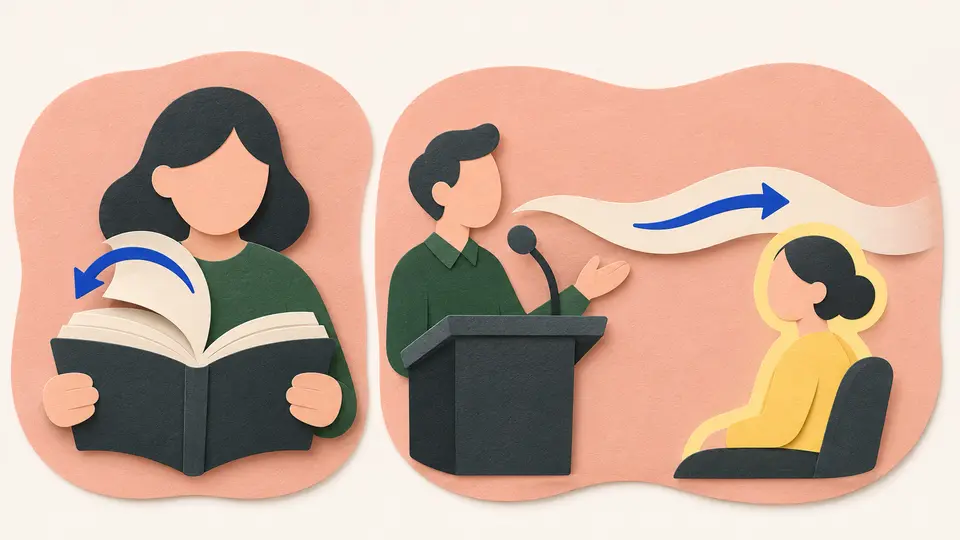
Psychologists call this the illusion of transparency, the belief that your inner feelings show more than they do. You feel your pounding heart from the inside, so you assume it leaks out. The audience sees only your face and hears your voice, which give away much less.
The illusion can feed itself. You feel nervous, believe it shows, and grow nervous about looking nervous.
Try to recallWhy does a nervous speaker usually look calmer to the audience than they feel?
Speakers feel their racing heart and shaking from the inside and assume it shows. This is the illusion of transparency. Listeners see only the outside, which reveals much less, so speakers rate themselves as looking more nervous than others rate them.
Stage fright is your body's danger alarm, and it peaks as you begin. A good first minute calms the whole talk, and the audience sees far less of your nerves than you feel.
Lessons in this topic
Why your body panics before a speech
Find out what the stress response does to a speaker, when it peaks, and why the audience sees far less of it than you feel.
Pace, pauses and why you should rehearse out loud
Learn how rate, volume, pauses and eye contact carry a talk, and why rehearsing aloud to listeners beats rereading your notes.
What actually helps with fear of speaking
See why facing the fear in steps works, and what the evidence says about telling yourself you're excited instead of calm.
Notes, memory or a full script
Compare the four ways to deliver a speech and see how Demosthenes, Churchill and TED speakers chose between them.
Three quick stories from this topic
Nervous about looking nervous
In a Cornell study, 27 of 40 speakers thought they looked more nervous than their partner
Students gave three-minute speeches they hadn't prepared, then rated their own nerves and their partner's. Speakers judged from the racing heart they felt inside, while partners saw only faces and voices, which showed far less.
Both thought so
In eight of the pairs, both speakers believed they were the more nervous-looking one.
The illusion of transparency
Psychologists call it the illusion of transparency. Your feelings are loud to you and much quieter to everyone else.
The half-shaved orator
Demosthenes shaved half his head so he'd be too embarrassed to leave his practice room
Plutarch says the Athenian orator trained in an underground study, sometimes for two or three months at a stretch. He also recited with pebbles in his mouth to fix a lisp, and rivals mocked him for refusing to speak unprepared.
Smelling of lamp-wicks
A rival sneered that his arguments smelled of lamp-wicks, meaning they came from late nights of study.
Neither written nor unwritten
Demosthenes said his speeches were neither fully written out nor unwritten, much like speaking from notes today.
The 'get excited' trick
Saying 'I am excited' made speakers feel excited, but a retest found no better speeches
In a 2014 study, judges rated the 'excited' speakers more persuasive and confident than the 'calm' ones. A 2025 replication found the same lift in feelings, but observers saw no difference in how well anyone spoke.
Why excitement
Anxiety and excitement are both high-arousal states, so relabeling one as the other seemed easier than calming down.
What holds up
The boost in feeling held up in both studies. Whether it changes how you come across is still open.
Sources
- The illusion of transparency and the alleviation of speech anxiety, Journal of Experimental Social Psychology 39 (2003), Savitsky and Gilovich
- De Oratore, Wikipedia
- Fight-or-flight response, Wikimedia Foundation
- Glossophobia, Wikipedia
- Milestones of anticipatory public speaking anxiety, Communication Education 48 (1999), Behnke and Sawyer
- Public speaking anxiety as a function of sensitization and habituation processes, Communication Education (2004), Behnke and Sawyer
- Scared speechless, TCU Magazine, Texas Christian University
- Illusion of transparency, Wikipedia
- Plutarch, Life of Demosthenes, LacusCurtius, University of Chicago (Loeb translation)
- Getting excited about public speaking: a replication, Psychology of Language and Communication 29 (2025), Poynter and Pasqualini