Language & Communication · Writing, speaking & persuasion
How speakers help listeners keep up
Find out how speakers order and signpost a talk so listeners who hear it only once can follow and remember it.
What you will learn
- Explain why listeners need a speech's structure made more obvious than readers do
- Use transitions, internal previews, internal summaries and signposts to help an audience follow a talk
- Name the six parts of a classical oration and what each part was for
- Explain how a classical speech's opening and closing worked on an audience's trust and feelings
Lesson 1 of 4 · 6 min
Listeners can't rewind a speech
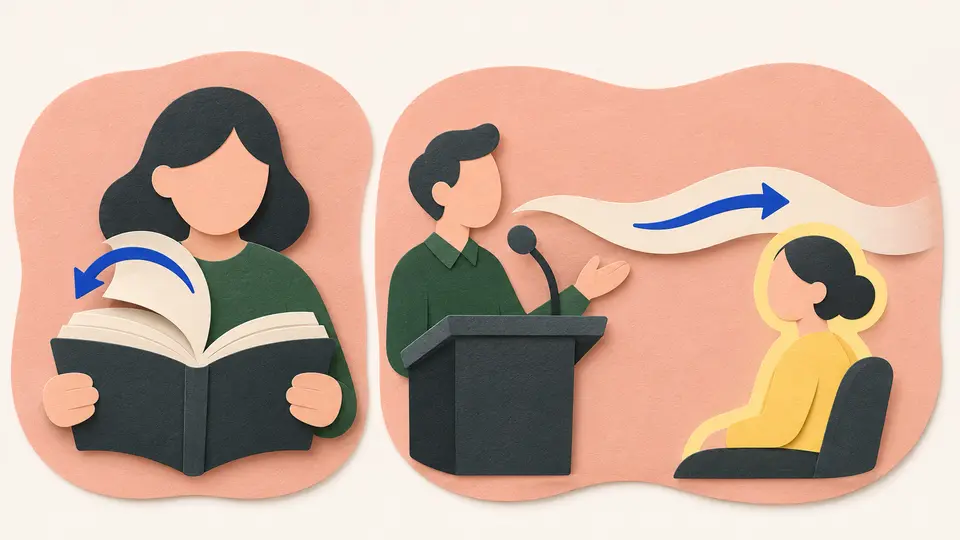
Lose the thread in a book and you flip back a page. Lose it in a speech and it's gone. One public speaking textbook puts it this way. "We cannot pick up our universal remote and rewind the person."
Listeners get one chance at each sentence, so a speech has to be easier to follow than an essay. That starts at the opening. Tell listeners your thesis right away, and how you'll support it. Saving the point for a late reveal may feel dramatic to the speaker. Listeners kept guessing will most likely get bored or confused.
Words that point back are the next trap, because a listener can't look up what "it" or "this" refers to. Picture a speech saying the government has failed to protect people from reality television, which exploits conflict and calls it human nature. Then comes "This cannot continue." This what? The failure, the television or human nature? "This failure cannot continue" settles it.
The words that name your subject need the same care. A speech exposing unethical insurance companies should keep saying "ethics" and not drift to "immoral" or "wrong." Hearing the same term again lets listeners connect each new point to the last.
A good speaker also narrates the route, and there are four tools for it.
A transition closes one main point and opens the next. "Now that we've seen the problems caused by lack of adolescent curfew laws, let's examine how curfew laws could benefit our community."
An internal preview says what's coming inside a point. Listeners who know what's coming listen for it, and they retain more. A speaker might promise to "first explain the positive benefits of recycling and then explore how recycling can help our community."
An internal summary looks back, and it works best after a complicated point. "To sum up, school bullying is a definite problem." The speaker then names the harm to victims' grades, test scores and future schooling.
Signposts are the smallest tool. They work like the green signs on a highway that count down the miles. "The first function of credibility is competence." "The second function of credibility is trustworthiness." The simpler the signpost, the easier the talk is to follow.
Do the same for the whole speech. Open by naming the three issues you'll cover. Close with a line like "I've talked to you today about such and such" before you sit down. Cues like these let listeners put the pieces together "without thinking too hard" and spend their attention on what you're saying.
Try to recallA speaker has just finished a complicated main point about school bullying. What could she say next to help listeners keep up, and why?
She could give an internal summary, a sentence that reminds listeners what they just heard, such as "To sum up, school bullying is a definite problem" followed by the harms she covered. Internal summaries work best after a complicated point. She could then add a transition that links the summary to her next point, such as the need for antibullying programs, so listeners know where the talk is heading.
A reader can look back and a listener can't. So state your point early and keep your main terms fixed. Then narrate the route, with previews of what's coming, summaries of what you covered and plain signposts in between.
Lessons in this topic
Listeners can't rewind a speech
Listeners can't go back over a speech the way readers reread a page, so speakers use transitions and previews to keep them on track.
The six-part plan behind a Roman speech
Follow the six parts Cicero and Quintilian set out for a speech, and see why a Roman defense could end with a torn tunic.
The five-step recipe for a persuasive speech
Walk through Monroe's motivated sequence, the pattern most public speaking textbooks teach, and see what happened when an experiment tested it.
Why listeners remember the start and end of a talk
See why listeners recall a talk's opening and closing best, and when the first or the last of two opposing arguments persuades more.
Three quick stories from this topic
The formula that didn't persuade
The textbook formula for a persuasive speech persuaded no better when it was tested
Alan Monroe's five-step "motivated sequence" dates from the 1930s, and most public speaking textbooks teach it. In a 2000 experiment, audiences rated messages built on it as more organized than others. Their attitudes didn't shift any more. Easy to follow isn't the same as convincing.
Five steps toward action
The steps are attention, need, satisfaction, visualization and action, and each aims for a response. After the need step, listeners should think, "Something needs to be done about the problem." The action step has to be realistic. Asking classmates for one dollar is considerably more realistic than asking for a thousand.
Why the pattern still helps
The textbook that reported the study warns against treating the sequence as "a kind of magic persuasive bullet". Research does support the idea that organized messages are perceived as more persuasive as a whole, so the steps can still help a speaker think through an argument.
The closing that showed scars
A Roman advocate ended a defense by tearing open his client's tunic to show battle scars
Marcus Antonius was defending Manius Aquillius, a former consul charged with extortion, and Aquillius was acquitted. Roman speeches saved emotional appeals for the final part, the peroratio. In Cicero's account, Antonius said it worked only because he felt the pity himself.
Two jobs for the ending
Classical rhetoric gave the peroratio two main purposes, reminding listeners of the speech's main points, called the recapitulatio, and influencing their emotions, called the affectus. Greek writers on rhetoric defined its role and called it epilogos, their word for the conclusion.
An honor to close the case
Major court cases in the first century BC often had two or more speakers on each side. Being asked to deliver the peroration, the closing speech, was considered an honor.
Who the first argument wins
Mock jurors most inclined to think things through were swayed more by the first argument
In a 1990 study, mock jurors watched a 45-minute interrogation of a murder suspect. One lawyer's argument came before the tape and the other's after. Jurors high in "need for cognition" leaned toward the first argument. Those low in it leaned toward the last.
A law that lasted 25 years
In 1925 Frederick Hansen Lund found that the first of two opposing documents influenced students more. In 1950 Cromwell found the opposite, and it now appears both effects occur.
Why thinkers favor the first
The researchers' explanation is that people who actively process information agree with the first account, then process what follows in ways that confirm it.
Sources
- Keeping Your Speech Moving (Stand Up, Speak Out: The Practice and Ethics of Public Speaking, section 10.3), Saylor Academy
- Speeches, The Writing Center, University of North Carolina at Chapel Hill
- Organizing Persuasive Speeches (Stand Up, Speak Out: The Practice and Ethics of Public Speaking, section 17.3), Saylor Academy
- Monroe's motivated sequence, Wikipedia
- Dispositio, Wikipedia
- Cicero, De Oratore, Book 2, sections 146-230, translated by J. S. Watson, Attalus
- Manius Aquillius (consul 101 BC), Wikimedia Foundation
- Juror interpretations of ambiguous evidence, Law and Human Behavior
- Law of primacy in persuasion, Wikipedia