Language & Communication · Language learning & multilingualism
How adults learn a second language
What has to happen for an adult to learn a language, how the main teaching methods compare, what the US diplomats' hour estimates assume, and what app studies can and can't show.

What you will learn
- Explain why input a learner mostly understands is the raw material of language learning
- Describe what speaking, conversation and noticing add that listening alone doesn't
- Compare what grammar-translation and audio-lingual drills each train and leave out
- Explain what communicative teaching and immersion add and why accuracy can lag
Lesson 1 of 4 · 5 min
What has to happen for a new language to stick
The linguist Richard Schmidt took a Portuguese course in Brazil and chatted with Brazilians on the side. With his colleague Sylvia Frota, he recorded a conversation every month. Their records raise a simple question. What has to happen for the language you hear to become language you can use?
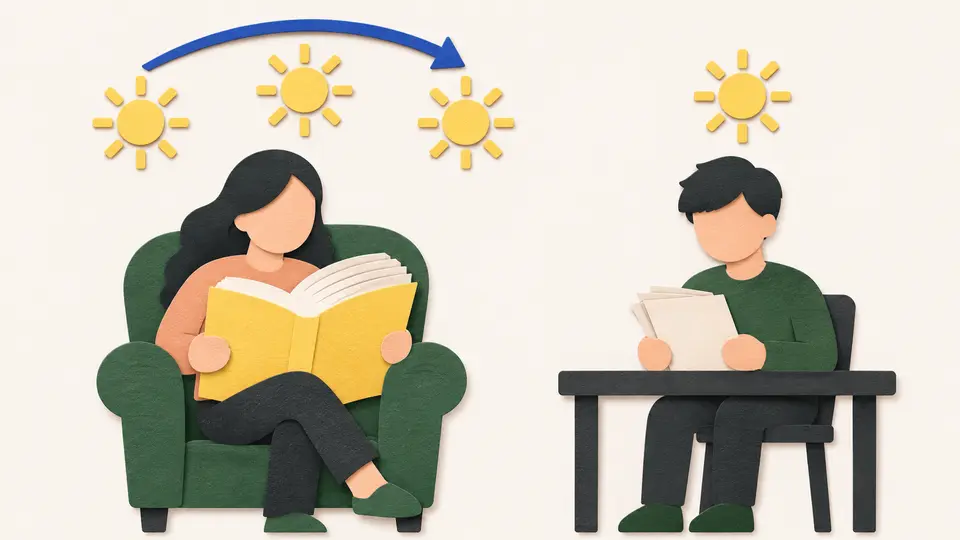
Start with input, the language you hear and read. The linguist Stephen Krashen argued that you learn from comprehensible input, meaning messages you understand. The best input sits one step above your level. Krashen called this i+1, where i is what you already know.
Understanding comes first because context does the work. Say you know the words for coffee and please, and you hear a new verb between them. The situation tells you what the verb means, so it can stick. Speech far beyond you gives no such foothold, so it washes past. Krashen went further and said input is the only cause of learning, and speaking is just its result.
Other researchers agree input matters but doubt it's enough. Merrill Swain proposed that output, what you say and write, does work of its own. When you try to speak, you hit gaps between what you mean and what you can say. Each sentence also tests a guess about the grammar, and the listener's reaction shows whether the guess held.
Michael Long added interaction. When a listener looks puzzled and asks "Sorry, you went where?", you both rework the sentence until it lands. That back and forth makes input easier to understand. It also hands you feedback while the mistake is fresh.
Schmidt's recordings supplied the last piece. Forms he had heard for weeks only appeared in his speech after he noticed them, often once someone pointed them out. Schmidt concluded in 1990 that noticing is what turns input into intake. He later softened this, saying noticing helps but isn't strictly required.
Try to recallSomeone has watched TV shows in a language for years and understands them well, yet speaks with the same grammar mistakes. What do output and noticing research suggest is missing?
They've had plenty of input but little output and feedback. Speaking would expose gaps between what they mean and what they can say, and a listener's reactions would test their guesses about grammar. Without that, nothing makes them notice their mistakes, so the mistakes stay.
Input you mostly understand supplies the raw language. Speaking and conversation expose your gaps and bring feedback, and noticing a form is what lets you start using it.
Lessons in this topic
What has to happen for a new language to stick
Learn why input you mostly understand is the raw material, and what speaking, conversation and noticing add to it.
From translation to role-play, four ways to teach languages
Compare grammar-translation, audio-lingual drills, communicative teaching and immersion, and see what each one trains.
How many hours a new language really takes
Use the US Foreign Service Institute's estimates to see why some languages take English speakers far longer, and what those numbers assume.
What language apps can prove, and why learners differ
Read app studies with care, see what a human partner's feedback adds, and learn how aptitude and motivation each shape progress.
Three quick stories from this topic
The 2,200-hour languages
US diplomats are expected to need about 2,200 class hours to reach working Japanese
The Foreign Service Institute puts Arabic, Mandarin, Cantonese, Japanese and Korean in its hardest group. Dutch, French, Italian and Spanish take 600 to 750 hours, because more of English carries over to them.
Full-time hours
The hours are full-time classes, about 25 a week. The hardest group's 2,200 hours fill 88 weeks.
Why the gap
Shared words, grammar and sounds transfer from the languages you know. The further a language sits from English, the less an English speaker can reuse.
Immersion's weak spot
Years of French immersion left Canadian pupils understanding well but speaking with errors
Taught school subjects in French, immersion students reached near-native listening and reading. Yet they fell behind native speakers in grammar when they spoke and wrote, and many rarely said more than a clause.
Where it started
Canada's first French immersion program began in Quebec in 1965. Pupils learned ordinary subjects through French.
What it changed
Merrill Swain argued that learners also need to speak and get feedback, because speaking shows them the gaps that listening hides.
The correction that rarely sticks
Teachers mostly correct by recasting, which rarely gets students to fix the error
In four French immersion classrooms, teachers mostly said a student's sentence back correctly. Students seldom repaired the error themselves afterward. Asking them to try again or giving a hint led to more self-correction.
What a recast is
A recast quietly hands over the right form, so the learner can hear it as agreement and carry on.
What works better
A 2010 review of 15 classroom studies found corrections that prompt the learner had larger effects than recasts.
Sources
- Noticing hypothesis, Wikipedia
- Input hypothesis, Wikipedia
- Comprehensible output, Wikipedia
- Merrill Swain, Wikipedia
- Interaction hypothesis, Wikipedia
- The Role of Consciousness in Second Language Learning (Schmidt, 1990), Applied Linguistics
- Effectiveness of L2 Instruction: A Research Synthesis and Quantitative Meta-analysis, Language Learning
- Foreign Language Training (archived December 2024), US Department of State, Foreign Service Institute
- Second-language acquisition, Wikipedia
- Developing Oral Proficiency in the Immersion Classroom, Center for Advanced Research on Language Acquisition, University of Minnesota
- Language immersion, Wikipedia
- Corrective Feedback and Learner Uptake (Lyster and Ranta, 1997), Studies in Second Language Acquisition
- Oral Feedback in Classroom SLA: A Meta-Analysis (Lyster and Saito, 2010), Studies in Second Language Acquisition