Business & Organizations · Operations & supply chains
Supply chains
A cotton T-shirt can cross the Pacific twice before it's worn out. See how goods, orders and money move between the firms in a chain, why lead time sets how much stock you need, and how firms trade low cost against safety.
What you will learn
- Trace the stages and tiers of suppliers that a product passes through
- Describe how goods, money and information each move along a supply chain
- Explain why a longer lead time forces a firm to hold more stock
- Describe ways firms shorten lead time, including faster information
Lesson 1 of 4 · 4 min
Follow one T-shirt from farm to market stall
In 1999 a protester at Georgetown University asked a crowd, "Who made your T-shirt?" The economist Pietra Rivoli took it as a challenge. She bought a shirt and traced its whole path.
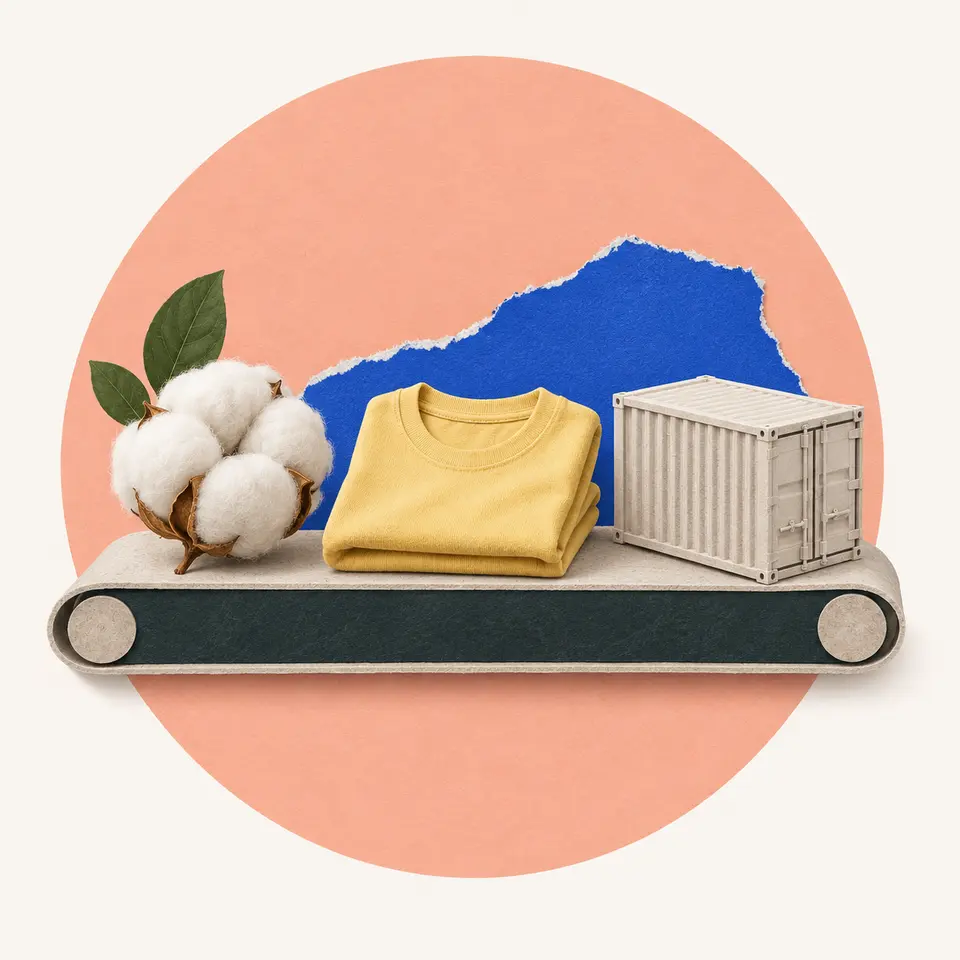
The cotton grew on a Texas farm. It traveled in bales to the port of Shanghai. Trucks took it to plants that knit it into cloth and sewed the cloth into shirts. The shirts sailed back to the US to be sold. Years later, given away, her shirt turned up in used-clothing markets in Tanzania.
That whole sequence of getting inputs, making goods and delivering them is a supply chain. Each stop is a different firm, because each one specializes in a few jobs. A firm's direct supplier is its first-tier supplier. That supplier's own supplier is second tier, and so on back to the farm.
Three things move along a supply chain. Goods travel downstream, from the farm toward the shopper. Money travels upstream, as each firm pays the supplier behind it. When you buy a shirt, the store pays the brand, the brand pays the sewing plant, and the plant pays for its cloth.
Information travels both ways. Orders and sales figures go upstream, telling each supplier what to make. Shipping notices and prices come back down. A firm can plan only with the information it receives, so a chain where orders arrive late or wrong makes the wrong things, even if its trucks run perfectly.
Try to recallIn a supply chain running from a cotton farm to a clothing store, which way do goods, money and information each travel?
Goods travel downstream, from the farm toward the store. Money travels upstream as each firm pays its supplier. Information flows both ways, with orders and sales data going up and shipping notices coming down.
You can now break any product's journey into its separate firms and tiers, and say which way goods, money and information move between them.
Lessons in this topic
Follow one T-shirt from farm to market stall
Trace a cotton T-shirt through the firms that grow, make, ship and sell it, and see the three things that flow between them.
Why a slow supplier means a full warehouse
Learn what lead time is, why a longer wait forces a firm to hold more stock, and how firms cut the wait without faster ships.
The bookshop, the carmaker and the sandwich bar
See why some firms build before you order and others after, and find the point in each chain where stock waits for a customer.
The fire that stopped Toyota's factories
See why firms rely on single suppliers and thin stock, what that cost Toyota in 1997, and how firms decide how much spare to carry.
Three quick stories from this topic
One plant, every brake
In 1997 one burned factory had made about 99% of Toyota's brake valves
The fire at Aisin's plant in Kariya stopped almost all of Toyota's car plants in Japan. Toyota held only days of stock, by design, because one supplier meant lower costs and simpler quality control.
A rescue by rivals
Other suppliers, even a sewing machine maker, built new valves. The first arrived four days after the fire.
The trade
Single suppliers and thin stock save money every day and cost dearly on the rare day something breaks.
Cars built on a guess
Car makers have mostly built cars before anyone ordered them
Building to a forecast fills dealer lots so buyers can drive away quickly. It also ties up billions of dollars in finished cars, which is why some makers build to order instead.
Why not build to order?
A factory that waits for orders sits partly idle when demand drops, so many makers prefer to guess.
Where stock waits
Every chain keeps stock at the point where forecasts stop and real orders take over.
The T-shirt's round trip
One cotton T-shirt crossed the Pacific twice before reaching a market in Tanzania
The economist Pietra Rivoli traced a shirt bought in the US. Its cotton grew in Texas, was knit and sewn near Shanghai, came back to be sold, and was later resold secondhand in Tanzania.
Why she looked
In 1999 a Georgetown protester asked, "Who made your T-shirt?" Rivoli bought a shirt and followed it to find out.
Many firms, one shirt
Farm, port, mill, sewing plant and store are separate firms. Each does one job and passes the product on.
Sources
- What T-Shirts Can Teach Us About Trade, Time (2005)
- Behind Shanghai's Boom Is a Simple T-Shirt, NPR (2005)
- Pulling It Together: Resource Planning, OpenStax, Introduction to Business
- Supply chain, Wikipedia
- Supply chain management, Wikipedia
- 1997 Aisin fire, Wikipedia
- The Toyota Group and the Aisin Fire, MIT Sloan Management Review (Nishiguchi and Beaudet, 1998)
- Build to order, Wikipedia