Business & Organizations · Operations & supply chains
Toyota and lean production
Toyota learned to build cars with little stock and few defects by letting any worker stop the line. See how just-in-time and built-in quality work, where they came from, and what happened when others copied them.

What you will learn
- Explain how a pull system with kanban cards makes only what the next step needs
- Explain why low stock exposes problems that a big stockpile hides
- Explain why Toyota stops work to fix a defect where it happens
- Describe how asking why repeatedly and small daily improvements remove root causes
Lesson 1 of 4 · 4 min
Why Toyota wants almost nothing in stock
In a supermarket you take a carton of milk, and the store refills that gap on the shelf. Nobody fills the shelf on a guess. Taiichi Ohno, the engineer who built Toyota's system, saw that a factory could work the same way.
Toyota calls this just-in-time, making only what is needed, when it's needed, in the amount needed. Each step takes parts from the step before. The earlier step then makes only enough to replace what was taken. Demand pulls work through the plant, instead of a schedule pushing it.
The signal is a kanban, a card that travels with each batch of parts. When a batch is used, its card goes back as an order for more. Toyota's rule is strict. Nothing is made or moved without a card.
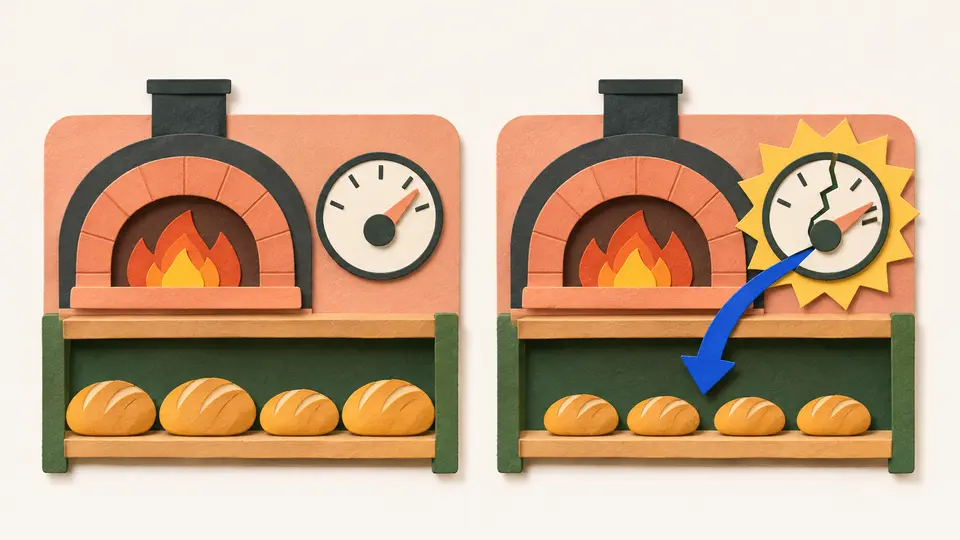
Toyota sets a limit on how many parts may wait at each point. When parts pile past the limit, something upstream is going wrong. Once it's fixed, Toyota lowers the limit again to find the next problem.
Think of stock as water in a river and problems as rocks on the bed. High water hides the rocks. Lower it and you hit them, so you have to clear them. The comparison stops working in one place. A factory chooses to lower its water.
That's why copying the low stock alone fails. Many Western firms that visited Toyota cut stock without fixing the causes, and their lines broke down.
Try to recallWhy does Toyota deliberately keep only a little stock between the steps of its production line?
Stock hides problems. With a big pile, a slow machine or late delivery doesn't stop anything, so nobody fixes it. With little stock, the problem shows up at once and has to be solved, and then the limit can be lowered again.
Toyota makes a part only when a kanban says one was used, and it keeps stock low so every problem surfaces. You can now explain why copying the low stock without fixing problems backfires.
Lessons in this topic
Why Toyota wants almost nothing in stock
See how Toyota makes each part only when the next step asks for it, and why keeping stock low brings hidden problems into view.
The cord any worker can pull
Learn why Toyota lets anyone halt the line when something's wrong, and how asking why and making small fixes keeps the problem from coming back.
How a weaving loom shaped the way Toyota builds cars
Trace Toyota's ideas back to a loom that stopped itself, and see why the hard years after World War II pushed the company toward building less.
When GM, hospitals and coders tried the Toyota way
See what happened when Toyota ran a plant with General Motors, how lean spread far beyond cars, and what Toyota's own recalls revealed about its limits.
Three quick stories from this topic
The loom that stopped
Toyota's way of building cars began with an 1896 weaving loom
Sakichi Toyoda's powered loom stopped itself when a thread broke. That freed weavers from watching each machine, and the idea, called jidoka, now lets any Toyota worker halt a car line.
From looms to cars
The Toyoda loom company set up a car department, which became Toyota Motor in 1937.
Why stop?
A fault caught where it happens costs one fix. Found at the end, it means undoing everything built on top.
GM's worst plant reborn
A car plant once called America's worst matched Japanese quality with the same union
GM shut its Fremont, California, plant in 1982. Reopened with Toyota in 1984 as NUMMI, with the old union leaders rehired, it soon built Corollas with as few defects as those made in Japan.
What changed
Workers trained at a Toyota plant in Japan and learned to stop the line and fix problems where they began.
The hard part
GM struggled to spread the system to its other US plants, despite watching it work up close.
Built like a supermarket
Toyota modeled its factory parts system on American supermarkets
Taiichi Ohno saw that a supermarket refills only what shoppers take. Toyota made each step take parts from the one before, which then makes just enough to replace them.
The card
A kanban card goes back when a batch is used. Nothing is made or moved without one.
Why it matters
Making only what was taken keeps stock low, which brings hidden problems into view.
Sources
- Toyota Production System, Wikipedia
- Toyota Production System, Toyota Motor Corporation
- Kanban, Wikipedia
- Autonomation, Wikipedia
- Sakichi Toyoda, Wikipedia
- NUMMI, Wikipedia