Business & Organizations · Customers & marketing
Advertising campaigns and media buying
Follow a campaign from the client's brief to the agency's idea to the bill for airtime. See how firms buy reach, why sales figures can't show an ad worked, and how they set the budget.

What you will learn
- Describe how a client's brief becomes a creative brief built around a single message
- Explain how the Think Small campaign turned the Beetle's weak points into its message
- Distinguish reach from frequency and explain the trade-off between them
- Use cost per thousand to compare ad slots of very different sizes
Lesson 1 of 4 · 4 min
How a plain little car got the century's best ads
A company has a product, some money and a problem. Maybe nobody knows the product, or people know it and don't like it. So the company, called the client, hires an advertising agency, a firm that makes and places ads for other businesses.
The client starts with a client brief describing the product, the market and what it wants. At the agency, an account manager turns that into a creative brief for the writers and designers.
A creative brief asks plain questions. Who is the audience, and what do they already think? What should the ads achieve, and how will anyone measure it? Its center is the single message, the one thing the audience should remember.
One message matters because it gives everyone a test. Each draft either serves it or doesn't, so the account manager can say whether work is on-brief.
In 1959, Americans were buying big cars for growing families. The Volkswagen Beetle was small and odd-looking. It was also built in Wolfsburg, Germany, in a plant the Nazis had built, which made it harder to sell.
Volkswagen hired the New York agency Doyle Dane Bernbach, or DDB. Its 1959 print ads were mostly white space with a small photo of the car. The headline said "Think small." The copy below listed the advantages of owning a small car.
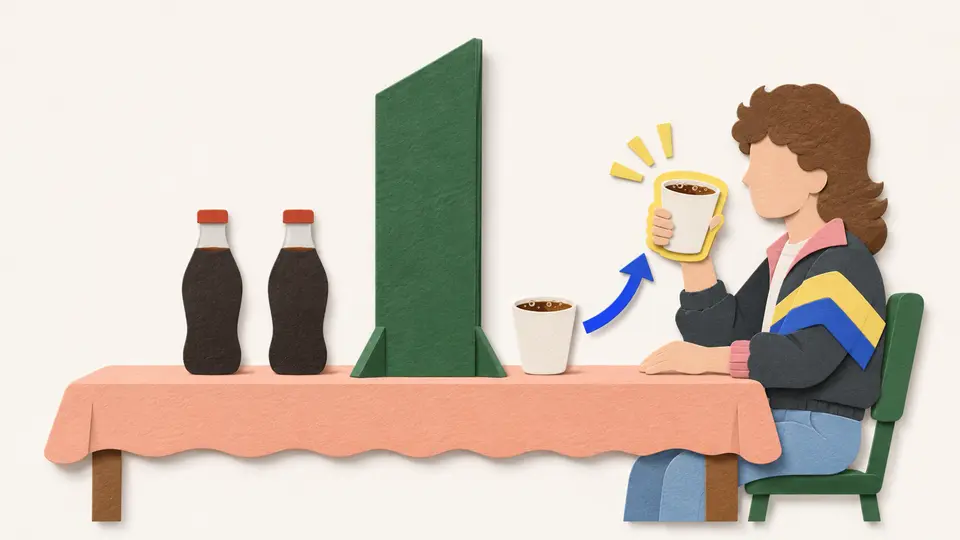
The ads were black and white when color was common. Many of them poked fun at the car's shortcomings and turned each one into a reason to buy. Volkswagen's US ad budget in 1960 was only $800,000, so plain pages also suited the money.
Try to recallWhy did DDB's 1959 Think Small ads admit the Volkswagen Beetle was small and plain instead of hiding it?
Buyers could already see the car was small and odd next to big American cars, so denying it would have rung false. The ads turned each shortcoming into a reason to buy and listed the advantages of a small car. Their honest, plain look also stood out among glossy car ads.
A campaign starts with one message the client and agency agree on. Volkswagen's worked because it was the thing buyers already saw, said out loud and made into a reason to buy.
Lessons in this topic
How a plain little car got the century's best ads
See how a client's brief becomes one message an agency can build on, and how Volkswagen's 1959 Beetle ads made a selling point out of what looked like a flaw.
What $8 million buys in a Super Bowl break
Learn the three numbers media buyers trade in, reach, frequency and cost per thousand, and use them to compare a Super Bowl slot with a local radio spot.
Why sales figures can't tell you an ad worked
See why sales that rise during a campaign prove little, and how switching ads off for a random group measures what they really did, at a steep price in sample size.
How firms decide what to spend on ads
Compare the rules firms use to set an ad budget, see why tying it to sales makes ads vanish in a recession, and learn why many split spending between brand building and quick offers.
Three quick stories from this topic
The ad that coined lemon
A 1960 Volkswagen ad is the first known use of lemon to mean a faulty car
The ad came from the same agency team behind Volkswagen's Think Small campaign. Their ads made a habit of owning up to the car's flaws, and that honesty is what made them stand out.
Owning the flaws
Volkswagen's ads of the time poked fun at the Beetle's shortcomings and turned each into a reason to buy.
Best of the century
In 1999 Advertising Age ranked Think Small the top campaign of the 20th century.
The $8 million half minute
A 30-second Super Bowl ad cost $37,500 in 1967 and about $8 million in 2025
Even adjusted for inflation, the 1967 price is only about $362,000 in 2025 money. The price climbed because the game is one of the few times over 100 million Americans watch the same thing.
Divide by the crowd
The 2025 game averaged 127.7 million viewers. That puts the slot at about $63 for every thousand people watching.
Why brands still pay
No set of smaller ads gathers that many people at once, and the ads themselves become something people talk about.
TV dollars that lose money
For over 80% of 288 brands studied, the last dollars spent on TV ads lost money
The 2021 study found TV ads moved sales much less than earlier research suggested. Only a third of the brands earned back their TV spending overall, which suggests most firms spend past the point where ads pay.
Small effects
Many brands' estimated ad effects were too small to tell apart from zero, or even negative.
Why firms overspend
Ad effects are so hard to measure that a budget can grow for years without anyone seeing that the last dollars don't pay.
Sources
- Creative brief, Wikipedia
- Advertising agency, Wikipedia
- Think Small, Wikipedia
- Volkswagen advertising, Wikipedia
- Ad Age Advertising Century: Top 100 advertising campaigns, Advertising Age (archived copy)
- Lemon (automobile), Wikipedia
- Super Bowl advertising, Wikipedia
- TV advertising effectiveness and profitability: generalizable results from 288 brands, Econometrica (Shapiro, Hitsch and Tuchman, 2021), abstract on EconPapers