Business & Organizations · Customers & marketing
What New Coke revealed about brands
In 1985 Coca-Cola swapped its drink for one that won taste tests, and drinkers revolted. Work out what a brand adds beyond the product, and why that's so hard to measure.
What you will learn
- Explain why Coca-Cola replaced its original formula in 1985
- Explain why drinkers protested a new formula that had won taste tests
- Define brand equity as the value a brand adds beyond the product itself
- Explain why people can judge the same product differently once they see its brand
Lesson 1 of 4 · 5 min
The cola that won the taste tests
In April 1985 Coca-Cola stopped making the drink it had sold for 99 years and put a new formula in its place. The new one had won taste tests against the original and against Pepsi. Within weeks drinkers revolted against it.
The company had reasons to try something. After World War II it held 60% of the market for cola. By 1983 its share had fallen below 24%, largely because of competition from Pepsi.
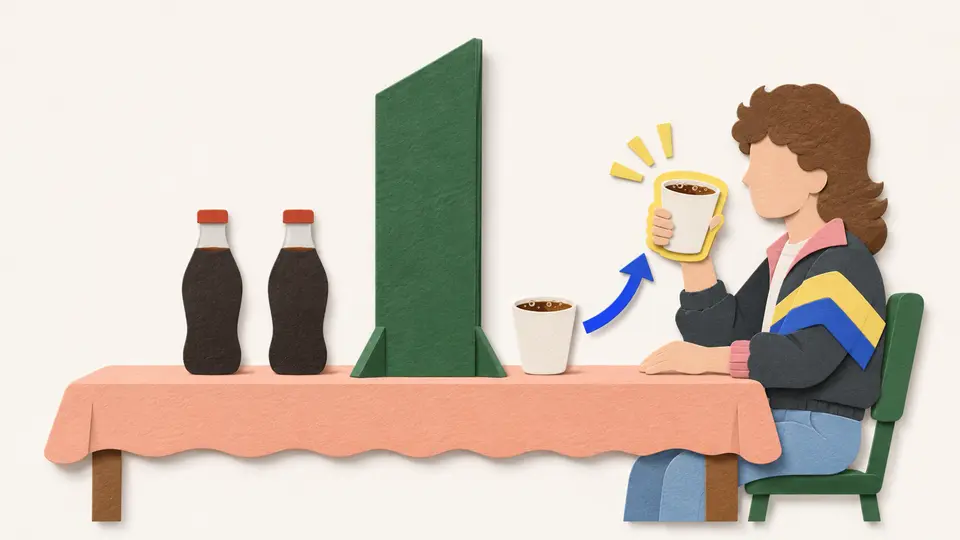
Taste looked like the cause. In blind taste tests, where drinkers don't know which brand they're sipping, people preferred Pepsi's sweeter taste.
So Coca-Cola secretly developed a sweeter formula of its own. It beat both the original Coke and Pepsi in taste tests, surveys and focus groups. The company says the formula was preferred in taste tests of nearly 200,000 consumers. It replaced the original on April 23, and people called it New Coke.
Many loyal drinkers were furious. By June the company's hotline was taking 1,500 calls a day, against 400 a day before the change. One letter to the chief executive, Roberto Goizueta, was addressed to "Chief Dodo, the Coca-Cola Company." It reached him.
Some people filled their basements with cases of the old drink. A man in San Antonio, Texas, drove to a bottler and bought $1,000 worth. A psychiatrist the company hired to listen in on calls said many people sounded as if they were discussing the death of a family member.
For many of them, taste wasn't the main complaint. Carlton Curtis, the company's director of corporate communications, came to see that drinkers were more upset about losing the old formula than about the taste of the new one.
One protester shows the gap between taste and loyalty. Gay Mullins, a retiree in Seattle, formed a group called Old Cola Drinkers of America to lobby for the old formula. Yet in two informal blind taste tests, he either couldn't tell New Coke from the old drink or preferred New Coke.
The company's research had held a warning. Asked whether they'd buy the new drink if it were Coca-Cola, most testers said they would. But about 10 to 12% felt angry and alienated at the thought and said they might stop drinking Coke. The company downplayed that clue. Its own history now says the taste tests didn't show the bond consumers felt with their Coca-Cola.
Try to recallCoca-Cola's new formula beat the original in blind taste tests, yet many drinkers protested when New Coke replaced the original in 1985. Explain what the taste tests missed.
A blind taste test measures only how the drink tastes. It can't capture people's attachment to the brand they know. Many drinkers were more upset about losing the original than about the taste of the new formula. The leader of one protest group couldn't reliably tell the two apart in blind tests. Even in the company's research, some testers were angry at the idea of the change.
Coca-Cola brought the original back as Coca-Cola Classic on July 11, 1985, 79 days after the launch. When word got out, ABC interrupted the soap opera General Hospital to report it. In the next two days the company's hotline took 31,600 calls, about 40 times its daily rate before New Coke.
A blind test hides the brand on purpose, which makes it a fair test of taste. For the same reason it can't show what the brand means to the people who buy it. Coca-Cola had measured the drink. Its customers were attached to more than the drink.
Lessons in this topic
The cola that won the taste tests
Coca-Cola's sweeter formula was preferred in taste tests of nearly 200,000 people. See why drinkers revolted anyway when it replaced the original in 1985.
What a brand adds to a product
See how a name lets a seller charge more for an equivalent product, and how a label can change what people think they taste.
Putting a number on a brand
Work out a brand equity index from market share, price and loyalty, and see why marketers still disagree on how to measure a brand.
Was New Coke a blunder or a clever plan?
Look at the quieter option Coca-Cola turned down, and test the popular claim that New Coke was a clever plan all along.
Three quick stories from this topic
Old Coke's return on TV
ABC interrupted a soap opera in 1985 to report that the old Coca-Cola was coming back
Coca-Cola had replaced its formula that April with a sweeter one that won its taste tests, and drinkers protested by the thousands. When the company gave in, a senator told the Senate it was "a very meaningful moment in the history of America."
What the tests missed
Coca-Cola's own history says the taste tests didn't show the bond consumers felt with their Coca-Cola. Many were more upset about losing the original than about the new taste.
Not planned, says its president
The quick reversal spread a theory that the switch had been planned to boost sales. The company's president answered, "We're not that dumb, and we're not that smart."
The protester's taste test
The man who led the protest against New Coke could not pick old Coke in blind tests
Gay Mullins, a Seattle retiree, founded Old Cola Drinkers of America in 1985 to get the original formula back. In two informal blind tastings he either couldn't tell the drinks apart or preferred New Coke. A blind test hides the brand, and the brand was what drinkers missed.
A warning in the research
Before the launch, about 10 to 12% of testers felt angry and alienated at the thought of the new drink being Coca-Cola. The company downplayed the clue.
What a blind test hides
A blind test removes the brand so that it measures taste alone. Coca-Cola's own history says its tests didn't show the bond consumers felt with their Coca-Cola.
The yellow 7-Up label
A yellower label made 7-Up drinkers say the same drink tasted more lemony
One research firm found the effect with the flavor left identical. Market researchers call it sensation transference. Tasters fold their reaction to the package into their judgment of the taste, without noticing they're doing it.
Blind tests hide the brand
In the original Pepsi Challenge, launched by PepsiCo in 1975, shoppers tasted two colas without knowing which was which. When cups carry brand names, preference ratings change.
Even letters matter
The Pepsi Challenge more often than not labeled the Pepsi cup M and the Coca-Cola cup Q. A preference for one letter may drive some of the results.
Sources
- New Coke, Wikipedia
- New Coke: The Most Memorable Marketing Blunder Ever?, The Coca-Cola Company
- Coca-Cola's Big Fizzle, John Greenwald, Time (magazine archive, article of July 1985)
- Pepsi Challenge, Wikipedia