Technology & Computing · Cybersecurity & privacy
Phishing and online scams
Most online fraud starts with a message that gets someone to click, pay or hand over a code. See how scams pressure people in a hurry, how to check a message, and what to do in the first hour after a mistake.
What you will learn
- Explain how authority, urgency and emotion push you to act before you think
- Explain why phishing pays even though almost everyone ignores it
- Read a link and a sender address to find who really controls them
- Confirm a message through a channel the sender didn't give you
Lesson 1 of 4 · 4 min
Why a scam message makes you hurry
Say a text lands at 5:40 pm. It looks like it's from your bank. A payment of $940 is about to leave your account, and you have 30 minutes to stop it. There's a link. Your first thought is the money, not the sender.
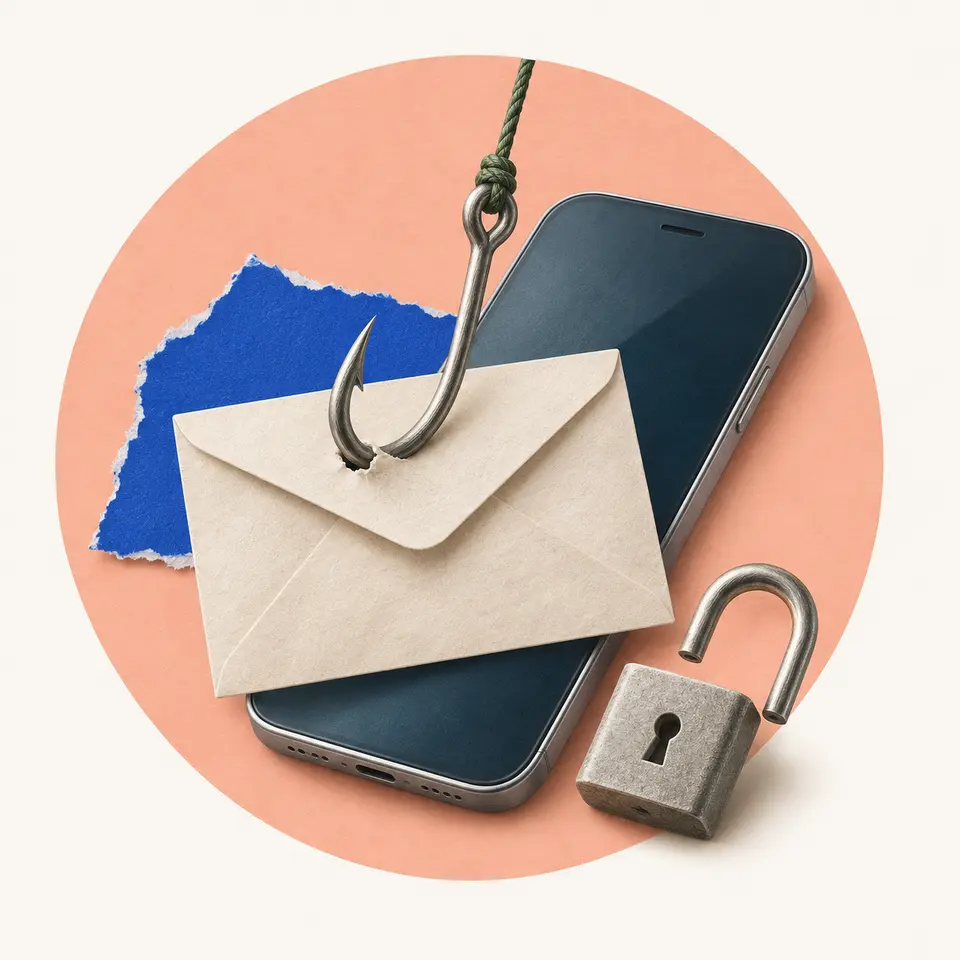
That text is phishing, a fake message that tries to get you to click, pay or hand over details. Most of these messages lean on the same few pressures. The UK's National Cyber Security Centre lists them.
They claim authority, posing as your bank, a doctor or your tax office. They add urgency, such as "reply within 24 hours" or face a fine. They stir emotion, like fear, hope or curiosity. Some offer something scarce, like the last concert tickets. Others ride current events, like a refund offer at tax time.
Every one of these pressures does the same job. It pushes you to act before you think. The psychologist Robert Cialdini found the same levers at work when he trained undercover at car dealers and telemarketing firms. His 1984 book Influence named authority and scarcity among six principles of persuasion.
Companies test their own staff by sending fake lures and counting who clicks. Verizon's 2026 Data Breach Investigations Report puts the median click rate for email tests at 1.4%. Lures sent by text or phone call did better, at about 2%.
That sounds like failure, but sending costs almost nothing. Say a scammer sends a lure to 100,000 addresses. At 1.4%, that's 1,400 clicks. Rented phishing kits copy a bank's login page, so running a campaign takes little skill.
What the scammer wants is a password, a one-time code, a payment or a download that installs malware. The theft often comes in a later step. In 2025 the FBI got more complaints about phishing than any other crime, 191,561 of them. Yet losses filed under phishing itself ranked only 13th.
Some old scams were badly written on purpose, by one researcher's account. Microsoft's Cormac Herley argued that an implausible email repels everyone except the most gullible. The few who reply are then the best targets for the scammer's time.
Try to recallWhy can a phishing campaign make money when roughly 98 or 99 of every 100 people ignore it?
Sending a fake message costs almost nothing, so a scammer can send it to huge numbers of people. Even a small click rate across 100,000 messages gives over a thousand responses. Each one can lead to a password, a code or a payment, so the few who answer pay for the whole campaign.
A phishing message uses authority, urgency and emotion so you act before you think. It works on volume, because a tiny share of clicks from a huge send is enough to pay.
Lessons in this topic
Why a scam message makes you hurry
See the pressures phishing messages use to make you act before you think, and why scammers profit even when almost everyone ignores them.
How to check a message before you trust it
Learn to read who really owns a link or a sender address, and why the safest check is to contact the organization yourself.
When the scam is built for one person
See how targeted scams use real details, live calls and faked faces, and how romance and investment scams spend weeks on trust before taking money.
What to do in the first hour after a scam
Learn the order of first steps after a scam, starting with the money, where to report, and why blaming the victim helps the scammer.
Three quick stories from this topic
Money frozen in time
An FBI team froze 58% of the money scammers tried to move in the 2025 cases it took on
Across 3,900 cases, the Recovery Asset Team froze $679 million of $1.16 billion. It works with banks to stop transfers before the money moves on, which is why the FBI says to report a fraudulent transfer at once.
Speed is the point
Scammers move money through many accounts quickly. A freeze only works while the trail is fresh.
Giving it a chance
Call your bank and ask for a recall, then file a report at ic3.gov with the full transaction details.
The all-deepfake video call
A finance worker sent $25 million after a video call where every colleague was a deepfake
The worker in Arup's Hong Kong office first suspected the email asking for a secret transaction. Then the faces and voices of colleagues he recognized put his doubts aside. He sent HK$200 million in 15 transfers.
Doubt came first
The email looked like phishing to him. The video call, with a fake chief financial officer, is what changed his mind.
Why a call back works
Faces and voices can now be faked. A call to a number you already had reaches the real person.
Most reported, not most costly
Phishing was the crime most reported to the FBI in 2025, yet only 13th for losses
There were 191,561 phishing complaints and about $216 million in losses filed under phishing. A phishing message usually opens the door, and the theft tends to happen in a later step, like a fake invoice or a taken-over account.
Where the money went
Investment scams led losses at $8.6 billion, and business email compromise came next at $3 billion.
Why the click matters
The message is often how a scam starts. Stopping it there stops the theft that would have followed.
Sources
- Phishing scams: how to spot a scam email, text message or call, National Cyber Security Centre (UK)
- Phishing, Wikipedia
- Robert Cialdini, Wikipedia
- 2026 Data Breach Investigations Report, Verizon
- 2025 IC3 Annual Report, FBI Internet Crime Complaint Center
- Advance-fee scam, Wikipedia
- British engineering giant Arup revealed as $25 million deepfake scam victim, CNN