Mind & Psychology · Personality & development
The fundamental attribution error and its limits
People read an essay written to order as the writer's real opinion. See what the fundamental attribution error is, which famous claim about it failed its tests, and how it varies across cultures.
What you will learn
- Describe the fundamental attribution error and the 1967 study that demonstrated it
- Name the explanations offered for why it happens
- State the actor-observer hypothesis and what the meta-analysis found
- Explain how a well-supported early result can fail to survive
Lesson 1 of 4 · 6 min
Why we judge the person and overlook the situation
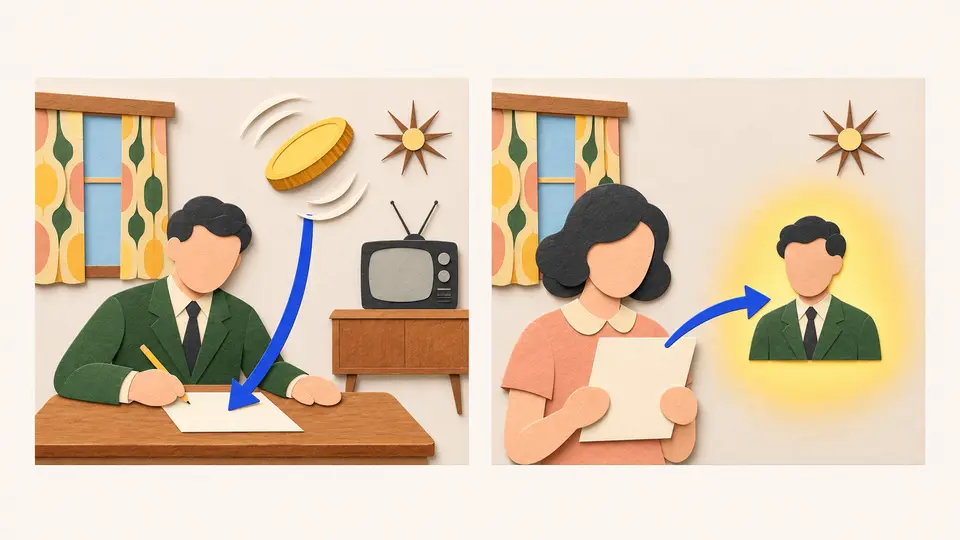
In 1967, Edward Jones and Victor Harris gave people essays about Fidel Castro to read. Some essays praised him and some attacked him. Readers then rated what each writer really thought of Castro.
One group was told the writers had picked their own side. They rated the pro-Castro writers as more favorable to him, which makes sense.
Another group was told a coin toss had assigned each writer a side. An essay written to order tells you little about its author. Yet these readers still rated the pro-Castro writers as more favorable to Castro. Jones and Harris had predicted the opposite.
Ten years later, Lee Ross gave the effect a name, the fundamental attribution error. When you explain someone else's behavior, you give too much weight to their character and too little to their situation. He's late, so he must be selfish. You don't think of the traffic.
Jones called the name "overly provocative and somewhat misleading." He also joked, "I'm angry that I didn't think of it first."
The error isn't believing in traits. People do differ. The error is reading a trait into behavior that the situation already explains.
Three explanations compete, and each makes predictions that can be tested.
The simplest is the salience account. When you watch someone act, the person fills your view. The traffic, the deadline and the boss's orders are out of sight. You explain what you see by what you're looking at.
The second is called lack of effortful adjustment. First you read the behavior as a sign of character, automatically. Then you're supposed to adjust for the situation, and that takes effort. Skip the second step and the first impression stands.
This account predicts more errors when people are tired or distracted, under what psychologists call cognitive load. That's what studies find. It also explains why knowing about the coin toss wasn't enough.
The third is about comfort. In the 1960s Melvin Lerner began studying the just-world fallacy, the belief that people get what they deserve. If failures come from bad character, the world is fair and your own fate is in your hands.
That comfort has a price. In Lerner's 1966 experiment, observers watched a woman receive what looked like electric shocks. They couldn't stop it. As it went on, they began to think less of her.
Try to recallWhy would someone who is tired or distracted make the fundamental attribution error more often? Answer with the account that predicts it.
The lack of effortful adjustment account predicts it. You first read behavior as a sign of character, automatically. Correcting that reading for the situation takes effort. A tired or distracted person, under cognitive load, has less to spend on the correction, so the first impression stands. The same account explains why the error survives even when you know about the situation.
Next time someone cuts you off or snaps at you, notice how fast "what a jerk" arrives. That's the automatic first step. The correction is a deliberate question. What situation could make a decent person do this? The readers in 1967 knew about the coin toss and still skipped that step.
Lessons in this topic
Why we judge the person and overlook the situation
Readers knew a coin toss had decided which side each essay argued, and still took the essays as the writers' real views. See the 1967 study and three explanations for it.
The famous attribution claim that failed its tests
Psychologists long held that you explain your own behavior by circumstances and other people's by character. A review of 173 studies found the effect was close to zero.
What the attribution error does and doesn't claim
Three labels in this field are often used as one. Pull them apart and you can see which claim the evidence supports, which it doesn't, and what the critics argue.
Is the attribution error the same in every culture?
American and Indian adults explained the same kinds of behavior differently. See what the cross-cultural studies found, the proposed reason, and what a group difference can't tell you.
Three quick stories from this topic
173 studies, no effect
A famous rule for how we explain ourselves came out near zero across 173 studies
The rule says you put your own actions down to circumstances and other people's down to their character. A 2006 review found it holds only for bad outcomes. For good outcomes it flips, and people credit themselves. Averaged together, nothing is left.
Where the rule came from
Edward Jones and Richard Nisbett proposed it in 1971, and early experiments backed it. It came to be described as robust and firmly established.
What was left
The review pooled studies published from 1971 to 2004. Its author suggested the split between bad and good outcomes may reflect a self-serving habit, and he found finer differences in the reasons people give.
Blaming the victim
Observers who couldn't stop a woman's apparent electric shocks began to think less of her
In a 1966 experiment at the University of Kansas, 72 observers watched what looked like a learner being shocked for her mistakes. The more she seemed to suffer, the more they devalued her. When they were told she'd be compensated, they didn't.
The just-world belief
Melvin Lerner explained the result with the belief that people get what they deserve. If suffering can't be stopped, deciding the victim deserved it keeps the world feeling fair.
The link to blame
The same belief is one proposed reason people explain others' failures by their character instead of their circumstances.
The coin toss they ignored
Readers took essays as sincere even after learning a coin toss picked each writer's side
In a 1967 study, people read essays for or against Fidel Castro and rated what each writer really thought. Told the sides were assigned by coin toss, they still rated the pro-Castro writers as more favorable to him. The researchers had predicted the opposite.
The result
Readers who knew about the coin toss still rated the writers of pro-Castro essays as more positive toward Castro than the others.
What it's called
Observers underweight the situation and overweight character. Lee Ross named it the fundamental attribution error ten years later.
Sources
- Fundamental attribution error, Wikimedia Foundation
- Actor observer asymmetry, Wikimedia Foundation
- Victims, Vignettes, and Videos: Meta-Analytic and Experimental Evidence That Emotional Impact Enhances the Derogation of Innocent Victims, Personality and Social Psychology Review
- Evaluation of performance as a function of performer's reward and attractiveness, Journal of Personality and Social Psychology
- Observer's reaction to the "innocent victim": compassion or rejection?, Journal of Personality and Social Psychology
- Just-world fallacy, Wikipedia, Wikimedia Foundation
- The actor-observer asymmetry in attribution: a (surprising) meta-analysis, Bertram Malle, Psychological Bulletin, 2006 (PubMed record)