Mind & Psychology · Emotions & motivation
How emotions work, from racing heart to smile
An emotion combines a feeling, a bodily change, a reading of the situation and an expression. See how the parts fit together, and why neither a racing heart nor a smile tells you what someone feels.

What you will learn
- Identify several components of an emotional episode
- Explain why a bodily response alone can't pin down which emotion someone feels
- Explain appraisal with a concrete contrast
- Distinguish influencing an emotional response from commanding it to disappear
Lesson 1 of 4 · 3 min
The four parts of an emotion
Say two people are invited to speak in front of a group. Both feel their hearts pound. One calls it excitement and the other calls it dread. If their bodies are doing the same thing, what makes these two different emotions?
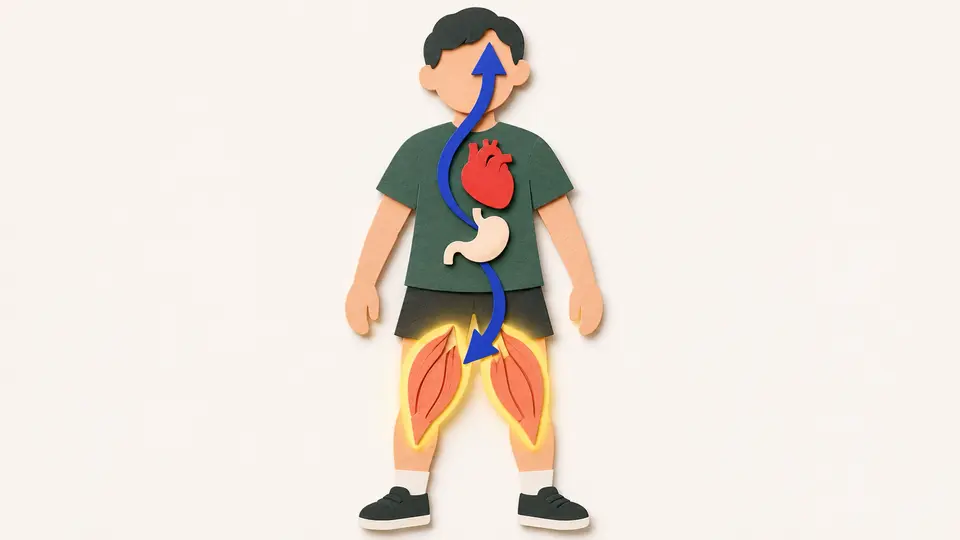
An emotion has four parts. There's the feeling itself, which only you can report. There are bodily changes, such as a faster heartbeat or sweating. There's an appraisal, meaning your reading of what the situation means for you. And there's an expression, the part other people can see or hear.
It's tempting to line the four parts up, as if the event comes first, then the body, then the feeling. Psychologists haven't settled on an order, and some parts may happen at the same time.
What's clearer is that the parts shape each other. Say your stomach churns. In a bakery, your brain may make hunger of it. In a waiting room before medical test results, the same churn may become worry. The psychologist Lisa Feldman Barrett uses this pair to show that one bodily state can feed two different experiences.
A 1962 experiment shows how much the appraisal does. Schachter and Singer injected men with epinephrine, also called adrenaline, which makes the heart race. Each man then waited with a stranger who acted either euphoric or angry. Men who'd been told what the injection would do reported no change in emotion. Men with no explanation for their pounding hearts were more likely to feel euphoric or angry, matching the stranger.
So a racing heart doesn't single out fear, joy or anger, and it doesn't single out lying either.
A polygraph, the machine known as a lie detector, records this kind of arousal while someone answers questions. Its accuracy is highly questionable, because there's no evidence that lying comes with any particular pattern of arousal. The machine can measure the body correctly and still leave the examiner wrong about the mind.
Back to the two speakers. Their hearts are doing the same thing. One sees a welcome chance to share an idea, and the other expects embarrassment. The pounding is the same kind of signal, and the appraisal decides what it becomes.
Try to recallWhy isn't a racing heart enough evidence that someone is lying?
A racing heart is arousal, and arousal goes with fear, excitement and anger as well as lying. There's no evidence that lying has an arousal pattern of its own. So a polygraph can record the heartbeat accurately and still can't say what caused it. That takes the situation and the person's reading of it.
An emotion is a feeling, a bodily change, an appraisal and an expression working together. So when you notice one part, in yourself or in someone else, treat it as one clue. A pounding heart tells you a body is worked up. It can't tell you whether that's stage fright, excitement or the strain of a lie. For that you need the situation and the person's reading of it.
Lessons in this topic
The four parts of an emotion
An emotion has a feeling, a bodily change, a reading of the situation and an expression. See why a pounding heart alone can't tell you which emotion someone has, or whether they're lying.
Why the same message scares one person and not another
Learn what appraisal is, and why rethinking a situation can change a feeling when hiding the feeling doesn't.
Why a smile doesn't prove someone is happy
See what research on real faces found, including judo winners who rarely smiled, and why software can't read a feeling from a face.
Which comes first, the racing heart or the fear
Compare three classic theories of emotion, then see how an adrenaline injection experiment tested them and what it left unsettled.
Three quick stories from this topic
What a lie detector measures
A lie detector records a racing heart, and no pattern of arousal is known to mark a lie
A polygraph tracks signs of arousal, such as heart rate, breathing and sweating, while someone answers questions. Strong emotions of any kind raise the same signs, and there's no evidence that lying comes with a pattern of its own.
What the examiner looks for
Someone trained to read the test looks for answers that come with more arousal and treats them as possible signs of dishonesty.
Why arousal isn't enough
In a 1962 experiment, men injected with adrenaline and not told what it would do were more likely to feel euphoric or angry, matching a stranger in the room. The same arousal took its meaning from the situation.
Judo winners rarely smiled
Only 8 of 55 winning judo fighters gave a full smile, all while interacting with someone
The full smile, which crinkles the corners of the eyes, is often taken as a sign of real happiness. In field studies of judo winners, whether a fighter was interacting with an audience predicted that smile better than how happy the fighter reported feeling.
A second study agreed
In a second study, 25 of 119 winning fighters produced the eye-crinkling smile. A 2019 review counted this as weak evidence, at best, that the smile reliably goes with happiness.
What a smile tells you
When one analysis pooled 47 studies, the facial expression expected for an emotion appeared about 19% of the time. A face is a clue to be read with the situation.
Hiding a feeling stirs the body
People told to hide their disgust looked calm while their bodies grew more aroused
In a 1998 experiment, 120 people watched a disgusting film. Those told to let nothing show did hide it, but activity rose in their sympathetic nervous system, which puts the body on alert. Only people told to rethink the film reported feeling less disgust.
Two ways to manage a feeling
Suppression means hiding the outward response. Reappraisal means changing how you read the situation, so that the feeling itself changes.
Same face, different body
Both groups showed less on their faces than people who simply watched. The difference lay underneath, in what they felt and how their bodies reacted.
Sources
- Emotion, OpenStax, Psychology 2e
- Emotional Expressions Reconsidered: Challenges to Inferring Emotion From Human Facial Movements, Barrett et al., Psychological Science in the Public Interest; PMC full text
- Fight-or-flight response, Wikimedia Foundation
- Antecedent- and response-focused emotion regulation: divergent consequences for experience, expression, and physiology, Journal of Personality and Social Psychology (PubMed record)