Language & Communication · How language works
How signed languages use space
Find out how a sign language builds words from the hands and face, and how it turns the space around a signer into grammar.
What you will learn
- Explain why Deaf communities in different countries use different sign languages
- Explain why an iconic sign still has to be learned as a convention
- Name the five parameters that signs are built from
- Explain how minimal pairs show that sign languages have their own phonology
Lesson 1 of 4 · 5 min
Why there isn't one sign language
Say a deaf signer from the US meets a deaf signer from Britain. Both grew up surrounded by English. They can't understand each other's signing.
American Sign Language, or ASL, and British Sign Language aren't even related. ASL is related to French Sign Language, known as LSF from its French name, Langue des Signes Française. ASL took shape in the early 1800s, when LSF met the sign languages already used in some North American villages. One of those was on the island of Martha's Vineyard.
So a sign language doesn't copy the spoken language around it. ASL is a complete language with a grammar that differs from English. It has drifted from its French relative too. ASL and LSF still share some signs, but their users can no longer understand each other.
There's no universal sign language either. Most countries have their own, and some have several. The 2021 edition of Ethnologue, a catalog of the world's languages, listed 150. Another survey, the SIGN-HUB atlas, lists over 200 and says more are still undocumented.
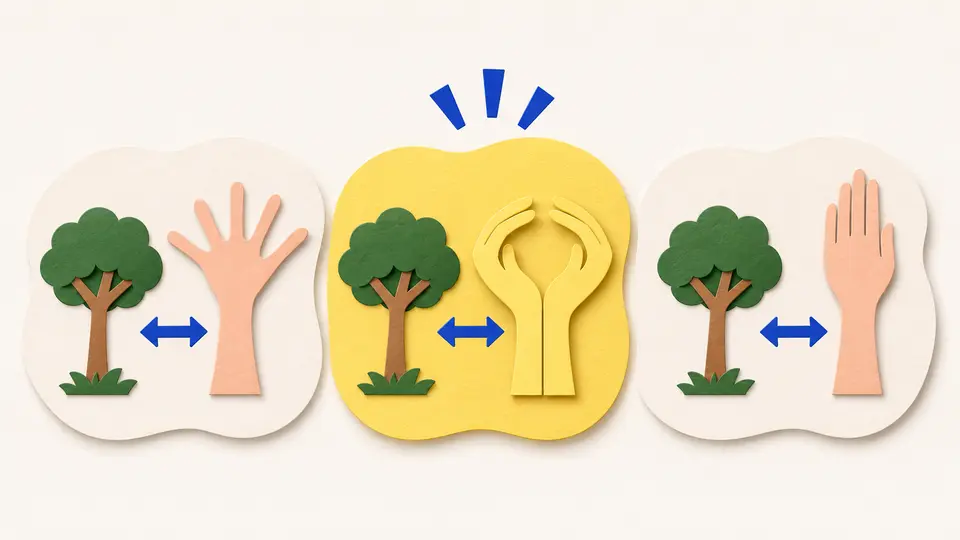
Many signs look like what they mean. Linguists call such signs iconic. Spoken words rarely manage this, and onomatopoeia, words that sound like what they name, sits at the edge of spoken languages. A language made with the hands and taken in by the eyes has far more room for resemblance.
But iconic doesn't mean obvious. Signs are written as English words in capitals, so TREE is the sign for tree. American, Chinese and Danish Sign Language each have a TREE that evokes a tree's shape. Each evokes it differently, and each language has fixed its own version.
A signer can't swap in another form because it looks more like a tree. As one linguistics lecture puts it, "Conventionality trumps iconicity." The agreed form beats the more picture-like one.
The picture can also wear away. ASL's HOME comes from EAT plus BED, and SISTER from GIRL plus SAME. JOT comes from PUT plus PAPER, yet native signers no longer see those parts in it. English speakers do the same with cupboard, where few still hear cup and board.
Try to recallAmerican, Chinese and Danish Sign Language each have an iconic sign for tree. Why can't someone who doesn't sign simply work out which one a language uses?
Each sign evokes a tree's shape, but each does it in a different way, so resemblance alone doesn't tell you which form a language chose. The form is a convention of that language, and signers can't swap in another sign even if it looks more like a tree. Iconic origins also fade, as in ASL HOME from EAT plus BED, so the sign has to be learned like any word.
Two things keep sign languages apart. Each grew from its own history, which is why ASL is related to French Sign Language and not to British. And each has fixed its own forms by convention, even for something as easy to picture as a tree.
Lessons in this topic
Why there isn't one sign language
American and British signers can't understand each other, because a sign language doesn't copy the speech around it. Even a sign that looks like what it means has to be learned.
The five parts every sign is built from
Break a sign into handshape, location, movement, orientation and the face, and see how changing one part makes a different word.
Pointing at people who aren't there
See how signers park absent people at spots in space, then point and move between those spots to show who did what.
How a hand becomes a car, a person or a plane
See how a handshape can stand for a car or a person, how its path shows what happened, and which part of that anyone could mime.
Three quick stories from this topic
ASL's French relative
American Sign Language is related to French Sign Language, not to British Sign Language
A deaf American and a deaf Briton can't understand each other's signing, though both grew up around English. ASL took shape in the early 1800s from French Sign Language and local North American sign languages. A sign language doesn't copy the speech around it.
No universal sign language
Most countries have their own sign language, and some have several. The 2021 edition of Ethnologue listed 150.
Even the French link has faded
ASL and French Sign Language still share some signs, but their users can no longer understand each other.
Late or not yet
In American Sign Language, only the tongue and head separate "late" from "not yet"
The hands do the same thing in both. For "not yet," the tongue touches the lower lip and the head turns from side to side. The face carries grammar in ASL as well, and raised eyebrows mark a yes-or-no question.
Five parts of a sign
Linguists describe a sign by its handshape, location, movement, orientation and non-manual features such as the face and head. Changing one can make a different word.
Like bad and dad
CANDY and APPLE differ only in handshape, the way bad and dad differ in one sound. Pairs like these show that signs are built from small parts with no meaning of their own.
Pointing at empty space
ASL signers park absent people at spots in the air and point back to them later
A signer names someone and points to an empty spot, and that spot stands for the person from then on. A verb like "see" can then move from one spot to another to show who saw whom. In practice signers use no more than eight spots.
The spot works as a pronoun
Linguists call the spot a locus. Pointing at it does the job that she or him does in English, referring back to someone already named.
Verbs that travel
The sign SEE moving from the dog's spot to the cat's means the dog sees the cat. Reverse the movement and the cat sees the dog.
Sources
- Sign language (Linguistics 001 lecture slides, Fall 2016), University of Pennsylvania, Department of Linguistics
- American Sign Language, National Institute on Deafness and Other Communication Disorders
- Sign language, Wikipedia
- American Sign Language grammar, Wikipedia