Language & Communication · Translation & intercultural communication
How interpreters keep up with a speaker
See how interpreters carry a speech into another language within seconds, and what working that fast costs them.
What you will learn
- Distinguish consecutive, simultaneous and whispered interpreting by when and where the interpreter speaks
- Explain what an interpreter's A, B and C languages are and which way each one works
- Explain why the Nuremberg trial used simultaneous interpreting instead of the consecutive kind
- Describe how the courtroom's equipment and rules kept speakers and interpreters in step
Lesson 1 of 4 · 5 min
Three ways to interpret a speech
In the days before interpreting booths, a star interpreter named André Kaminker could listen to a speech for an hour and a half, without notes, and then deliver all of it in another language. A translator works on written text, with time to look things up and revise. An interpreter works on speech, on the spot.
Kaminker's method is consecutive interpreting. Speaker and interpreter take turns. The interpreter listens, usually taking notes, then conveys the message in the other language. It needs no special equipment, and the audience has to sit through everything twice.
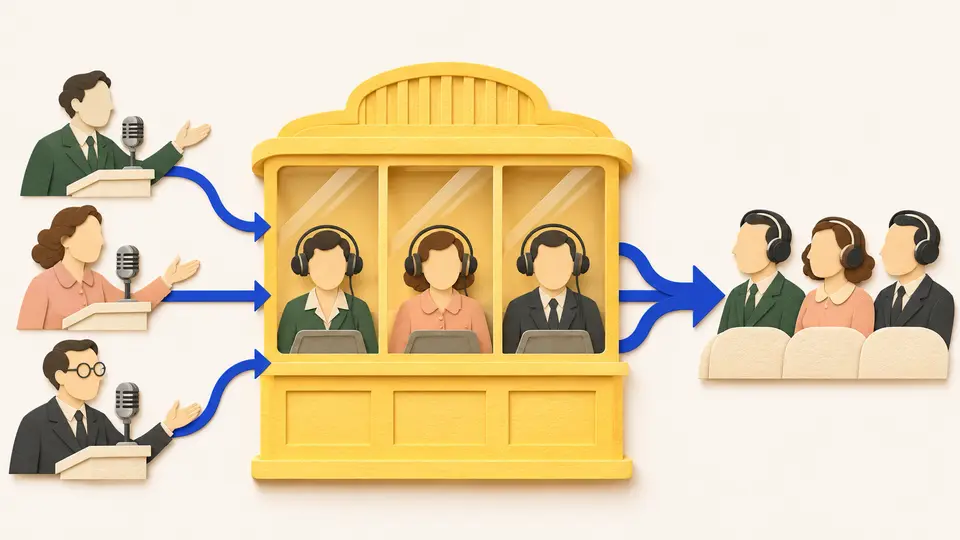
In simultaneous interpreting, nobody waits. Interpreters sit in soundproof booths and relay the message in real time, and listeners follow on headsets.
Whispered interpreting, known by its French name chuchotage, is simultaneous interpreting for one or two people with no booth. The interpreter sits close to the client and speaks in a low voice. There's usually no actual whispering. A whisper is hard to make out, and straining to be heard at one "can be as bad for your voice as shouting."
The mode is half of the job. The other half is direction. Conference interpreters sort their working languages into three classes.
The A language is the mother tongue, and an interpreter works into it from all their other languages. A B language is active, so the interpreter works both from it and into it. A C language is passive. The interpreter works from it and never into it, and many interpreters have several.
So the question to ask an interpreter is which way they go. Say someone has Spanish as an A language and Italian as a C. They can take Italian into Spanish all day, and they can't take Spanish into Italian.
The first large trial of simultaneous interpreting was built on this logic. At Nuremberg in 1945, the interpreters were split into four sections, one for each language of the court. Each section had three interpreters, and all three worked into the same language, their mother tongue. In the English section, one took the German, one the French and one the Russian.
Try to recallAn interpreter has English as her A language, French as a B language and German as a C language. In which directions can she work?
She can work from French and from German into English, her A language, since interpreters work into their mother tongue from their other languages. French is a B language, an active one, so she can also work from English into French. German is a C language, a passive one, so she works from German but not into it. A meeting that needs interpreting into German would need a colleague who works into German.
To book an interpreter you need two answers. Should the interpreting follow the speaker or run alongside? And which language do your listeners need to hear? An interpreter can deliver only into an A or a B language.
Lessons in this topic
Three ways to interpret a speech
Find out how consecutive, simultaneous and whispered interpreting differ, and how interpreters sort their working languages.
The trial that ran in four languages
Consecutive interpreting would have made the Nuremberg trial last four times as long, so its interpreters worked in real time, alongside each speaker.
Why a late German verb makes interpreters wait or guess
Simultaneous interpreters stay a few seconds behind the speaker, and a German verb that comes last can stretch that lag or force a guess.
Why interpreters swap every half hour
See why simultaneous interpreters hand over the microphone about every half hour, and what a small study found when they kept going.
Three quick stories from this topic
Half an hour of interpreting
In 30 minutes an interpreter delivers more words than a staff translator writes in a day
At a comfortable speaking pace, a 30-minute turn means taking in and delivering 3,000 to 3,900 words, about 12 to 15 typed pages. Staff translators produce 3 to 10 pages a day, a 1998 University of Geneva study noted. So interpreters swap about every half hour.
Why they work in pairs
Conference interpreters work stints of 20 to 30 minutes, in teams of at least two per language. Their professional standards cite the physical and mental fatigue of sustained concentration.
They can't tell when they slip
In the same study, meaning errors rose steadily as interpreters kept going. Three of five carried on for another half hour, apparently unaware of the decline.
Put the verb early
A Nuremberg defendant urged the others to put their verbs early to help the interpreters
Hans Fritzsche wrote "Suggestions for Speakers" for his fellow accused, asking for short sentences with the verb near the front. German often holds the verb to the end, so interpreters working into English had to wait for it or guess. Many defendants believed better interpretation meant better chances of survival.
Why the verb mattered
The National WWII Museum counts German sentence structure, with its long sentences and verbs placed at the end, among the challenges interpreters faced at Nuremberg. English needs its verb early, so an interpreter working into English has to wait for a late verb or guess it.
Time to think
Many defendants spoke English and other languages but used the wait for interpretation to gather their thoughts, gain time and perhaps slow the proceedings. Sometimes Speer or Göring saw interpreters struggling with words, wrote the translation on paper and passed it to the booth.
One in twenty passed
Of the 700 people tested to interpret the Nuremberg trial, roughly 5% could do the job
Candidates first had to name ten trees, ten car parts and ten farm tools in two languages. Then came mock trials on the new equipment, listening in one language while speaking in another. Those who failed were reassigned to work the interpreters called "Siberia."
A skill nobody had
Before Nuremberg, only limited experiments in simultaneous interpreting had been done. Listening in one language while speaking in another seemed impossible at first.
Who passed
The court ended up with 36 interpreters working in three teams of 12. Those who performed well were typically between 35 and 45 years old.
Sources
- Translating and Interpreting the Nuremberg Trials, The National WWII Museum
- Working with AIIC Interpreters, AIIC, International Association of Conference Interpreters
- About interpreting, AIIC Switzerland
- Language interpretation, Wikipedia
- Cognitive load in simultaneous interpreting: Model meets data, International Journal of Bilingualism, via University of Geneva
- Simultaneous interpretation, Wikipedia
- Prolonged turns in interpreting: Effects on quality, physiological and psychological stress, Interpreting, via Archive ouverte UNIGE
- AIIC Professional Standards, AIIC, International Association of Conference Interpreters