Language & Communication · Conversation & body language
Body language and what it can tell you
Gaze, posture and distance carry real information, though far less reliably than popular books claim. See what the body adds to talk, where the '93%' figure came from, and what happened when famous claims were retested.

What you will learn
- Describe how gaze helps manage turns and shows attention in conversation
- Explain why the same body signal can repeat, replace or contradict the words, so context decides its meaning
- Describe what Albert Mehrabian's 1967 experiments tested and how he combined them into the 7-38-55 rule
- Explain why the 7-38-55 figures don't apply to ordinary conversation
Lesson 1 of 4 · 4 min
What your body does while you talk
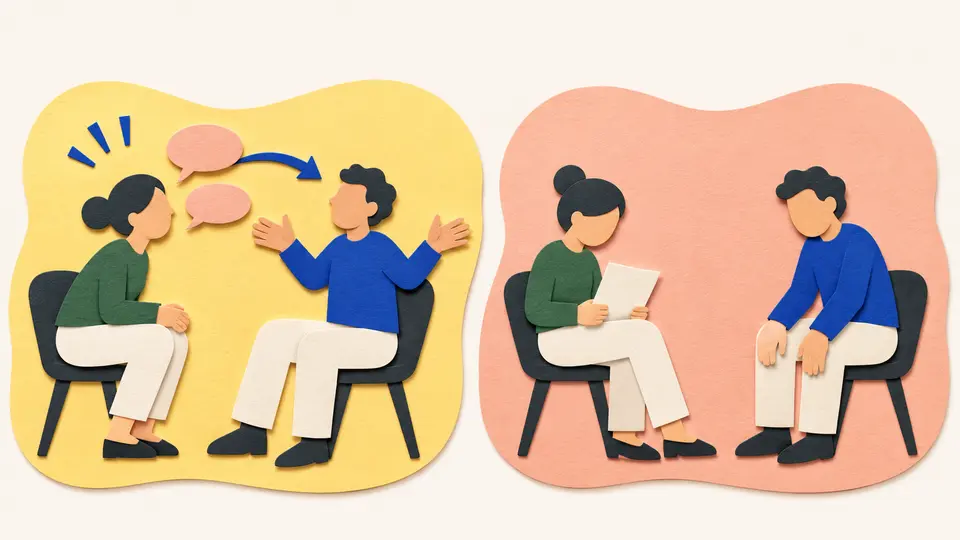
Say you're telling a friend about your weekend. While you plan the next sentence, your eyes drift away. As you reach the end, you look back, and your friend starts talking. Neither of you thought about it. That small return of gaze handed over the turn.
People who study conversation find that speakers tend to look away mid-turn and look back at the next speaker as they finish. So gaze helps manage turns, along with pauses and the shape of the sentence. Eye contact also shows attention, because looking at someone is the plainest sign you're following them.
How much people look varies a lot. In a 2009 study of ten languages, speakers looked at the person they were asking in 21% of questions among speakers of ‡Ākhoe Hai‖om and 88% among Japanese speakers. So a steady gaze that feels attentive in one place can feel intense in another.
Body signals don't run on a separate track. They work with the words, and you can sort them by what they do to the spoken message. A nod while you say yes repeats it. A thumbs-up with no words substitutes for it. Saying 'I'm fine' with a slumped back contradicts it.
Other signals complement the words, like a pointing hand that adds to 'that way'. Some regulate the talk, like the look that hands over a turn. Some accent a word, the way a sharp hand movement stresses one syllable.
So a body signal has no fixed meaning. Crying can come from sadness or from joy. A nod means agreement in some cultures and disagreement in others. You read a signal through the words and setting around it, which means a posture pulled out of context tells you little.
Try to recallSomeone says 'I'm not upset' while staring at the floor with arms tightly folded. How do the body signals and the words relate, and why can't you read the posture on its own?
The posture contradicts the words, which is one of the ways body signals work with speech. But folded arms and a lowered gaze don't carry one fixed meaning. You'd need the setting, such as whether the person is cold or tired, before deciding what it says.
Your eyes hand over turns and show you're listening. Your body repeats, replaces, adds to or contradicts your words, and the setting tells others which.
Lessons in this topic
What your body does while you talk
Learn how your eyes help hand over turns and show you're listening, and why a body signal means little without the words and setting around it.
Where the 93% figure came from
Find out what Albert Mehrabian's 1967 experiments really measured, and why '93% of communication is nonverbal' doesn't describe ordinary talk.
How close is too close
Learn Edward Hall's four zones of personal space, and what a 42-country survey found about how far people like to stand from strangers, friends and partners.
What happened when body language claims were retested
See how the famous power pose fared in larger studies, and why the world's favorite sign of a liar barely works.
Three quick stories from this topic
The look-away myth
The world's most common sign of a liar, looking away, has little link with lying
In a 2006 study across 58 countries, 66% of people named gaze aversion as the way to spot a liar. A review of 158 possible cues found it barely differs between liars and truth tellers.
Near chance
In studies of 24,483 judges, people sorted lies from truths correctly 54% of the time. Guessing gets 50%.
What does show
Liars tended to seem more tense and tell less forthcoming stories, but no single movement gives them away.
Distant strangers, close partners
Romanians kept strangers farthest away of 42 countries, but partners among the closest
People marked on a diagram how close others could come. Romanians wanted strangers about 140 cm away, the largest gap of any country, yet put intimate partners at about 50 cm. Relationship reshuffles the country rankings.
Nearly 9,000 people
The 2017 study asked 8,943 people in 42 countries about strangers, acquaintances and partners. Argentinians let strangers come closest, at about 80 cm.
Preferences, not behavior
The numbers are what people said they'd prefer on a drawing. Women and older people wanted more space, and warmer countries let strangers closer.
Where 7-38-55 came from
The famous rule that words carry 7% of meaning was based on single spoken words
Listeners in 1967 heard words like 'dear' or 'terrible' in different tones and judged the speaker's feelings. Albert Mehrabian later said the formula doesn't apply unless someone is talking about feelings or attitudes.
Two studies, one ratio
A second study paired photos of faces with a taped voice. Mehrabian combined both results into 7% words, 38% voice and 55% face.
Why it misleads
The tests used lone, mismatched words and only women. Later studies of posture and of mood gave very different weights.
Sources
- Turn-taking, Wikipedia
- Nonverbal communication, Wikipedia
- Universals and cultural variation in turn-taking in conversation, Proceedings of the National Academy of Sciences (via PubMed Central)
- A world of lies, Journal of Cross-Cultural Psychology (via PubMed Central)
- Cues to deception, Psychological Bulletin (PubMed)
- You're in my space: how preferred interpersonal distance varies across the world, British Psychological Society Research Digest
- Preferred interpersonal distances: a global comparison, Journal of Cross-Cultural Psychology (University of Warwick repository)
- Albert Mehrabian, Wikipedia
- Silent Messages: a wealth of information about nonverbal communication, Albert Mehrabian