Arts & Culture · Music & sound
Why instruments sound different
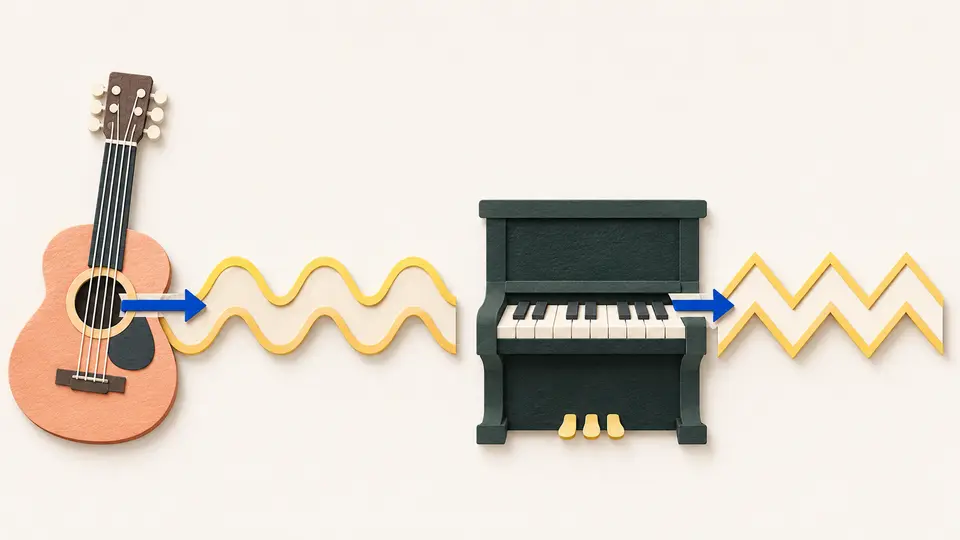
A guitar and a piano playing the same note just as loudly still sound different. See what that difference is made of, from the harmonics inside a note to its first instant, and how Ravel composed with it.
What you will learn
- Define timbre as the quality that separates sounds of equal pitch and loudness
- Give examples of how players and singers change timbre without changing pitch
- Calculate the first few harmonics of a note from its fundamental frequency
- Explain why a flute and a tuning fork sound different on the same note
Lesson 1 of 4 · 5 min
What makes the same note sound different
Play the same note on a guitar and a piano at the same volume, and nobody mistakes one for the other. Both are in tune and equally loud. Yet each keeps its own sound. Musicians call that quality timbre, or tone color.
Timbre lets you tell sounds apart by their source. It even separates close relatives, such as an oboe and a clarinet, which are both woodwinds.
The formal definition is an odd one. The Acoustical Society of America calls timbre the attribute that lets a listener judge two sounds as different when they have the same loudness and pitch. Joe Wolfe, who studies music acoustics at the University of New South Wales, calls that a negative definition. Timbre is whatever is left once pitch and loudness are matched.
So what is left? The society says timbre depends mainly on the frequency spectrum, the mix of frequencies a sound contains. It also depends on sound pressure and on how the sound behaves over time.
Musicians change timbre by changing how they play. A violinist can bow over the fingerboard, called sul tasto, for a light, airy sound. Bowing close to the bridge, called sul ponticello, gives a harsh, glassy one that brings out the higher frequencies. The string and the note are the same. Electric guitarists get their changes from effects units and equalizers.
Singers do it with vowels. Sing ah and then ee on one note at the same loudness, and timbre is the only thing you've changed. Wolfe notes that the two vowels have very different spectra. A spectrum is a chart of how much of each frequency a sound contains, and timbre depends partly on the relative size of those frequency components.
That mix of frequencies is why musicians reach for words like bright, dark, warm and harsh. You can see it as well as hear it. Sing a steady note into software that displays a spectrum, switch vowels, and the picture changes.
Try to recallHow can a singer change the timbre of a note without changing its pitch or its loudness?
A singer can change the vowel. Singing ah and then ee on the same note at the same loudness changes the balance of frequencies inside the sound, and the two spectra look very different. Because the pitch and loudness stay the same, whatever a listener hears as different is, by definition, a change of timbre. A violinist does something similar by moving the bow toward the bridge or over the fingerboard.
So timbre is the difference that survives when pitch and loudness are matched, and you change it every time you switch vowels. Hermann von Helmholtz called it Klangfarbe, German for tone color. John Tyndall proposed the English "clangtint," and Alexander Ellis disapproved of both terms.
Lessons in this topic
What makes the same note sound different
Learn what timbre is, why it's defined by what's left over once pitch and loudness match, and how players and singers change it on a single note.
The harmonics hidden inside one note
One note from a flute holds a whole stack of frequencies. Work out the harmonic series, and see why a flute and a tuning fork sound different on the same note.
Why the start of a note gives the instrument away
See how a note's envelope, its rise and fall, shapes timbre, how Robert Moog built one with a doorbell button, and why a spectrum alone can't tell you which instrument is playing.
How Ravel made four instruments sound like one
Boléro repeats its tune for about 15 minutes and changes only who plays it. See how Ravel used timbre as his material, and how he fused a horn, a celesta and two piccolos into one new sound.
Three quick stories from this topic
A piano without its first instant
Cut the first instant off a piano note and it gets hard to tell it's a piano
The same goes for a trumpet. The hammer hitting the strings, or the first blast of the player's lips on the mouthpiece, is highly characteristic of the instrument. Much of what you recognize is the way the note begins.
The start is called the attack
A note has a shape in time. The attack is its opening rise, and listening tests find it's one of the main things people use to tell sounds apart.
The mix of frequencies is not enough
A violin note filtered until its frequencies match a trumpet's would still sound like a violin, according to the acoustician Joe Wolfe.
Boléro's instrument that doesn't exist
Ravel built a new instrument in Boléro out of a horn, a celesta and two piccolos
The celesta and piccolos play exactly where the horn's own harmonics would ring, and in strict time with it, so the four blend into one sound. The piccolos even play in different keys from the horn to hold that spacing.
Built from harmonics
Above the horn's C5, the celesta sounds C6 and C7 and the piccolos G6 and E7. Beavers says Ravel voiced them as an exact replica of the harmonic series.
Fused by timing
The instruments play in perfect synchrony, and each stays in its own key so the intervals hold as the melody moves. Stephen McAdams suggested it may be a case of intended fusion into a single new composite timbre.
The doorbell button behind the synthesizer envelope
Robert Moog first shaped his synthesizer's notes with a doorbell button
At first the notes could only switch on and off. The composer Herbert Deutsch suggested a fix was needed, so Moog wired in a doorbell button and a capacitor that held a key's voltage and released it slowly. Envelope controls became standard on synthesizers.
A capacitor and two switches
A capacitor stored the voltage from a key and released it slowly. Moog then removed the need to press a separate button by giving every key two switches, one setting the pitch and one triggering the envelope.
From four parameters to ADSR
In 1965, after discussions with Vladimir Ussachevsky, head of the Columbia-Princeton Electronic Music Center, Moog developed a module with attack time, initial decay time, sustain level and final decay time. ARP later simplified these to the modern ADSR form, the four stages of the most common kind of envelope generator.
Sources
- Timbre, Wikipedia
- What is a Sound Spectrum?, Music Acoustics, University of New South Wales
- Glossary of music terminology, Wikipedia
- MTO 27.1: Beavers, Ravel's Sound, Music Theory Online, Society for Music Theory
- Boléro, Wikipedia
- Envelope (music), Wikipedia