Arts & Culture · Film & photography
The birth of cinema
How still photographs were made to move in the 1890s, how the Lumières and Méliès found two different uses for film, and how silent film became a full art before sound arrived in 1927.
What you will learn
- Explain how a fast series of still frames produces the look of motion
- Describe how the Lumières' projected screening differed from Edison's peephole Kinetoscope
- Contrast the Lumières' films of real life with Méliès's trick films
- Explain how early filmmakers began telling stories across several shots
Lesson 1 of 4 · 4 min
Why a strip of still pictures looks like motion
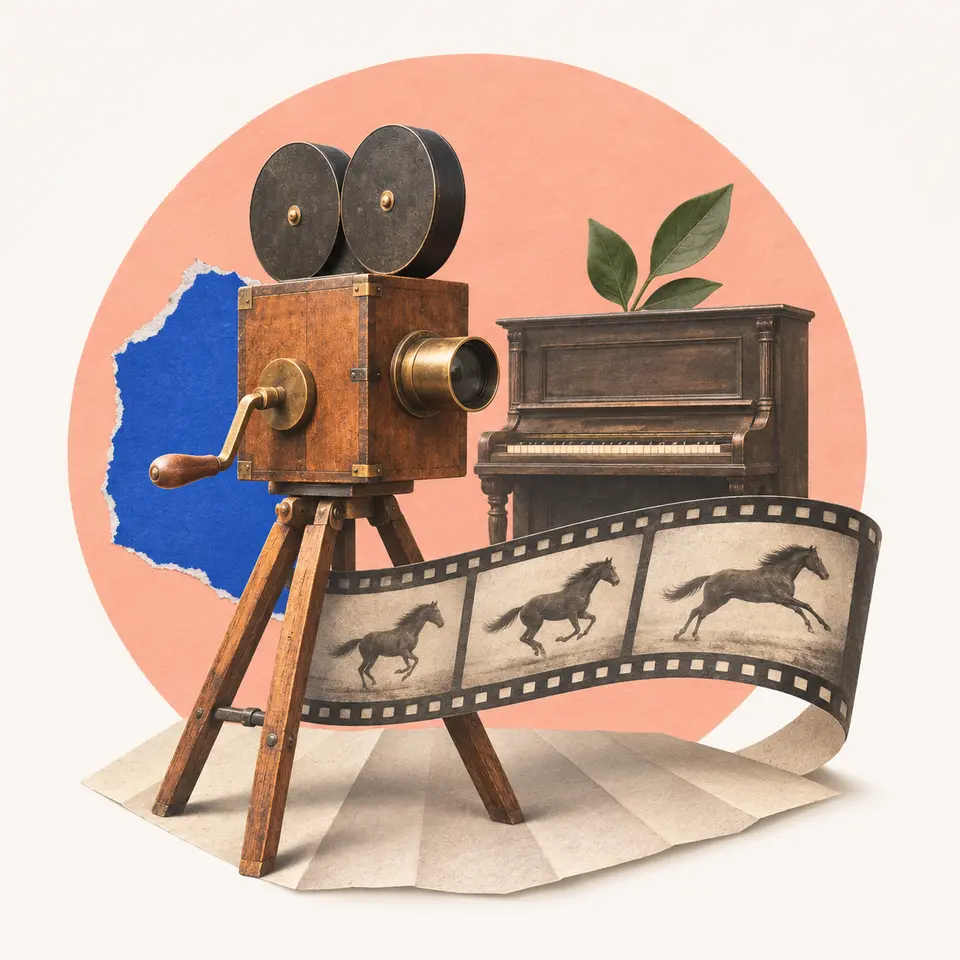
In June 1878, on a racetrack in Palo Alto, California, a horse galloped past a row of 12 cameras. Each shutter fired as the horse tripped a wire. The photographer, Eadweard Muybridge, was settling an old question for the racehorse owner Leland Stanford.
The pictures showed all four hooves off the ground at once. But the legs were tucked under the body, not stretched out front and back as famous paintings showed them. The eye simply couldn't catch it. A popular story says Stanford won a big bet on it, but there's no first-hand evidence of one.
Muybridge then copied his photographs onto a spinning disc and projected them, and the horse seemed to run again.
Why do still pictures look like motion? Your vision can take in about 10 to 12 images a second as separate pictures. Show them faster, each slightly changed, and you see one thing moving. Silent films ran at roughly 16 to 24 frames a second.
Older books credit persistence of vision, the idea that each image lingers on the retina and blends into the next. Psychologists rejected that explanation long ago. In 1912 Max Wertheimer flashed a figure in two places. People saw it move, though nothing appeared in between, so the brain builds the motion.
Muybridge's demonstrations helped spur Thomas Edison. His assistant William Dickson did most of the work on the Kinetoscope, a cabinet with a peephole on top. Inside, a strip of film ran past a light for one viewer at a time.
On 14 April 1894 the first Kinetoscope parlor opened on Broadway in New York. Ten machines showed ten films of 15 to 20 seconds each. Twenty-five cents bought a row of five.
In Lyon, the Lumière brothers made photographic plates. Their Cinématographe was one hand-cranked box that worked as camera, printer and projector, at about 16 pictures a second.
On 28 December 1895, in a room of the Grand Café in Paris, they projected ten films of about 50 seconds each for around 40 paying guests. An American projector had shown films for money that May, but the Paris show is traditionally called the birth of cinema. What mattered was projection, one film shared by a whole room.
Try to recallHow did the Lumières' way of showing films in 1895 differ from Edison's Kinetoscope?
The Kinetoscope was a peephole cabinet that showed a film to one person at a time. The Lumières' Cinématographe projected the film onto a screen, so a whole paying audience watched together. That shared screening became the model for cinema.
Fast still frames look like motion because your brain builds the movement. Projecting them for a room full of people turned that trick into cinema.
Lessons in this topic
Why a strip of still pictures looks like motion
See how a row of cameras froze a galloping horse, why fast still frames look like movement, and how projection turned a peephole toy into cinema.
Real life or magic tricks, the first two kinds of film
See how the Lumières pointed the camera at everyday life, how the magician Méliès used it to stage the impossible, and how films began to tell stories shot by shot.
How silent films spoke without a sound
See how titles, close-ups and live music let silent films tell any story, and how Germany and the Soviet Union built two very different film styles.
When the movies learned to talk
See how The Jazz Singer launched talking pictures in 1927, what sound did to cameras, actors and musicians, and why most silent films are now lost.
Three quick stories from this topic
Films melted into shoes
In World War One the French army melted hundreds of Méliès films, partly for shoe heels
The army seized over 400 of Georges Méliès's original prints and melted them down for their silver and celluloid. The celluloid went into heels for shoes. Today only about 200 of his more than 500 films survive.
A ruined magician
Méliès went bankrupt in 1913. By 1925 he was selling sweets and toys from a stall in a Paris railway station.
Most silent films are gone
A 2013 study for the Library of Congress found only 14% of American silent features survive complete in their original form.
Silent films in color
By the early 1920s, about 80% of silent films could be seen in some kind of color
Most of it came from dyeing whole scenes, blue for night and red for fire, and some from hand-coloring. Color was more common in silent films than in the first decades of sound, because the dyes interfered with soundtracks printed on film.
Painted by hand
Méliès sold hand-colored prints of some films. A Paris lab of about two hundred women painted them frame by frame.
Lost with sound
Once soundtracks were printed on the film, tinting was dropped. Color didn't become as common again for decades.
The panic that never happened
No report from the time says audiences fled from the Lumières' famous train film
The story says viewers screamed and ran as a train seemed to rush at them in 1896. Historian Martin Loiperdinger found no account of panic in the press. Comic films from 1901 mocking country folk who fled the screen may have spread the myth.
Not at the first show
The train film wasn't in the Lumières' first paid program in December 1895. It was first shown publicly in January 1896.
Startled, not fooled
Some viewers did describe being frightened. Historian Stephen Bottomore found no confirmed case of anyone believing the train was real.
Sources
- Eadweard Muybridge, Wikipedia
- The Horse in Motion, Wikipedia
- June 1878: Muybridge Photographs a Galloping Horse, IEEE Spectrum (Vaclav Smil)
- Frame rate, Wikipedia
- Persistence of vision, Wikipedia
- Kinetoscope, Wikipedia
- Lumière brothers, Wikipedia
- Cinematograph, Wikipedia
- Georges Méliès, Wikipedia
- Silent film, Wikipedia
- L'Arrivée d'un train en gare de La Ciotat, Wikipedia