Arts & Culture · Games & digital culture
Saving games and digital art
A book from 1086 is still readable, while a digital survey from 1986 needed rescuing after 16 years. See why digital works stop working, why most classic games are no longer on sale, and what emulation can and can't save.
What you will learn
- Explain why a digital work can become unreadable even when its disc or file survives
- Distinguish decay of a storage medium from loss of the equipment and code that read it
- Explain how the 2023 Video Game History Foundation study decided whether a classic game was available
- Explain why US libraries and archives can't simply offer the classic games the market has dropped
Lesson 1 of 4 · 6 min
Why digital works stop working
The Domesday Book is a survey of England compiled in 1086. It's kept at the national archives in Kew, and it's still perfectly readable. Its 1986 sequel was in trouble after 16 years.
The BBC made the sequel to mark the book's 900th anniversary. Over a million people took part, many of them schoolchildren, writing about their local area and their daily lives. Their pages were linked with maps, photos, statistics and video.
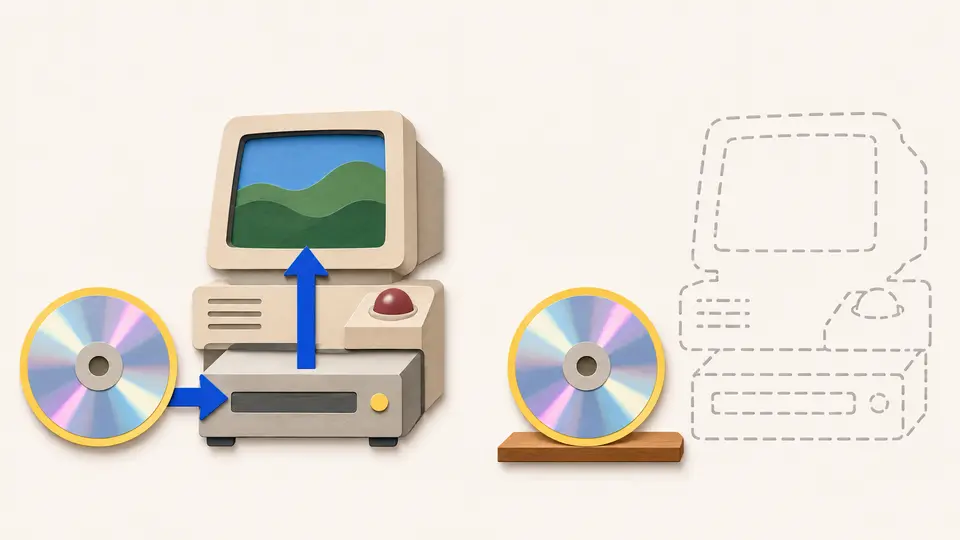
All of it went onto adapted laser discs, which held analog video and pictures alongside digital data. Reading them took a particular machine, a BBC Master computer with extra hardware that controlled a Philips laser disc player.
By 2002, computers that could read the format had become rare, and working players rarer still. The discs still existed. "The 15-year-old version is unreadable, while the ancient one is still perfectly usable," said Paul Wheatley, who worked on the rescue. "We're lucky Shakespeare didn't write on an old PC."
Archivists call this digital obsolescence. Data is lost because the hardware or software needed to read it keeps being replaced by newer systems that don't handle the old formats.
Games are especially exposed. A book or a photograph can be copied into many formats. A video game typically needs specialized hardware and software to run, and sometimes a company's servers that the player doesn't control.
Digital files feel permanent because you can make endless identical copies. But every copy sits on something physical. Paper records copied to microfilm can stay readable for centuries in ideal conditions. Magnetic tape, disks and optical discs offer only decades.
The decay has names. On tape and floppy disks, the glue under the magnetic layer breaks down, or the layer loses its magnetism. That's bit rot. Optical discs can oxidize between badly sealed layers, which is disc rot. Most memory cards store each bit as an electric charge, and the charges leak away.
Losing the machine is the other danger. NASA's Viking missions of the 1970s stored their data on magnetic tape. A decade later much of it was inaccessible, including over 3,000 unprocessed images of the surface of Mars.
The tapes still existed. But NASA had replaced and thrown away the computers and the source code needed to decode them. The programmers had left or died, and nobody could make sense of their notes.
Getting the data back took more than a year of reverse engineering, which means working out from the tapes themselves how the data had been encoded. The team had to consult the engineers who had built the landers' cameras.
Try to recallMuch of the data on NASA's 1970s Viking tapes was inaccessible a decade later. How did that loss differ from bit rot, and what did recovery take?
Bit rot is decay of the medium itself, such as the adhesive under a tape's magnetic layer breaking down or the layer losing its magnetism. The Viking problem was the loss of what reads the data. NASA had thrown away the computer hardware and source code needed to run the decoding software, and the programmers' notes were indecipherable. Getting the images back took more than a year of reverse engineering how the data had been encoded, including consulting the original camera engineers.
A digital work needs two things to survive. Its medium has to hold the data, and some machine has to be able to read it. For the Domesday discs and the Viking tapes, the machines went first, in under two decades.
Lessons in this topic
Why digital works stop working
A book from 1086 can still be read, while a digital survey from 1986 was in trouble after 16 years. See the two ways a digital work is lost, a decaying medium and a missing machine.
The classic games you can't buy
A 2023 study found that only 13% of classic video games are still on sale. See how it decided what counts as available, and why US archives can't simply share the rest.
How archives keep old software running
Compare the ways archivists keep old files usable, from plain backup to emulation, and follow how an emulator brought the BBC's 1986 Domesday discs back.
When the machine is part of the art
See why a museum kept an old Nintendo for one digital artwork and rewrote the software for another.
Three quick stories from this topic
The Domesday that needed rescuing
The Domesday Book of 1086 is still readable, and its 1986 digital sequel needed a rescue
The BBC's 1986 survey lived on laser discs that needed one particular computer and player, and by 2002 working sets were rare. "We're lucky Shakespeare didn't write on an old PC," said Paul Wheatley, who worked on the rescue.
Rescued by emulation
The CAMiLEON project, a partnership of the universities of Leeds and Michigan, copied the discs' data files to a Linux computer and digitized their pictures uncompressed, about 70 GB per disc side. A modified version of the free emulator BeebEm then gave access to the archived data.
A rescue that vanished too
A Windows version of one disc, reverse-engineered from an original and using images from the videotape masters, went online as Domesday 1986 in July 2004. It was taken offline early in 2008, when its programmer, Adrian Pearce, died suddenly.
Art that needs a Nintendo
A Guggenheim show concluded one artwork is best preserved by storing an old Nintendo
Cory Arcangel made I Shot Andy Warhol in 2002 by prying the graphics chip off a game cartridge, reprogramming it and soldering it back. The 2004 exhibition's organizers judged that the hardware hack is the work's impact, and that an emulated version would lose it.
What you shoot
The game is a shooting gallery played with a Nintendo light gun. Its characters are the Pope, Flava Flav and Colonel Sanders, and the targets are the Warhols.
The artist's view
Arcangel tested the game in an emulator before making the cartridge, but he wanted it exhibited on real hardware. "In thirty years a laptop running that game is going to mean nothing to the public," he said.
Classic games and silent films
Just 13% of classic games are still on sale, close to the survival rate of US silent films
A 2023 study by the Video Game History Foundation checked games released in the United States before 2010. About 14% of American silent films survive. So games from the 1980s to the 2000s are in about as bad a shape as movies from the 1920s.
What counted as on sale
An updated edition that plays the same counted. A remake built from the ground up didn't, and neither did expensive collector's editions.
Why libraries can't fill the gap
US libraries and archives can preserve games digitally but can offer access only on their premises. In 2024 the Copyright Office rejected an exemption that would have allowed remote access for researchers.
Sources
- BBC Domesday Project, Wikipedia
- Digital obsolescence, Wikipedia
- Video game preservation, Wikipedia
- Digital Domesday Book lasts 15 years not 1000, The Observer (The Guardian)
- Seeing Double: Emulation in Theory and Practice, Variable Media Network
- The Game Availability Study, Explained, Video Game History Foundation
- 87% Missing: the Disappearance of Classic Video Games, Video Game History Foundation