Body & Health · Disease & immunity
The immune system
Meet the body's defenses in layers, from skin and fast general responders to cells that each fit one target. See how they tell self from invader and what happens when they fail.
What you will learn
- Explain how skin, mucus and body chemicals keep most germs out
- Describe how phagocytes and inflammation fight germs within minutes without knowing which germ it is
- Explain why the targeted response takes days, and how B cells and antibodies attack one germ
- Describe what killer T cells and helper T cells each do
Lesson 1 of 4 · 4 min
The defenses that act within minutes
Pick up a splinter and white blood cells start crowding around it within minutes. Before any of that, your body spends every day keeping germs out. Those outer defenses stop most microbes, so it's worth seeing how they work.
Your skin is the main wall. Its surface is a layer of dead cells too dry for bacteria to grow on. You shed those cells all the time, and germs leave with them. Sweat makes the surface slightly acidic, which many microbes can't stand.
Your nose, mouth and gut are openings that need other guards. Mucus traps microbes there. In your airways, cells with tiny hairs sweep that mucus up to your mouth. You swallow it, and stomach acid kills many of the germs.
Saliva and tears carry lysozyme, an enzyme that breaks down the walls of bacteria. Harmless bacteria in your gut help as well, because they use up the food and space a harmful one would need.
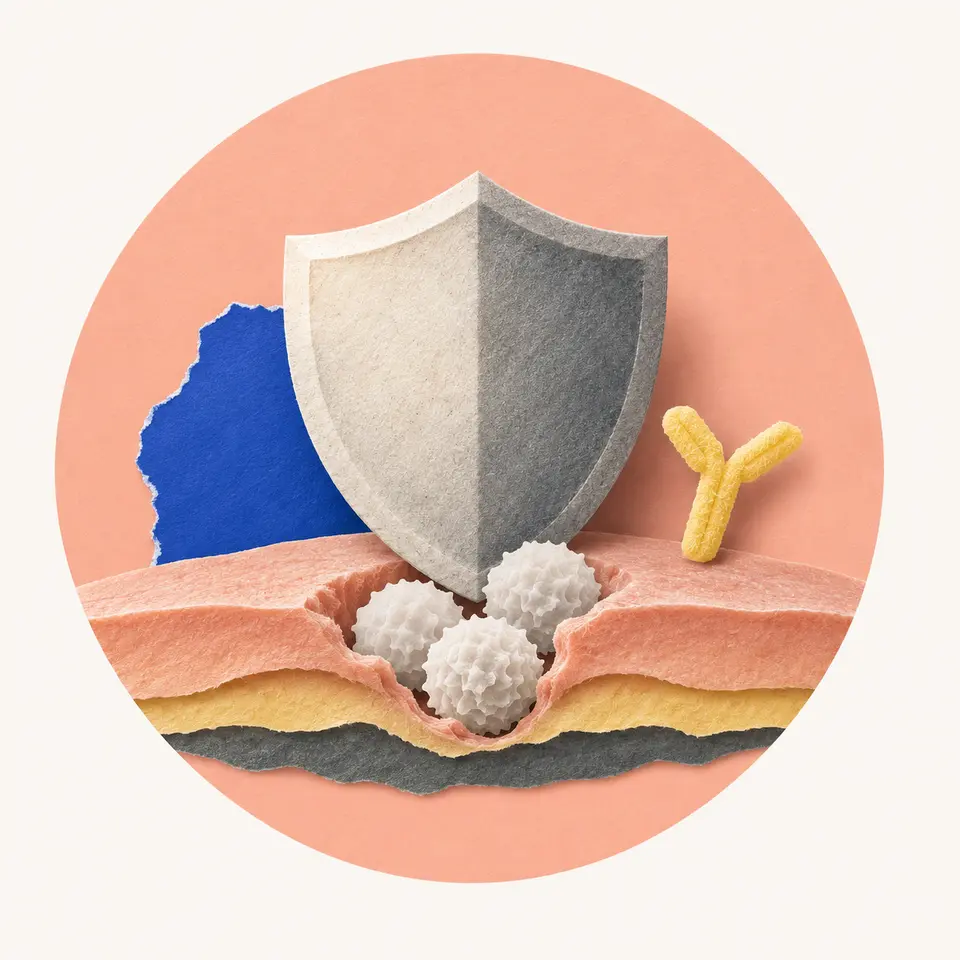
Germs that get past the barriers meet the innate immune system, the defenses you're born with. Its cells carry receptors that spot features shared by whole groups of microbes, such as parts of bacterial cell walls. So they react fast, but they treat every bacterium in much the same way.
Macrophages sit in your tissues like guards on duty. Neutrophils travel in the blood and make up 50% to 60% of your white blood cells. Chemical alarm signals call them out, and they're usually the first cells to reach an infection, often within minutes. Both kinds swallow germs whole and digest them, which is called phagocytosis.
Try to recallWhy does the skin around an infected cut turn red, warm and swollen?
Damaged and infected cells release signals that widen nearby blood vessels. More blood flows in, which makes the skin red and warm, and fluid leaks out, which causes swelling. The extra blood delivers immune cells such as neutrophils to fight the germs.
Barriers keep most germs out, and the innate response attacks the rest within minutes to hours. You can now explain why a cut swells and why mucus ends up in your stomach. This response works on any germ, but it can't sharpen its aim on one particular invader.
Lessons in this topic
The defenses that act within minutes
See how skin, mucus and acid keep most germs out, and how general-purpose immune cells attack the rest before your body knows what the germ is.
The targeted defense that takes days to start
Learn why your body's most precise defense is slow the first time, how B cells and antibodies home in on one germ, and what killer and helper T cells do.
How your immune cells learn not to attack you
Find out how the thymus tests young T cells and kills most of them, and how your cells show what's going on inside so T cells can spot an infection.
When the immune system is too weak or too strong
See what happens when defenses are missing, as in SCID and HIV, and how allergy and autoimmune disease differ in what the immune system wrongly attacks.
Three quick stories from this topic
A brain's worth of lymphocytes
Your 2 trillion lymphocytes together weigh about as much as your brain
Only about 2% of them are in your blood at any moment. The rest move through your tissues, lymph nodes and spleen, each looking for the one target its receptor fits.
Each one fits one target
Your cells shuffle gene pieces at random to build receptors, which lets you make more than a trillion different antibodies.
Why it takes days
Only a few cells fit any new germ, so they must multiply first. A strong first response takes 4 to 7 days.
The penicillin allergy gap
About 10% of Americans say they're allergic to penicillin, but under 1% are
Both figures come from the CDC. A true penicillin allergy means IgE antibodies on mast cells that release histamine when the drug arrives, and most people carrying the label don't have them.
What a true allergy is
IgE antibodies sit on mast cells, and when the drug returns they trigger the cells within minutes.
Serious reactions are rarer still
Severe penicillin allergy affects only about 0.03% of people.
The organ thought useless
Until 1961, scientists dismissed the thymus as an evolutionary accident
Then Jacques Miller removed it from day-old mice. They lacked a whole group of lymphocytes, which were named T cells after the organ that trains them.
A school with a high failure rate
Young T cells are tested in the thymus, and only about 2% leave it as working T cells.
It shrinks with age
The thymus grows to 20 to 50 grams by puberty, then slowly shrinks and fills with fat.
Sources
- 21.2 Barrier defenses and the innate immune response, OpenStax, Anatomy and Physiology 2e
- Immune system, Wikipedia
- Neutrophil, Wikipedia
- Adaptive immune system, Wikipedia
- How common are penicillin allergies? CDC says true penicillin allergy is rare, NBC News
- Allergy, Wikipedia
- 21.6 Diseases associated with depressed or overactive immune responses, OpenStax, Anatomy and Physiology 2e
- Thymus, Wikipedia